

On this page
When a large power station suddenly trips off the grid, nothing goes dark at first. The lights stay on, but every generator in the country slows down a little, and the grid frequency starts to fall below 50 Hz. The reason is rotational kinetic energy. For the first few seconds, the missing power comes out of the spinning rotors of every other machine on the grid. With ½Iω² and one line of calculus you can work out how fast it falls.
Why does the grid run at exactly 50 Hz?
A synchronous generator makes AC whose frequency is fixed by how fast its rotor turns. For a machine with p poles turning at N revolutions per minute, f = pN/120. A two-pole steam turbo-generator must turn at 3000 rpm to give 50 Hz. A slow hydro generator with 24 poles gives the same 50 Hz at only 250 rpm. How a rotating coil makes a sine wave in the first place is shown in the AC generator simulation on why emf peaks when flux is zero, and why India chose 50 Hz at all is covered in AC versus DC in Class 10: why India uses 50 Hz power.
All the large generators on a synchronised grid are locked in step, so the frequency is a single number for the whole grid: a meter in Chennai and one in Delhi read the same value at the same moment. That is why a trip anywhere shows up everywhere.
Where does the power come from in the first seconds after a trip?
At every instant the power fed in must equal the power taken out. When a plant trips, the load does not change, so there is a sudden shortfall. Steam and water valves cannot open instantly, so the only store that can respond at once is the kinetic energy of the spinning rotors.
Each rotor gives up some of its ½Iω² to keep supplying power, so it slows down, and the frequency falls. This is the same stored energy that a flywheel uses; the formula and the role of I are worked through in how to calculate the energy stored in a rotating flywheel.
Power engineers measure this store with the inertia constant H: the rotor's kinetic energy at rated speed divided by the machine's rating S. H has units of seconds. It is the time the machine could supply its full rated power from its spinning mass alone. A review of power-system inertia puts most conventional generating units at about 2 to 6 s. Solar panels have H close to zero, because they have no rotating mass at all.
How much energy does one big generator store?
Take a large coal-fired unit of 500 MW at a power factor of 0.85, which is rated at about 588 MVA. Use H = 5 s, inside the typical range. These are round illustrative values, not a specific plant.
Stored energy. KE = H × S = 5 s × 588 × 10⁶ VA = 2.94 × 10⁹ J, or 2.94 GJ.
Angular speed. A two-pole machine at 3000 rpm has ω = 2π × 50 = 314 rad/s.
Moment of inertia. From KE = ½Iω², I = 2KE/ω² = 2 × 2.94 × 10⁹ / 314² ≈ 5.96 × 10⁴ kg m², about 60,000 kg m².
Check units. J divided by (rad/s)² gives kg m², as it should.
How fast does the frequency fall after a plant trips?
Now treat the whole grid as one big rotor. Let the total rating of all the spinning machines be S and their combined inertia constant be H, so the stored energy is E = HS at f₀ = 50 Hz.
Kinetic energy goes as ω², and ω is proportional to f, so E = HS(f/f₀)². Differentiate: dE/dt = (2HS/f₀²) f (df/dt). Right after the trip, f is still f₀, and the rotors must supply the shortfall ΔP, so dE/dt = −ΔP. That gives the initial rate of change of frequency:
df/dt = −ΔP × f₀ / (2HS)
Worked example, with illustrative grid values:
Data. 200 GVA of generators spinning, H = 5 s, and a 4 GW plant trips. So ΔP = 4 × 10⁹ W, S = 2 × 10¹¹ VA, f₀ = 50 Hz.
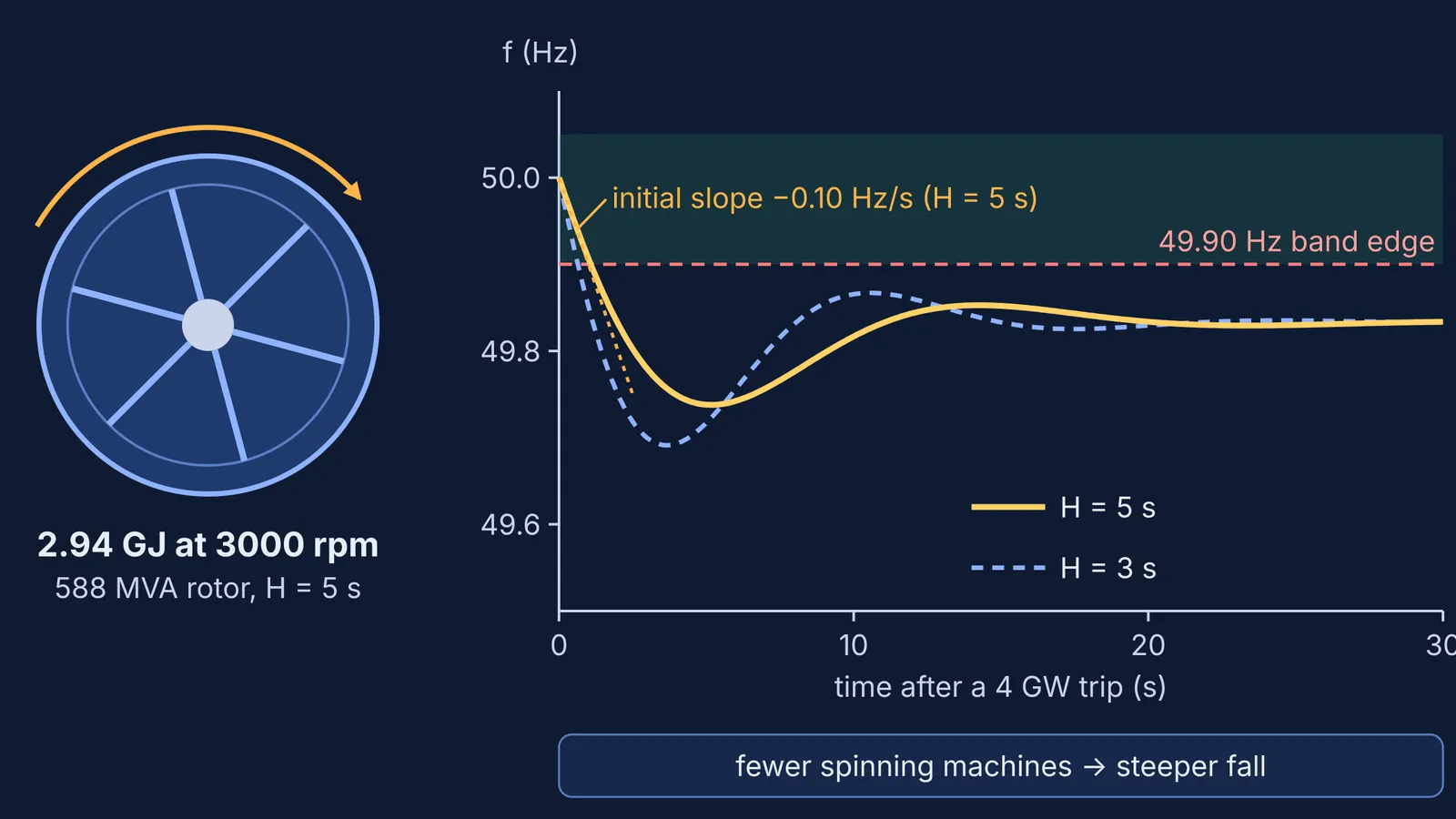
Rate of fall. df/dt = −(4 × 10⁹ × 50)/(2 × 5 × 2 × 10¹¹) = −0.10 Hz/s.
Time to the band edge. India's grid code sets the allowable band at 49.900 to 50.050 Hz, as quoted from Regulation 30 of the 2023 Indian Electricity Grid Code in this CERC order. Falling 0.10 Hz at 0.10 Hz/s takes about 1 s.
Check with energy. The grid stores 5 × 200 GVA = 1000 GJ. In one second it gives up 4 GJ, 0.4% of it. Then f = 50 × √0.996 = 49.90 Hz, which agrees.
Less inertia. With H = 3 s and everything else the same, df/dt = −0.17 Hz/s, and the band edge comes in about 0.6 s.
What stops the frequency from falling all the way?
The rotors only buy time. Three things then take over.
Governors. Each turbine's governor senses the speed drop and opens its steam or water valve further. This primary response adds power within seconds.
Load that falls with frequency. Motors driving fans and pumps take slightly less power when they slow down.
Reserves. Over the next minutes, grid operators bring in extra generation to restore 50 Hz.
The hero graph shows this in a simple model. The fall starts at the computed slope, reaches a lowest point (the nadir) a few seconds later, then settles. If the shortfall is too big for governors and reserves, under-frequency relays disconnect blocks of load in stages, so that the rest of the grid survives. The set points are decided by India's regional and national power committees, so check their current documents rather than an old textbook value.
Why do solar panels and batteries make the fall steeper?
Solar panels, most wind farms and batteries feed the grid through power-electronic inverters. They have no heavy rotor turning in step with the grid, so they add no natural inertia. On a sunny afternoon, when many coal units are switched off, the total HS of the machines still spinning is smaller. The same 4 GW loss then gives a steeper fall, as the H = 3 s line shows. The same review notes that inverters can be controlled to imitate some of this response, which it calls synthetic or virtual inertia.
To see how the slope changes when you vary H, S and ΔP, the Fermi Problem Library has a step-by-step solver that explains the reasoning for rotation and energy problems like this one.
Quick checklist
Frequency is set by rotor speed: f = pN/120, the same everywhere on a synchronised grid.
After a trip, the missing power first comes from the rotors' ½Iω².
H = stored KE ÷ rating, in seconds; conventional units are about 2 to 6 s.
Initial fall: df/dt = −ΔP f₀/(2HS). For 4 GW lost from 200 GVA at H = 5 s, that is 0.10 Hz/s.
Governors, falling load and reserves arrest the fall; under-frequency relays shed load as a last resort.
Less spinning mass means a steeper fall.


