

On this page
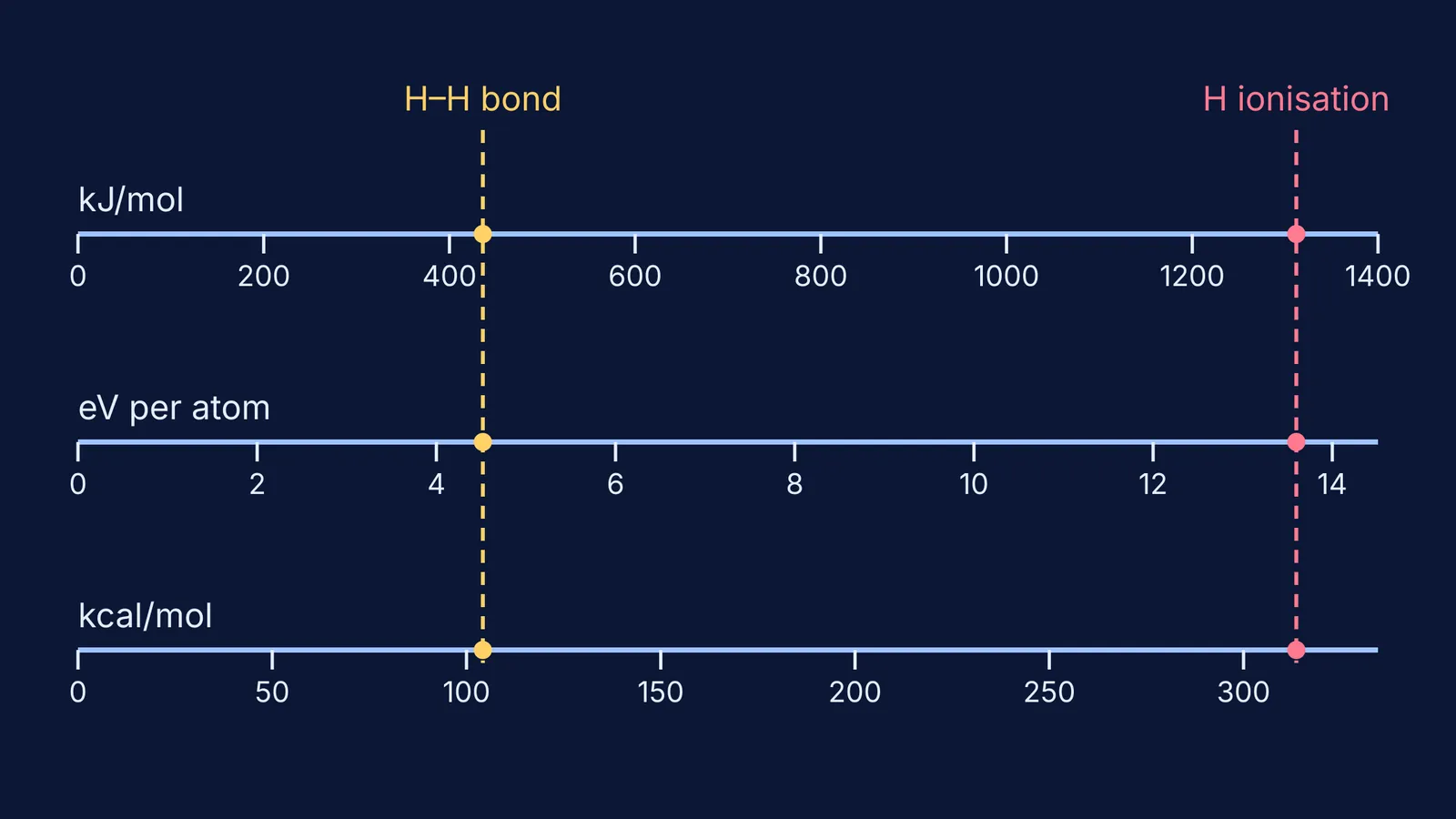
Chemistry books give ionisation and bond energies in kJ/mol, physics books give them in eV, and older tables and many research papers use kcal/mol. All three units measure the same thing. Once you see that the only difference is "per mole" versus "per atom", each conversion is a single multiplication or division.
Why is 1 eV per atom equal to 96.485 kJ/mol?
An electron volt is the energy one electron gains when it moves through a potential difference of one volt. NIST lists 1 eV as exactly 1.602176634 × 10^-19 J. That is a tiny amount of energy, and it describes what happens to one atom or one bond.
A kJ/mol value is the energy for a whole mole of atoms or bonds. NIST lists the Avogadro constant as exactly 6.02214076 × 10^23 per mole, so you multiply the per-atom energy by that number:
1.602176634 × 10^-19 J × 6.02214076 × 10^23 per mol = 96,485.33 J/mol = 96.485 kJ/mol.
This is the same number as the Faraday constant, 96,485.33212 C per mole. That is no coincidence. The Faraday constant is the charge on a mole of electrons, and multiplying that charge by one volt gives 96,485 J. If you remember the Faraday constant from electrochemistry, you already know the eV conversion factor.
How do you convert kJ/mol to kcal/mol?
The calorie used in chemistry tables is the thermochemical calorie. NIST's guide to SI units gives 1 thermochemical calorie as 4.184 J, so 1 kcal is 4.184 kJ. The same NIST table lists a slightly different "International Table" calorie of 4.1868 J. If a question doesn't say which one it means, use 4.184 for chemistry.
kJ/mol ÷ 4.184 = kcal/mol
kcal/mol × 4.184 = kJ/mol
1 eV per atom = 96.485 ÷ 4.184 = about 23.06 kcal/mol
1 kcal/mol = about 0.0434 eV per atom
What do ionisation and bond energies look like in each unit?
Example 1: Hydrogen's ionisation energy, from eV to kJ/mol
NIST's Atomic Spectra Database gives the ionisation energy of a hydrogen atom as 13.598434599702 eV. The same database gives 5.13907696 eV for sodium.
Hydrogen: 13.598 × 96.485 = 1312.0 kJ/mol
In kcal/mol: 1312.0 ÷ 4.184 = 313.6 kcal/mol
Sodium: 5.139 × 96.485 = 495.8 kJ/mol, or 118.5 kcal/mol
Your textbook's 1312 kJ/mol for hydrogen is the familiar 13.6 eV, just counted for a mole of atoms. For more practice with these values, see how to use successive ionisation enthalpies to find an element's group.
Example 2: The H–H bond, from kJ/mol to eV per bond
OpenStax Chemistry 2e gives the H–H bond energy as 436 kJ per mole of H–H bonds broken. The same section notes that some tabulated values, such as C–H at 415 kJ/mol, are averages rather than the exact energy needed to break any one bond.
Per bond in eV: 436 ÷ 96.485 = 4.52 eV
In kcal/mol: 436 ÷ 4.184 = 104.2 kcal/mol
Check in joules: 436,000 J ÷ (6.022 × 10^23) = 7.24 × 10^-19 J for one bond, and 7.24 × 10^-19 ÷ 1.602 × 10^-19 = 4.52 eV. The two methods agree.
Which mistakes cost marks in these conversions?
Dropping "per mole". A kJ/mol value is not the energy of one atom. To get the energy of one atom in joules, divide by Avogadro's number.
Mixing up kJ and J. 96.485 goes with kJ/mol. With J/mol, the factor is 96,485.
Using the wrong calorie. Use 4.184 unless the question gives 4.1868 or 4.2.
Forgetting the bond count. Breaking one mole of H2 breaks one mole of H–H bonds, but atomising a mole of CH4 breaks four moles of C–H bonds.
If you want to see where the electron volt itself comes from, read our explainer on electron volts, joules and particle speeds. To link these numbers to periodic trends, try reading the first ionisation enthalpy vs atomic number graph.
How can you check your conversions before a test?
Convert these three values in both directions and check that you get the same number back: 13.6 eV, 436 kJ/mol and 100 kcal/mol. If you keep landing on the wrong power of ten, the Fermi Problem Library has worked problems with a step-by-step solver that explains the reasoning rather than printing an answer. You can also look up the mole and the electron volt in the Fermi Concept Library, where each concept has its own lesson.


