

On this page
Take one rule, z → z² + c. Pick a number c, start at z = 0, and keep feeding each answer back in. Either the numbers stay small forever or they run off to infinity. The Mandelbrot set is the map of which c do which, and you can test the first few points with a pencil.
What is the Mandelbrot set, exactly?
The Mandelbrot set is the set of complex numbers c for which the orbit of z(n+1) = z(n)² + c, starting from z(0) = 0, does not tend to infinity, as defined in Wolfram MathWorld's entry. The orbit is just the list z1, z2, z3 and so on.
The same entry gives the shortcut computer drawings use: an escape threshold of 2. Once the size of z, written |z|, passes 2, escape is certain, so you can stop and mark c as outside.
The set lives on the complex plane. If multiplying complex numbers feels rusty, our post on finding powers of complex numbers with De Moivre's theorem is a quick refresher.
The set is named after Benoit Mandelbrot, who worked with IBM from 1958 and, according to his MacTutor biography, used computer graphics there to show how Gaston Julia's work is a source of striking fractals.
How do you test a point by hand?
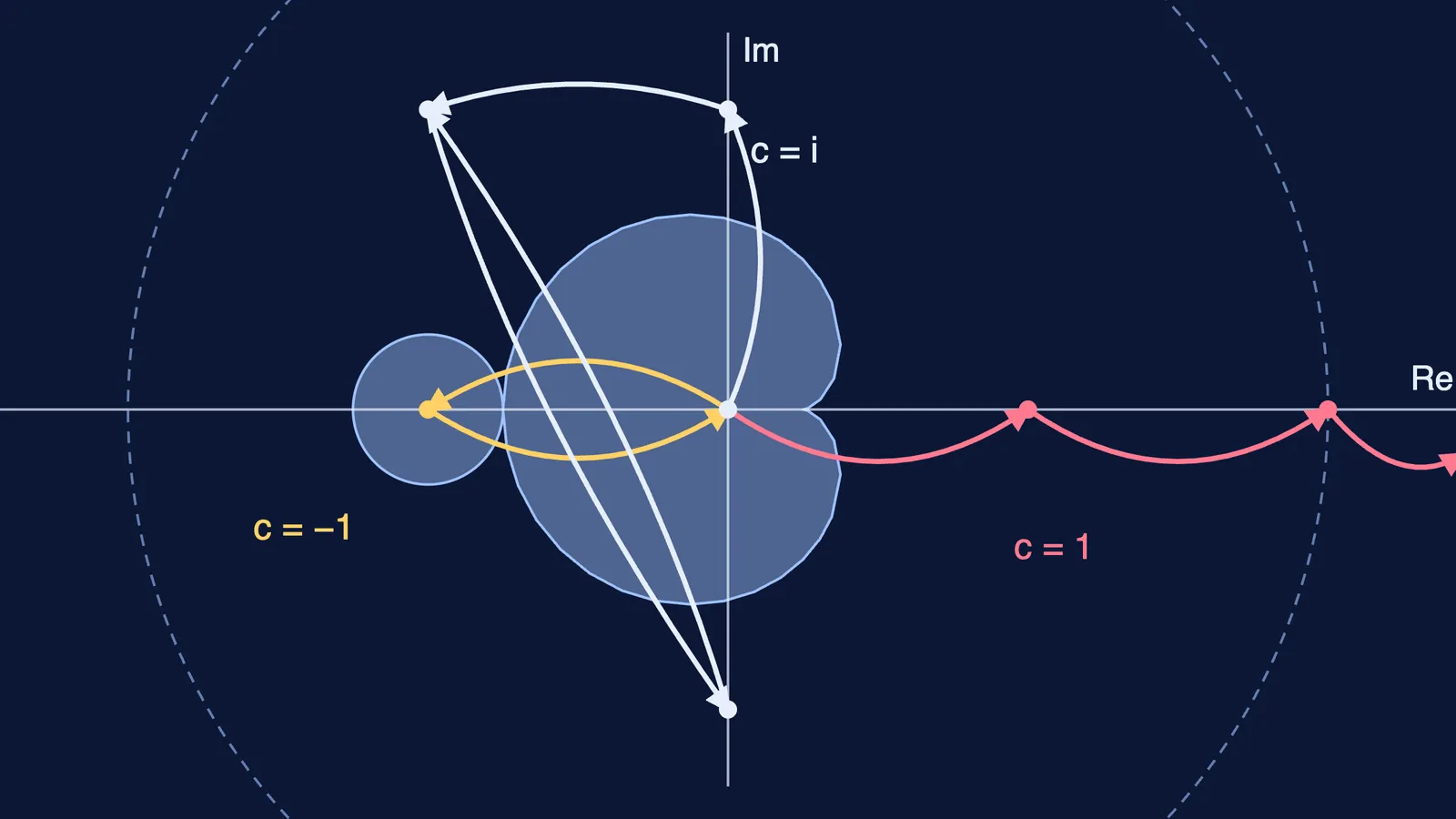
Start with c = 1, which escapes:
z1 = 0² + 1 = 1
z2 = 1² + 1 = 2
z3 = 2² + 1 = 5
At z3 the size has passed 2, so c = 1 is outside the set.
Now try c = −1, which cycles:
z1 = 0² − 1 = −1
z2 = (−1)² − 1 = 0
z3 = 0² − 1 = −1
The orbit bounces between 0 and −1 forever, so c = −1 is in the set.
Last, c = i, which lands on a loop. Remember that i² = −1.
z1 = i
z2 = i² + i = −1 + i
z3 = (−1 + i)² + i = −2i + i = −i
z4 = (−i)² + i = −1 + i
From z2 on, the orbit swings between −1 + i and −i, with sizes √2 and 1, both under 2. So c = i is in the set. Unlike c = −1, this orbit never returns to 0: it falls into a loop after one step.
How complicated is the edge of the Mandelbrot set?
MathWorld describes its main body as bordered by a cardioid, with an adjoining circle centred at −1 with radius 1/4; your c = −1 sits at the centre of that circle.
The boundary is far less simple. Mitsuhiro Shishikura proved, in a 1998 paper in the Annals of Mathematics, that the boundary of the Mandelbrot set has Hausdorff dimension two. A smooth curve has dimension one, and two is the most any set in a flat plane can have, so this edge is as crinkled as a boundary in the plane can be.
Yet the set encloses a finite area: pixel counting quoted by MathWorld puts it at about 1.5066 square units.
Is the Mandelbrot set self-similar?
Self-similarity is the property of an object that looks roughly the same on any scale, in MathWorld's definition. A fractal displays self-similarity on all scales, though not necessarily exactly the same structure at each, says its fractal entry.
The Koch snowflake and the Sierpinski triangle you can grow with the chaos game are built from exact smaller copies of themselves. The Mandelbrot set is subtler.
Tan Lei showed in a 1990 paper in Communications in Mathematical Physics that the set is "self-similar" about special boundary points called Misiurewicz points. Zoom in on one, raise the magnification by a carefully chosen factor, and the picture is unchanged except for a rotation. The paper's first example is the neighbourhood of c = i, the point whose orbit fell into a loop without returning to 0. There, magnified views of the set closely resemble the Julia set for c = i.
So the answer is: not exactly, like the snowflake, but self-similar near special points.
How can you explore it yourself?
A short plan:
Test c = −2. You should get −2, 2, 2, 2: bounded, so it is in the set, at its far left tip.
Test c = 0.5. You should see 0.5, 0.75, 1.0625, 1.6289, then about 3.15, so it escapes at step five.
If you code, use the escape test from MathWorld: repeat z = z*z + c up to a fixed limit, say 100 steps, stop when |z| passes 2, and print a dot for every grid point that never escapes.
If complex multiplication slows you down, the Fermi Concept Library covers every concept in mathematics, each with its own lesson, so you can fill that gap first. For ideas that are easier to see than read, the Fermi Simulation Lab has interactive simulations.
Start with c = −2 tonight.


