On this page
In 1904 the Swedish mathematician Helge von Koch published a curve you can draw with a ruler, but whose length you can never finish measuring. His paper, "Sur une courbe continue sans tangente, obtenue par une construction géométrique élémentaire", appeared in volume 1 of *Arkiv för matematik, astronomi och fysik* (Wikipedia's Koch snowflake entry gives the full reference). Draw the curve around a triangle and you get the Koch snowflake. It is one of the cleanest infinite geometric progression (GP) problems you will meet in Class 11 or JEE maths.
Who was Helge von Koch?
Koch was born in Stockholm on 25 January 1870 and died on 11 March 1924, according to his MacTutor biography. He took the chair of pure mathematics at KTH in Stockholm in 1905, and in 1911 he succeeded Mittag-Leffler as professor at Stockholm University.
The snowflake answered an old puzzle. MacTutor notes that Weierstrass had already given an analytic example of a function that is continuous everywhere but has no slope at any point. Koch gave a geometric construction of the same strange behaviour, built from nothing more than equilateral triangles.
How do you build a Koch snowflake?
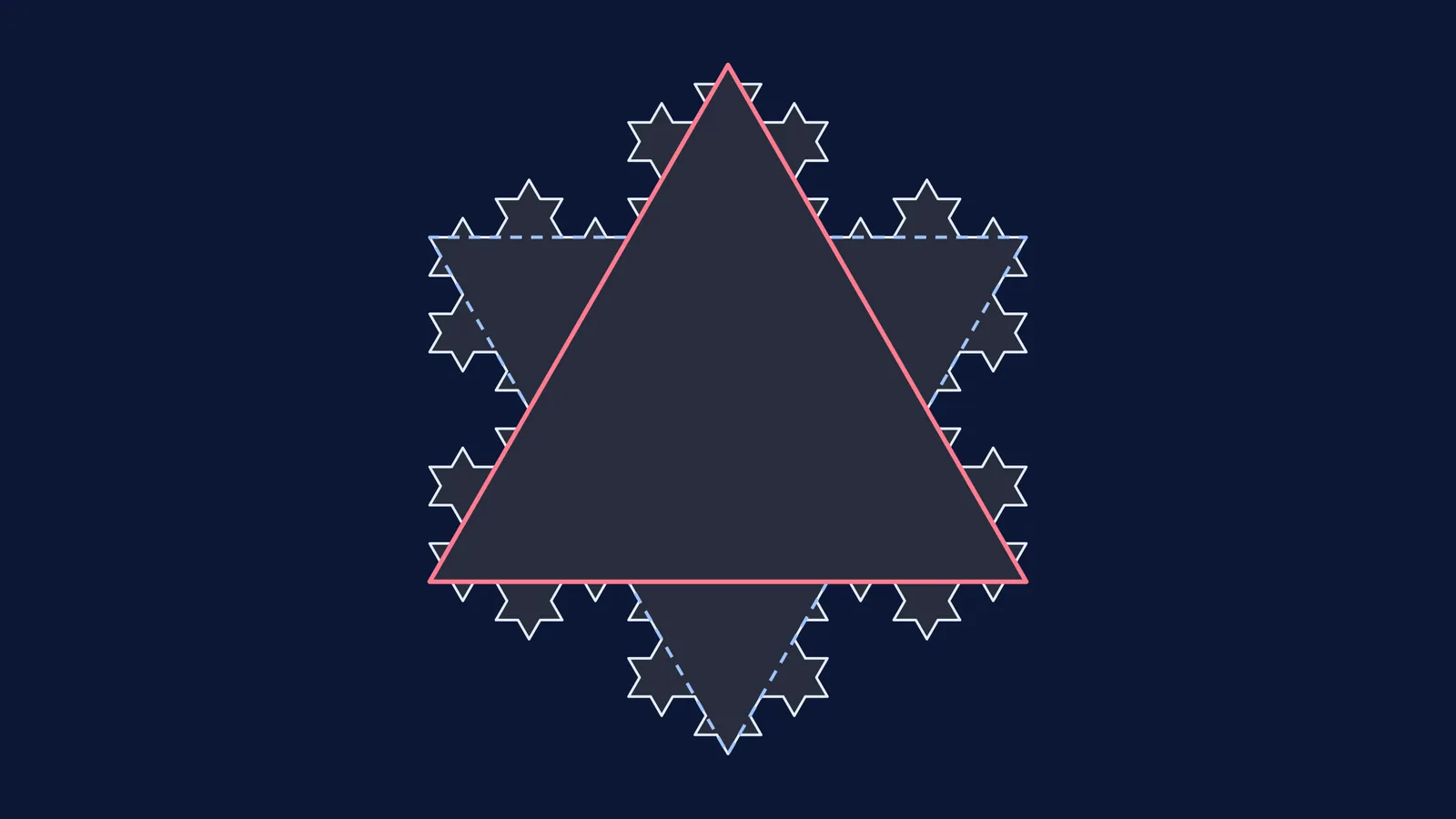
MacTutor describes the rule in one line: divide a segment into three equal parts and replace the middle part with the other two sides of an equilateral triangle built on it. Then do the same to every new segment, forever.
Start with an equilateral triangle of side s.
On each side, cut out the middle third and add a "tent" of two segments, each s/3 long.
Repeat on every segment of the new shape.
Koch's paper built the curve on a single segment. Wikipedia's entry notes that the closed snowflake, three such curves around a triangle, does not appear in it.
Why is the Koch snowflake's perimeter infinite?
Each step replaces every segment with 4 segments, each one-third as long. So the length is multiplied by 4/3 at every step. Wolfram MathWorld gives the snowflake after n steps as 3 × 4ⁿ segments, with perimeter 3(4/3)ⁿ for a unit side, or 3s(4/3)ⁿ for side s.
Because 4/3 is bigger than 1, (4/3)ⁿ grows without limit. Take s = 9 cm:
Step 0: 27 cm
Step 1: 36 cm
Step 2: 48 cm
Step 3: 64 cm
Step 10: about 479 cm
Step 29: about 1.13 km
A shape that fits on your notebook page passes a kilometre of boundary within 29 steps, and it never stops growing.
Why is the Koch snowflake's area finite?
Call the area of the starting triangle A. Now count what each step adds, using three questions.
How many new triangles? Step 1 adds 3 (one per side). After that, every segment gets a tent, and the number of segments multiplies by 4, so step n adds 3 × 4ⁿ⁻¹ triangles.
How big is each one? Their sides shrink by a factor of 3 each step, so their areas shrink by a factor of 9. Each new triangle at step n has area A/9ⁿ.
What does the step add in total? 3 × 4ⁿ⁻¹ × A/9ⁿ = (A/3) × (4/9)ⁿ⁻¹.
That is a GP with first term A/3 and common ratio r = 4/9. Since r is less than 1, the infinite sum is a/(1 − r):
(A/3) ÷ (1 − 4/9) = (A/3) × (9/5) = 3A/5.
Add the original triangle: A + 3A/5 = 8A/5. This matches MathWorld's limiting area of 8/5 times the original triangle. With s = 9 cm, A is about 35.07 cm², so the finished snowflake covers about 56.1 cm².
What did Koch prove, and what came after?
The infinite length was a side effect. Koch's real target was the missing tangent: MacTutor states the curve is continuous but has a tangent at no point. His longer 1906 paper in *Acta Mathematica* (DOI 10.1007/BF02418570) is mainly a proof of that fact, MacTutor says.
MathWorld gives the curve's fractal dimension as log 4 / log 3, about 1.2619: more than a line, less than a filled region. Measuring rough shapes like this later became central to Benoit Mandelbrot's work on fractals.
How can you use the snowflake to practise GP sums?
The three questions above (how many, how big, total per step) work for most "repeat forever" problems, such as bouncing balls and nested squares. Try them here:
Find the snowflake's area if the starting triangle has side 6 cm. (Answer: about 24.9 cm², using the 8/5 result.)
Build an "anti-snowflake" by pointing every tent inwards. Is the area still finite?
Write 0.272727… as a GP, the same move explained in recurring decimals as fractions using an infinite GP.
If you can set up the GP but lose marks in the algebra, the Fermi Problem Library has worked problems with a step-by-step solver that explains the reasoning rather than printing an answer. For the formulas behind it, read our guide to deriving the sums in sequences and series for JEE, or open GPs in the Fermi Concept Library.