

On this page
Have you ever wondered why dropping a glass tumbler results in a million shards, but a plastic bottle just bounces or dents? The answer lies in how their microscopic structures handle stress. Whether you are studying material properties for school or simply curious about everyday physics, understanding brittleness and ductility reveals a lot about the materials around us.
Why does glass break so easily?
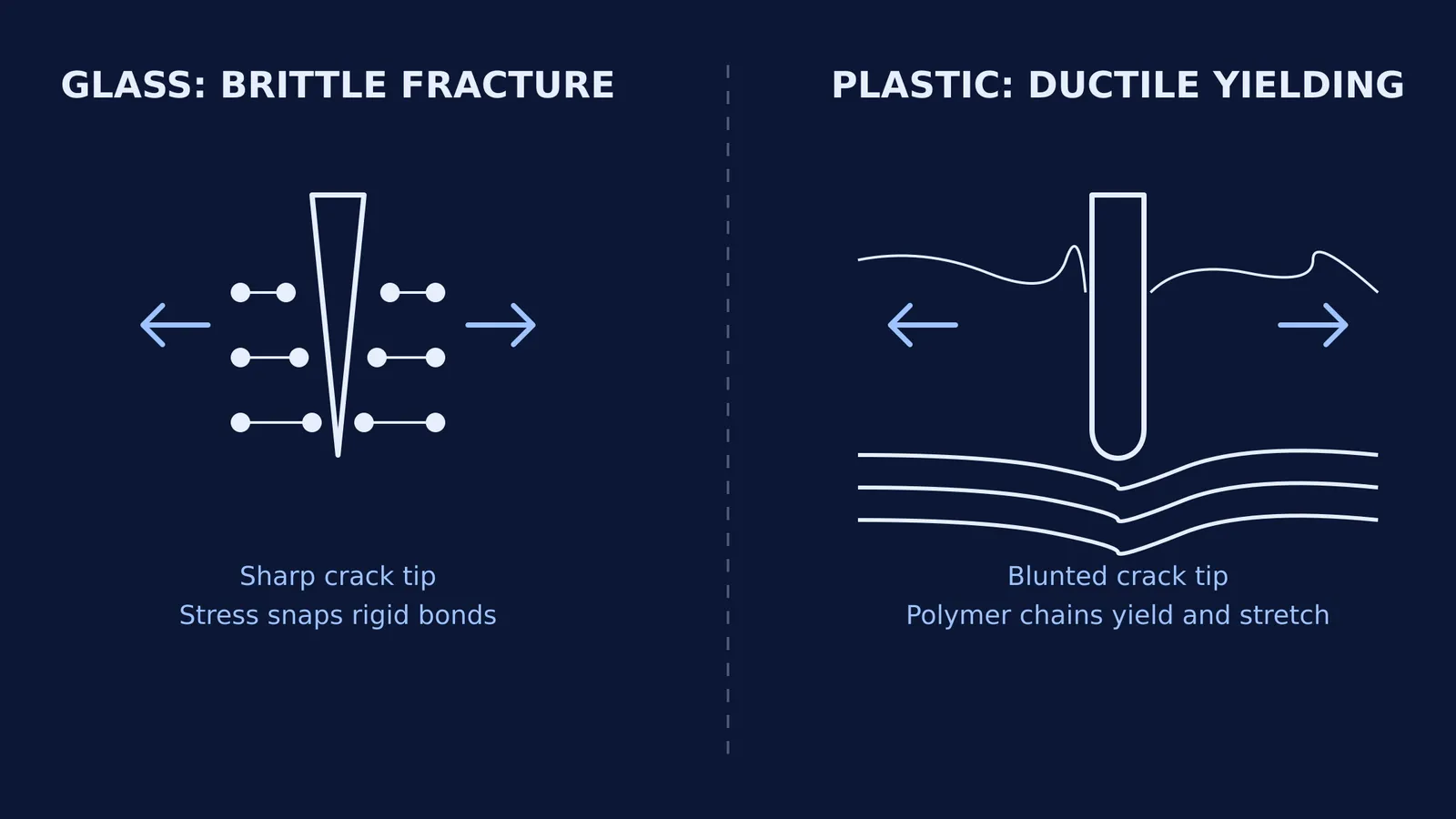
Glass is an amorphous solid made of a rigid three-dimensional network of atoms, such as silicon and oxygen, held together by strong covalent bonds. Unlike metals, which have crystal lattices with "slip planes" that allow layers of atoms to slide past one another, the atoms in glass are locked in place.
When you bend or hit glass, it behaves elastically at first. But because its atoms cannot rearrange themselves to absorb the energy, the applied stress builds up without relief.
How do Griffith flaws cause cracks to grow?
In 1921, the engineer Alan Arnold Griffith published a foundational paper explaining why materials like glass fail at stresses far below their theoretical atomic strength (Phil. Trans. R. Soc. A, 1921). He discovered that real glass is full of microscopic scratches and defects, now known as Griffith flaws.
When you apply force to glass, the stress concentrates intensely at the sharp tips of these tiny flaws. Because the rigid atomic network cannot flow to blunt the crack tip, the stress simply snaps the bonds. Once the stress exceeds the bond strength, the crack zips through the material catastrophically, creating the sudden shatter we associate with brittle materials.
To see how forces distribute across a material before it breaks, you can use the Fermi Simulation Lab to model stress and strain visually, making these hidden atomic forces easier to picture. You can also review how energy is stored in elastic materials by studying the elastic potential energy in a stretched wire.
Why does plastic bend instead of breaking?
Plastics, on the other hand, are polymers. Instead of a locked atomic network, they are composed of long, convoluted macromolecular chains held together by relatively weak intermolecular forces.
When a plastic is bent, it eventually reaches its yield stress. At this threshold, the energy from the applied stress overcomes the weak forces between the chains. This allows the long polymer chains to uncoil, slide past one another, and realign in the direction of the force. This process is known as plastic deformation.
Because the polymer chains can flow and slide, the material at the tip of a microscopic crack deforms, which blunts or rounds off the sharp tip. This spreading of stress prevents the crack from growing, allowing the plastic to bend permanently rather than shattering.
How can you visualise material behaviour?
Understanding how materials fail is a core part of physics and engineering. If you are working through elasticity problems, such as calculating a rod stretching under its own weight, grasping the molecular mechanisms gives the mathematical formulas real-world context.
If you ever find yourself struggling to connect the equations of stress and strain to what is actually happening at the atomic level, Fermi's AI tutor can work with you. It holds a line of reasoning across your study session, checking your understanding of yield stress and brittle fracture as it teaches, rather than just handing you the final answer.


