On this page
Picture a village pond on a still summer morning, fish gulping at the surface. Penn State Extension lists these as the signs of a low-oxygen fish kill: large numbers of fish of all species affected, fish gulping at the surface, and snails and crayfish leaving the water to crowd the pond edge.
The cause sits where two school chapters meet: the solubility of gases in chemistry, and respiration in biology.
Why do fish die in ponds during hot summers?
Fish breathe oxygen dissolved in water. In hot weather two things go wrong at once: the water holds less oxygen, and every fish needs more.
A fact sheet from California's State Water Resources Control Board names increases in water temperature and algal blooms among the biggest causes of low dissolved oxygen.
Why does warm water hold less oxygen?
As water warms, dissolved gas molecules have more energy and escape from the liquid more easily. This is the temperature side of Henry's law and the solubility of gases, the same reason a cold drink stays fizzy longer than a warm one.
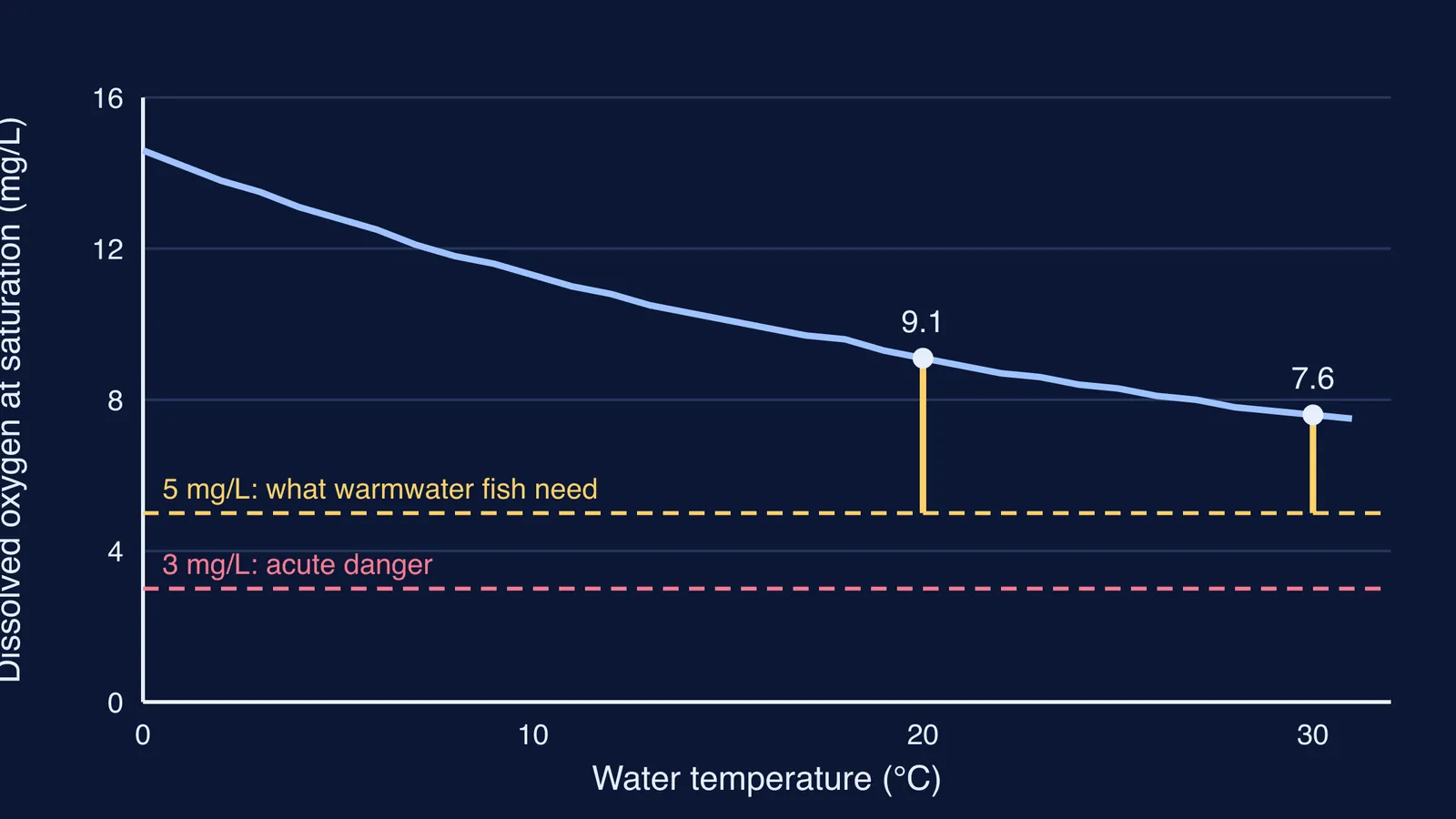
According to the California Clean Water Team dissolved oxygen fact sheet, fresh water fully saturated with air holds 14.6 mg/L of oxygen at 0°C, 9.1 mg/L at 20°C and 7.6 mg/L at 30°C.
The USGS Water Science School says that water with less than 2 mg/L of oxygen is defined as hypoxic.
Why do fish need more oxygen when the water warms?
Fish are ectotherms: their body temperature follows the water, so their chemical reactions speed up as it warms. Faster metabolism burns more oxygen.
In a review of 138 studies covering 69 species of bony fish, Clarke and Johnston (1999, Journal of Animal Ecology) found that, comparing species adapted to different temperatures, resting metabolism rose by a factor of about 1.83 for every 10°C. Within a single species, studies showed a steeper rise, with a median factor of 2.40 per 10°C. For African lungfish tested at 20, 25 and 30°C, Seifert and Chapman (2007) measured a factor of 3.3 per 10°C; their comparison of published values suggested tropical fish may be more temperature-sensitive than temperate ones.
New Mexico State University's pond guide W-105 notes that large fish die first because they need more oxygen. For the gill side of the story, read how fish breathe through their gills.
Why do fish die at dawn, not at noon?
By day, algae and water plants photosynthesise and add oxygen. At night that stops, but algae, plants, fish and bacteria all keep respiring. The California fact sheet says dissolved oxygen is generally highest in the late afternoon and lowest in the early morning before sunrise, and that bacteria decomposing dead algae consume large amounts.
The NMSU guide adds two summer triggers: sudden algae die-offs after several cloudy, hot, windless days, and a heavy cold rain that mixes a pond's layers and leaves oxygen critically low throughout the water.
A worked example: how much oxygen headroom is left?
Take a pond saturated with oxygen at dusk, using the California fact sheet values and the within-species demand factor of 2.40 per 10°C from Clarke and Johnston. The NMSU guide says warmwater fish need oxygen levels of 5 ppm (5 mg/L).
At 20°C, headroom above the safe line is 9.1 − 5 = 4.1 mg/L.
At 30°C, headroom is 7.6 − 5 = 2.6 mg/L, about 37% smaller.
At 30°C each fish uses about 2.4 times as much oxygen as at 20°C, so the useful headroom is like 2.6 ÷ 2.4 ≈ 1.1 mg/L at the old rate.
Compare 1.1 with 4.1: the hot pond has roughly a quarter of the night-time safety margin.
This is a simplified model: real ponds can be supersaturated at dusk, algae and bacteria also respire faster, and species differ. But it shows why a night that is harmless in mild weather can be fatal in a heatwave.
What can pond owners and students do?
If you keep fish:
Check the pond at first light. Fish gulping at the surface early in the morning is an oxygen warning, as the NMSU guide notes.
Aerate at the right time. In an April 2025 summer advisory, Bihar's Directorate of Fisheries told farmers to run aerators or air blowers for 2 to 4 hours each morning and evening, and to pause feeding if the water turns green or smells foul.
Do not kill all the weeds at once. NMSU advises treating no more than a quarter to a third of a pond at a time, 10 to 14 days apart, because rotting plants use up oxygen.
Students can explain it in three steps: gas solubility, fish metabolism, the dawn minimum. If solubility curves are easier to see than to read, the Fermi Simulation Lab has interactive simulations for ideas like this. To fill gaps in either chapter, the Fermi Concept Library covers every concept in physics, chemistry and biology, each with its own lesson.
For more on the numbers behind the curve, read why warm water holds less oxygen and what it means for fish.