

On this page
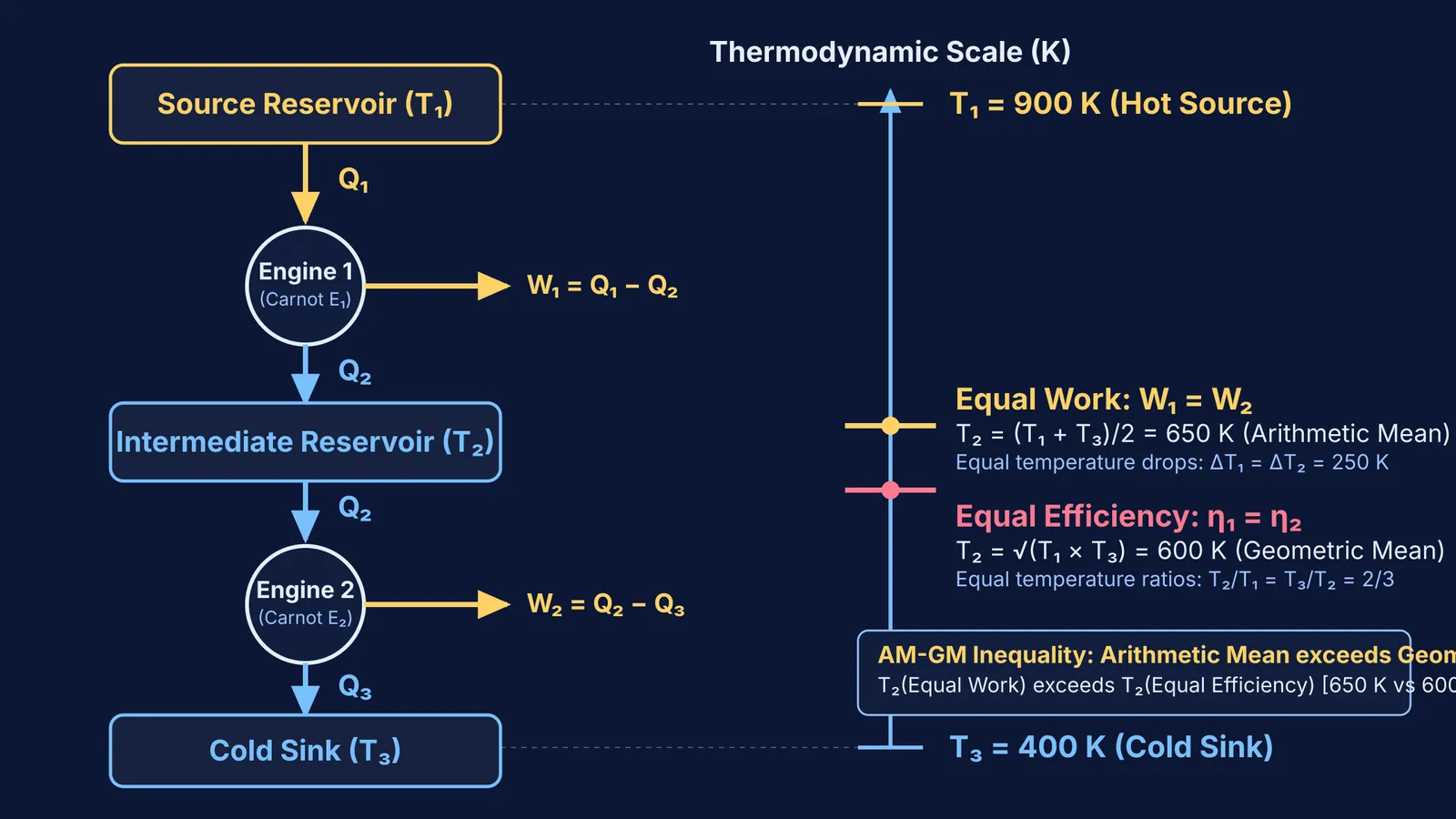
When two heat engines operate in a series cascade, thermal energy rejected by the first engine serves directly as the driving input for the second. Suppose Engine 1 operates between a hot reservoir at absolute temperature T₁ and an intermediate reservoir at temperature T₂. It absorbs heat Q₁ at source temperature T₁, delivers work W₁, and rejects heat Q₂ at intermediate temperature T₂. Engine 2 operates between the intermediate reservoir at T₂ and a cold sink at temperature T₃, absorbing heat Q₂ and rejecting Q₃ into the sink while producing work W₂.
According to OpenStax University Physics Volume 2, the efficiency of an ideal Carnot engine depends solely on reservoir temperatures: η = 1 − T_cold/T_hot. For any reversible cycle, heat transfers scale with absolute temperature: Q₁/T₁ = Q₂/T₂ = Q₃/T₃. In competitive exams such as JEE Main, problems regularly ask for the intermediate temperature T₂ under two distinct physical constraints: equal work output (W₁ = W₂) or equal thermal efficiency (η₁ = η₂).
This configuration links directly to Sadi Carnot's reversible heat engine cycle and the Kelvin-Planck and Clausius statements of the second law.
How do you find the intermediate temperature for equal work?
When both engines deliver identical mechanical work, W₁ = W₂.
From the first law of thermodynamics, work equals net heat transfer:
W₁ = Q₁ − Q₂
W₂ = Q₂ − Q₃
Because each stage is a Carnot cycle, Q₁ = Q₂ × (T₁/T₂) and Q₃ = Q₂ × (T₃/T₂). Setting W₁ = W₂ gives: Q₂ × (T₁/T₂ − 1) = Q₂ × (1 − T₃/T₂)
Dividing by Q₂ and multiplying across by T₂ simplifies the equation: T₁ − T₂ = T₂ − T₃ T₂ = (T₁ + T₃) / 2
When work outputs match, the intermediate temperature is the arithmetic mean of the source and sink temperatures.
Historically, this arithmetic progression helped define absolute temperature itself. In an 1848 paper reprinted in his Mathematical and Physical Papers, William Thomson (Lord Kelvin) proposed an absolute thermometric scale based on Carnot's cycle, calibrating temperature intervals against the mechanical work produced as heat descended between reservoirs.
For students tackling multi-step thermodynamics numericals, the Fermi Problem Library provides worked problems with a step-by-step solver that explains the reasoning rather than printing an answer.
How do you find the intermediate temperature for equal efficiency?
When both engines operate at identical thermal efficiencies, η₁ = η₂.
The Carnot efficiency for each engine is:
η₁ = 1 − T₂/T₁
η₂ = 1 − T₃/T₂
Equating the two expressions: 1 − T₂/T₁ = 1 − T₃/T₂
Canceling terms gives: T₂/T₁ = T₃/T₂ T₂² = T₁ × T₃ T₂ = √(T₁ × T₃)
When efficiencies match, the intermediate temperature is the geometric mean of the extreme temperatures.
Under this condition, work outputs are never equal. Because Engine 2 receives less heat than Engine 1 (Q₂ < Q₁), its work output is strictly smaller: W₂ = η₂ × Q₂ < η₁ × Q₁ = W₁.
Why is the intermediate temperature higher for equal work than equal efficiency?
For any two distinct positive temperatures T₁ and T₃, the arithmetic mean always exceeds the geometric mean: (T₁ + T₃)/2 > √(T₁ × T₃).
Physically, Engine 2 receives only Q₂, which is smaller than Q₁ because Engine 1 converted part of the heat into work. To match Engine 1's work output from a smaller heat supply, Engine 2 must run at higher efficiency (η₂ > η₁). This steeper relative temperature drop pushes T₂ upward toward the hotter source.
Real exam problems illustrate this difference directly. In the January 2019 JEE Main examination conducted by the National Testing Agency, candidates evaluated two Carnot engines in series operating between T₁ = 600 K and T₃ = 400 K. With equal work (W₁ = W₂), the intermediate temperature evaluated to the arithmetic mean, T₂ = (600 + 400)/2 = 500 K. Had the problem specified equal efficiency (η₁ = η₂), the intermediate temperature would have been the geometric mean, T₂ = √(600 × 400) ≈ 489.9 K.
A wider temperature spread highlights the underlying energy balance even more clearly. Consider a source at T₁ = 900 K and a sink at T₃ = 400 K:
Equal work: T₂ = (900 + 400) / 2 = 650 K. Here, η₁ = 27.78% and η₂ = 38.46%. If Q₁ = 900 J, each engine delivers 250 J of work.
Equal efficiency: T₂ = √(900 × 400) = 600 K. Here, η₁ = η₂ = 33.33%. If Q₁ = 900 J, Engine 1 delivers 300 J while Engine 2 delivers 200 J.
What is the total efficiency of a two-engine Carnot chain?
The total work produced by both engines is W_total = W₁ + W₂ = (Q₁ − Q₂) + (Q₂ − Q₃) = Q₁ − Q₃. Because net heat drawn from the external reservoir is Q₁, overall efficiency is: η_total = (Q₁ − Q₃) / Q₁ = 1 − T₃ / T₁
Overall efficiency is independent of the intermediate temperature T₂. Whether tuned for equal work or equal efficiency, the combined chain matches a single Carnot engine running directly between T₁ and T₃, as detailed in OpenStax University Physics Volume 2.
In terms of individual efficiencies: η_total = η₁ + η₂ − (η₁ × η₂)
Every step connects directly to net work in a cyclic process. To see how thermodynamic concepts fit together across the syllabus, the Fermi Concept Library covers every concept in physics, chemistry, biology, mathematics and computing, each with its own lesson and its place in the map.


