

On this page
The heat death of the universe sounds fiery, but it is the opposite: a quiet, even state where nothing can happen, because every temperature difference has been used up. Working out why is one of the clearest ways to understand the second law of thermodynamics.
What is the heat death of the universe?
Heat death is the hypothesis that the universe will reach a state with no thermodynamic free energy and maximum entropy, so it can no longer sustain any thermodynamic process (Wikipedia: Heat death of the universe).
The idea is older than modern cosmology. In 1852 William Thomson (later Lord Kelvin) published "On a Universal Tendency in Nature to the Dissipation of Mechanical Energy" (Wikipedia: Heat death of the universe). In 1865 Rudolf Clausius gave entropy its first mathematical form and its name (Wikipedia: Rudolf Clausius). In English translation, that paper ends with two lines: "The energy of the universe is constant. The entropy of the universe tends to a maximum."
Energy is never lost. What gets lost is its usefulness.
Why does entropy make usable energy run out?
The second law says the entropy of the universe never decreases during any thermodynamic process (OpenStax University Physics Volume 2, section 4.7). To get work out of heat, you need a hot place and a cold place. The most any engine can turn into work is set by the Carnot efficiency, e = 1 − Tc/Th, with both temperatures in kelvin (OpenStax, section 4.5).
A worked example you can do in two minutes:
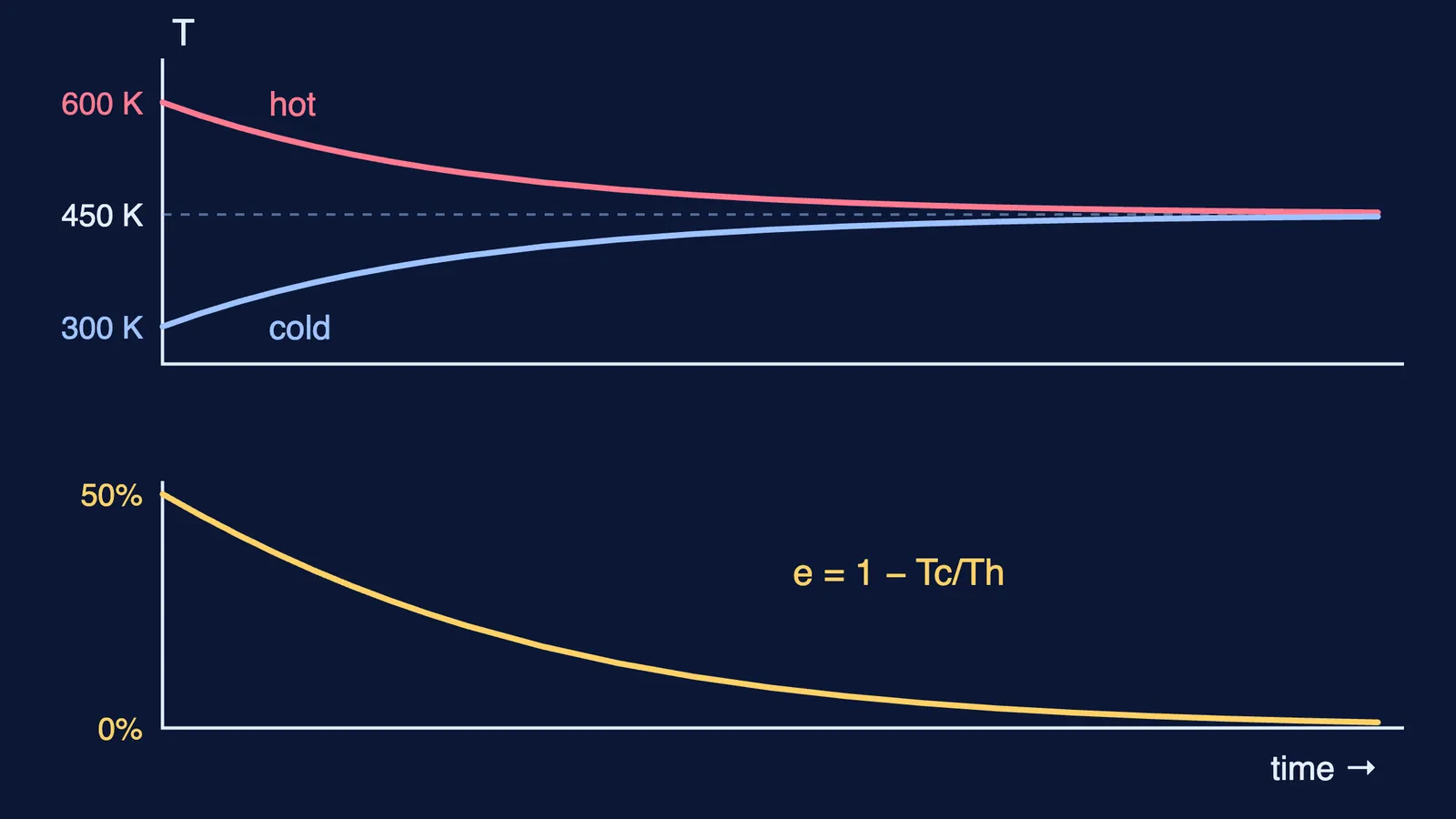
Take two identical blocks, one at 600 K and one at 300 K. At the start, an ideal engine between them has e = 1 − 300/600 = 0.5: at most half of each joule drawn from the hot block can become work.
Now let the blocks simply touch, with no engine. With equal heat capacities, they settle at 450 K. No energy has disappeared: the first law still holds.
Try to run an engine now: e = 1 − 450/450 = 0. The same energy is there, but it can do no work.
Check the entropy. For each block, ΔS = C ln(Tfinal/Tinitial). The total is C ln(450/600) + C ln(450/300) = C ln(1.125), about 0.118 C, which is positive, as the second law demands.
Heat death is, roughly, step 3 for the whole universe: no temperature differences left to run anything.
Our guide to why Carnot efficiency needs kelvin walks through that trap with numbers.
Is the universe actually heading for heat death?
NASA puts the age of the universe at about 13.8 billion years and says cosmic expansion is speeding up, likely driven by dark energy, so the universe will probably expand forever (NASA Science: Universe overview). NASA estimates that about 68.3 to 70% of the universe is dark energy (NASA Science: Dark energy). In a universe that keeps expanding, either a heat death or a Big Rip is expected (Wikipedia: Heat death of the universe).
The evidence for acceleration came from distant supernovae, reported in 1998 by Adam Riess and colleagues in The Astronomical Journal (Riess et al., 1998). A 1997 review by Fred Adams and Gregory Laughlin traced how planets, stars, galaxies and the universe itself would evolve over timescales far longer than its current age (Adams and Laughlin, Reviews of Modern Physics, 1997).
The details are still open. In March 2025 the DESI collaboration reported results from nearly 15 million galaxies and quasars that hint dark energy may be weakening over time (Fermilab news, 19 March 2025). Combined with other datasets, the preference ranged from 2.8 to 4.2 sigma, short of the 5 sigma threshold physicists use for a discovery. As the same release puts it, the fate of the universe hinges on the balance between matter and dark energy.
How can you use this idea in JEE and board exams?
JEE Main is unlikely to ask about the universe's fate, but it does test entropy, spontaneity and engines. Use heat death as the hook and this checklist when you revise:
Say what is conserved (energy) and what increases (total entropy) before you write a single equation.
For any heat engine question, convert to kelvin first, then find e = 1 − Tc/Th.
For an entropy question, add the system and the surroundings; read our explainer on why the surroundings' entropy change is −ΔH/T.
If you ever think you have beaten the second law, look for the hidden cost, as in the puzzle of Maxwell's demon.
If the jump from two blocks to "no more work" is hard to picture, the Fermi Simulation Lab has interactive simulations for ideas that are easier to see than read. To fill a gap in entropy or free energy first, look the idea up in the Fermi Concept Library, which covers concepts across physics, chemistry, biology, mathematics and computing.
Try the four-step example above with 500 K and 250 K, and check that the entropy still goes up.


