

On this page
Most thermodynamics questions in Class 11 chemistry and JEE Main ask about the system: the reaction in the flask. The second law, though, is about the system and its surroundings together. The surroundings term is where many students lose marks, usually through a wrong sign or a kJ-to-J slip. Here is the formula, why it has a minus sign, and how to use it to decide whether a process happens on its own.
What is the formula for entropy change of surroundings?
When a reaction runs at atmospheric pressure and its surroundings stay at a constant temperature T, the surroundings take in heat q_surr = −ΔH, so ΔS_surr = q_surr/T = −ΔH/T (LibreTexts, ChemPRIME 16.13/16%3A_Entropy_and_Spontaneous_Reactions/16.13%3A_Including_the_Surroundings)).
Here ΔH is the enthalpy change of the system, and T is in kelvin. The surroundings are treated as so large that their temperature does not change.
Why is there a minus sign in −ΔH/T?
The sign follows the heat. If a reaction gives off heat, its ΔH is negative. That same heat goes into the surroundings, so q_surr is positive. The minus sign turns the system's loss into the surroundings' gain, as the same LibreTexts page/16%3A_Entropy_and_Spontaneous_Reactions/16.13%3A_Including_the_Surroundings) explains.
Exothermic (ΔH < 0): ΔS_surr is positive. Heat released raises the entropy of the surroundings.
Endothermic (ΔH > 0): ΔS_surr is negative. The surroundings lose heat, so their entropy falls.
The 1/T matters as well. A fixed amount of heat causes a bigger entropy change in cold surroundings than in hot ones. That is why temperature can decide whether ice melts, as the second example below shows.
How do you use ΔS surroundings to judge spontaneity?
Add the two terms: ΔS_univ = ΔS_sys + ΔS_surr. A process is spontaneous if ΔS_univ > 0, non-spontaneous if ΔS_univ < 0, and at equilibrium if ΔS_univ = 0 (OpenStax Chemistry 2e, 16.3).
Worked example 1: magnesium burning at 298 K. The reaction is 2Mg(s) + O₂(g) → 2MgO(s), with ΔH = −1204 kJ/mol and ΔS_sys = −216.6 J/K per mol (LibreTexts/16%3A_Entropy_and_Spontaneous_Reactions/16.13%3A_Including_the_Surroundings)).
Convert ΔH to joules: −1,204,000 J/mol.
ΔS_surr = −(−1,204,000)/298 = +4040 J/K per mol.
ΔS_total = 4040 − 216.6 = +3823 J/K per mol. This is positive, so the reaction is spontaneous.
The system's entropy falls, because a gas is used up to make a solid. But the heat released raises the surroundings' entropy almost 19 times as much as the system loses. A reaction can look "wrong" if you only check ΔS_sys. That is also why exothermic reactions are often, but not always, spontaneous.
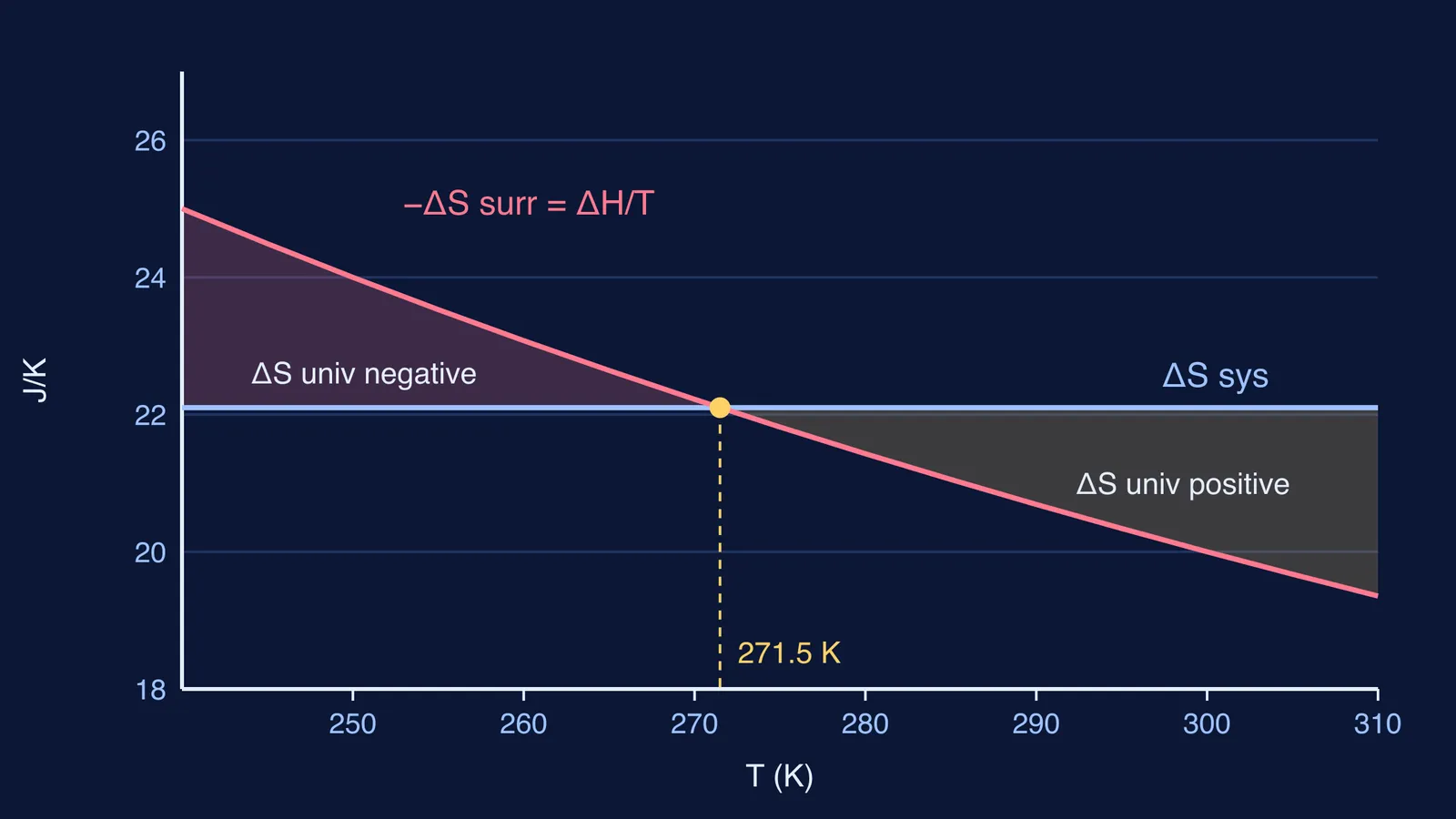
Worked example 2: ice melting, above and below 0 °C. OpenStax Example 16.4 takes melting ice with ΔS_sys = +22.1 J/K and q_surr = −6.00 kJ (the surroundings supply the heat).
At −10 °C (263.15 K): ΔS_surr = −6000/263.15 = −22.8 J/K, so ΔS_univ = 22.1 − 22.8 = −0.7 J/K. Not spontaneous.
At +10 °C (283.15 K): ΔS_surr = −6000/283.15 = −21.2 J/K, so ΔS_univ = 22.1 − 21.2 = +0.9 J/K. Spontaneous.
The same heat costs the surroundings less entropy when they are warmer. A check you can do yourself: set ΔS_univ = 0 and solve for T = 6000/22.1 ≈ 271.5 K. That is close to the real melting point of 273.15 K; the gap comes from rounded data and from treating ΔH and ΔS as constant. For phase changes this becomes the ΔS = ΔH/T rule for melting and boiling.
How does this connect to Gibbs energy?
Put ΔS_surr = −ΔH/T into the total and multiply both sides by −T. You get −TΔS_univ = ΔH − TΔS, which is ΔG (OpenStax Chemistry 2e, 16.4). So ΔG < 0 is the same test as ΔS_univ > 0, written using only the system's own properties. For the full picture, see the second law and the entropy of the universe.
A four-step check for any surroundings question
Write ΔH with its sign, and convert it to J.
Convert T to kelvin.
Find ΔS_surr = −ΔH/T, then check the sign makes sense: heat out means positive.
Add ΔS_sys. If the total is positive, the process is spontaneous. If it is near zero, you are close to equilibrium, so find the T where it crosses zero.
If step 3 keeps catching you out, try a few problems in the Fermi Problem Library. Its step-by-step solver explains the reasoning rather than printing an answer, so you can see where a sign went wrong. If entropy itself feels shaky, the Fermi Concept Library gives each concept its own lesson and its place in the map.


