

On this page
When you first learn about thermodynamics, it is easy to assume that exothermic reactions — those that release heat — always happen on their own. After all, systems in nature generally prefer to move to a lower energy state.
But spontaneity does not depend on enthalpy alone. The true measure of whether a chemical reaction will proceed without continuous outside help is the Gibbs free energy change, ΔG.
Are all exothermic reactions spontaneous?
No. An exothermic reaction releases heat (ΔH < 0), which does encourage the reaction to go forward. However, whether it actually happens spontaneously depends on the total Gibbs free energy change, which combines both enthalpy and entropy:
ΔG = ΔH − TΔS
For a process to be spontaneous, ΔG must be negative. If the reaction decreases the system's entropy (ΔS < 0), it means the products are more ordered than the reactants. In this case, the −TΔS part of the equation becomes positive. If the temperature T is high enough, this positive term outweighs the negative heat release (ΔH). This makes the overall ΔG positive, meaning the reaction becomes non-spontaneous.
What role does entropy play in spontaneity?
Entropy (ΔS) is a fundamental measure of molecular disorder. When a system becomes more ordered during a chemical or physical change, it naturally resists that change. Temperature acts as a multiplier for this resistance.
Take the freezing of water. Turning liquid water into solid ice is an exothermic process, releasing a heat of fusion of 333.55 J/g. But because the freely moving water molecules lock into a rigid crystal lattice, the entropy of the system drops significantly.
At low temperatures, the heat release is the dominant factor, and the water easily freezes. But as the temperature rises, the entropy penalty grows larger. Above 273.15 K (0 °C), the positive −TΔS term exceeds the released heat. The total free energy change becomes positive, which is why water will not spontaneously freeze at room temperature.
Why do some exothermic reactions become non-spontaneous at high temperatures?
The most famous industrial example of this temperature clash is the synthesis of ammonia from nitrogen and hydrogen gases, known as the Haber process.
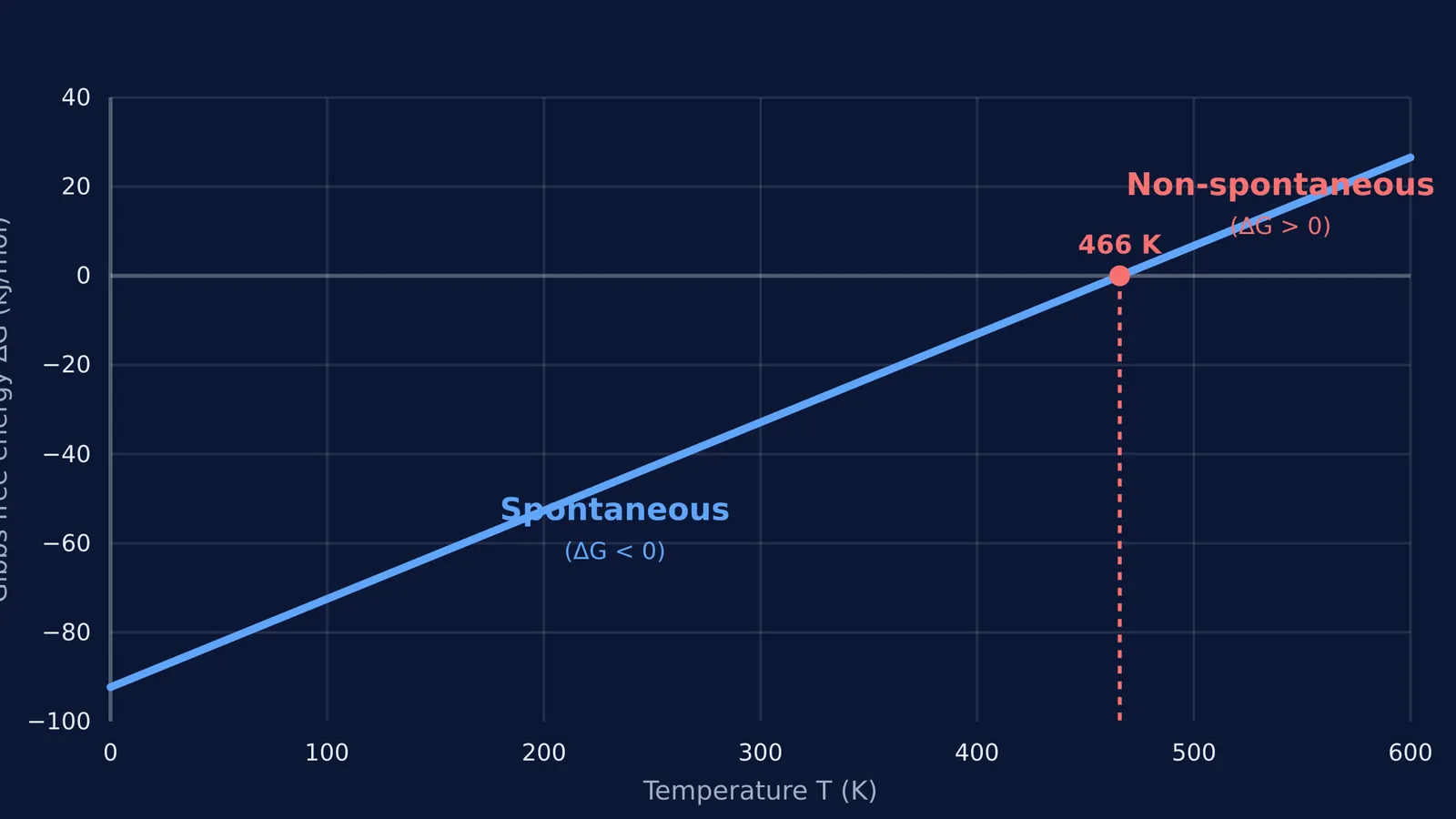
The reaction is highly exothermic, with a standard enthalpy change of ΔH = −92.3 kJ/mol. However, it takes four moles of reactant gases (one mole of N₂ and three moles of H₂) and combines them into just two moles of ammonia (NH₃). Reducing the total number of gas molecules creates order, giving the reaction a large negative entropy change.
Because both thermodynamic values are negative, ammonia synthesis is only spontaneous below a specific threshold. This creates a severe practical problem for industrial chemists. At low temperatures where the thermodynamics are favourable, the nitrogen triple bond is simply too strong to break, making the reaction uselessly slow. To speed the reaction up to a viable rate, industrial plants must run it at 400–500 °C, pushing the process directly into the non-spontaneous temperature range.
When does ammonia synthesis stop being spontaneous?
To find the crossover temperature where an exothermic reaction ceases to be spontaneous, you set ΔG to zero and solve for T. This gives you the precise point where the enthalpy and entropy terms balance each other out:
T = ΔH / ΔS
For the Haber process at standard pressure, the equilibrium constant becomes unity at around 150–200 °C, representing the temperature where ΔG crosses zero. Above this threshold, the reaction is no longer spontaneous at 1 atmosphere of pressure.
To solve this thermodynamic roadblock, chemical engineers rely on Le Chatelier's Principle. By running the reaction at extremely high pressures of 150–250 bar, they actively shift the equilibrium towards the side with fewer gas molecules, forcing the ammonia to form in high yields despite the high temperature.
Understanding exactly how enthalpy, entropy and equilibrium interact is crucial for mastering physical chemistry exams like the JEE or NEET. If you are struggling to piece these interrelated variables together, you can explore the Fermi Concept Library. Fermi's AI tutor connects these ideas for you, breaking down the maths behind Gibbs free energy and drawing the thermodynamic graphs directly on the board to help you see exactly when a reaction tips from spontaneous to non-spontaneous.
For more on thermodynamics, you can read our step-by-step guides on the free expansion of an ideal gas and how to accurately calculate the net work in a cyclic process loop area.


