

On this page
Why does an ice cube melt on a warm table, but a puddle of water never spontaneously gathers itself into a solid cube? The answer is not just about the energy of the water itself. It comes down to a strict rule governing all of nature: a process will only happen on its own if it increases the total disorder of everything.
In chemistry, we often get tunnel vision, focusing solely on the beaker or the test tube in front of us. But to understand why reactions happen, we have to look outside the beaker.
What is the entropy of the universe?
The Second Law of Thermodynamics states that for any spontaneous process, the entropy of the universe must increase/19%3A_Chemical_Thermodynamics/19.05%3A_Gibbs_Free_Energy) (ΔS_univ > 0). Entropy is a measure of how spread out or dispersed energy is.
In thermodynamics, the "universe" simply means the system (the reaction we are studying) plus its surroundings (the rest of the room).
ΔS_univ = ΔS_sys + ΔS_surr
A reaction like the free expansion of an ideal gas clearly spreads out matter, increasing the system's entropy. But what about a reaction that creates order, like a gas condensing into a liquid? For that to happen spontaneously, the surroundings must gain more entropy than the system loses.
How does the system change its surroundings?
How does a chemical reaction affect the air around it? Mostly by transferring heat.
At a constant temperature and pressure, the entropy change of the surroundings depends on the enthalpy change (ΔH) of the system. If a reaction is exothermic (ΔH < 0), it releases heat. This heat makes the molecules in the surrounding air move faster and spread out more, increasing their entropy.
The exact relationship is given by the formula ΔS_surr = −ΔH / T/19%3A_Chemical_Thermodynamics/19.05%3A_Gibbs_Free_Energy). The minus sign is there because heat leaving the system (−ΔH) enters the surroundings as positive heat.
Dividing by temperature (T) in Kelvin accounts for the fact that a little bit of heat creates a lot more relative disorder in a cold room than it would in a hot room. If the surroundings are already hot and chaotic, adding more heat barely makes a difference to their entropy.
What is the Gibbs free energy shortcut?
Chemists needed a way to predict spontaneity without having to measure the entire room. By substituting the surroundings formula into the universe equation, we get:
ΔS_univ = ΔS_sys − ΔH / T
If we multiply the entire equation by −T, we get a new expression:
−TΔS_univ = ΔH − TΔS_sys
The term on the right is so useful that scientists gave it a name: the change in Gibbs free energy (ΔG). Because a spontaneous process must have a positive ΔS_univ, and temperature in Kelvin is always positive, the term −TΔS_univ must be negative.
This means a process is spontaneous if and only if ΔG < 0.
By defining ΔG = ΔH − TΔS/19%3A_Chemical_Thermodynamics/19.05%3A_Gibbs_Free_Energy), we have perfectly repackaged the Second Law of Thermodynamics so that it only uses the properties of the system. We no longer have to measure the surroundings at all; we have baked their effect into the ΔH term. This same principle extends across physical chemistry, allowing you to link cell EMF to ΔG° and K in electrochemistry.
When does temperature take control?
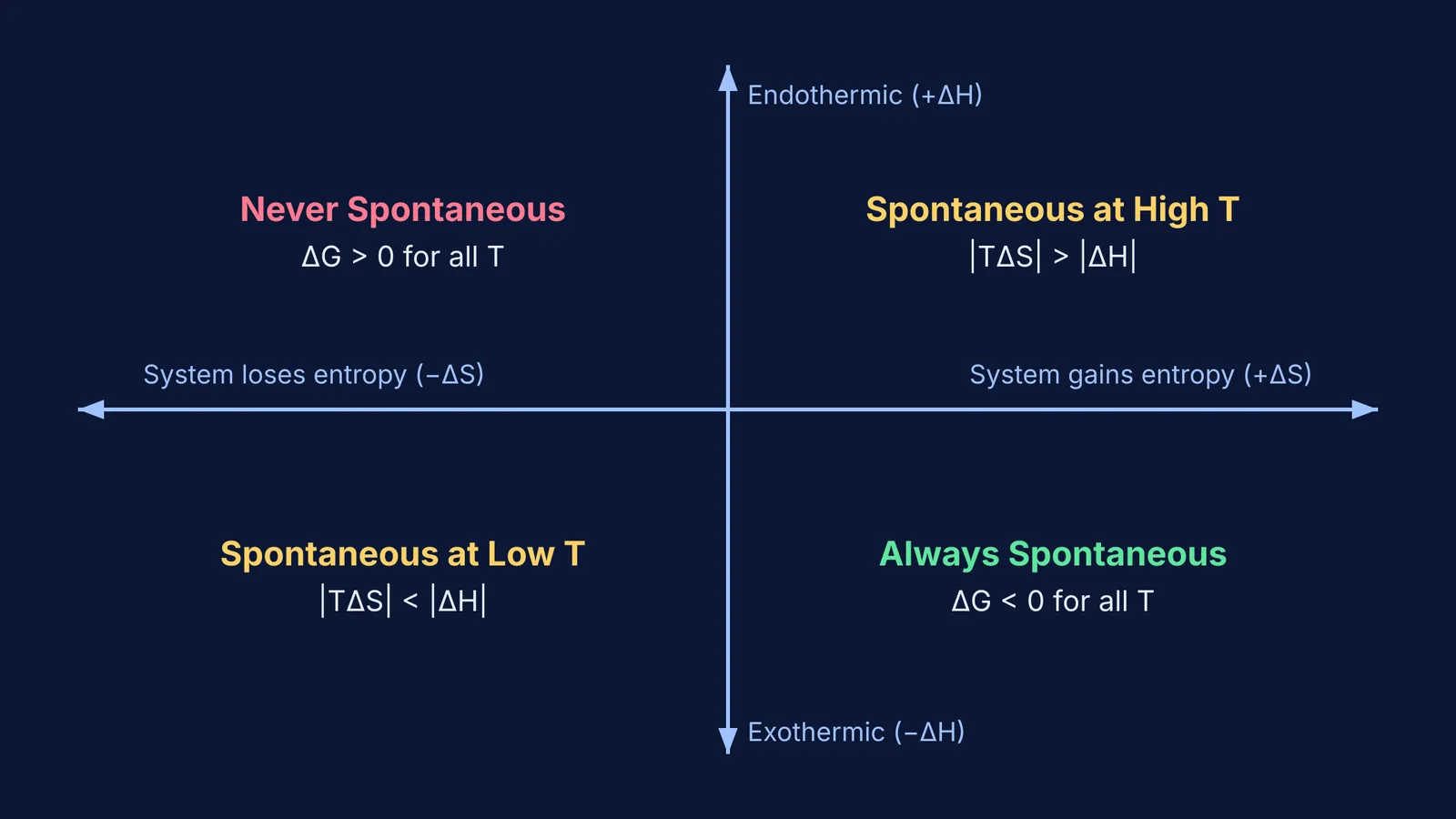
Because ΔG depends on both enthalpy (ΔH) and entropy (ΔS), the temperature (T) acts as a volume dial for the entropy term. This creates four possible scenarios for a reaction:
Exothermic and disordering (ΔH < 0, ΔS > 0): Both terms help make ΔG negative. The reaction is always spontaneous, like a solid explosive turning into hot expanding gases.
Endothermic and ordering (ΔH > 0, ΔS < 0): Neither term helps. The reaction is never spontaneous.
Exothermic but ordering (ΔH < 0, ΔS < 0): The surroundings want the reaction to happen (because it releases heat), but the system does not (because it becomes more ordered). It is only spontaneous at low temperatures, where the enthalpy term dominates. A classic example is water freezing into ice.
Endothermic but disordering (ΔH > 0, ΔS > 0): The system wants to happen, but the surroundings do not. It is only spontaneous at high temperatures, where the TΔS term is large enough to overpower the enthalpy penalty. This is why ice melts and sweat evaporates only when there is enough thermal energy available.
If you struggle to picture how these energy states balance out, the Fermi Concept Library has every concept in physics, chemistry, biology, mathematics and computing, each with its own lesson and its place in the map. And when you sit down to solve a tricky thermodynamics problem, Fermi's AI tutor can help. Most learning tools answer questions. Fermi teaches — it holds a line of reasoning across a whole session, notices where a student is stuck, and decides whether to explain, ask, or show.
How do you solve exam questions on spontaneity?
When a chemistry exam asks you to predict if a reaction is spontaneous, follow these steps:
Find the sign of ΔH: Is the reaction absorbing heat (+) or releasing it (−)?
Find the sign of ΔS_sys: Are you creating more moles of gas (+), or moving to a more ordered state like a solid (−)?
Check the signs against each other: If they match, the temperature will decide the outcome. If they are opposite, the reaction is either always or never spontaneous.
Calculate the tipping point: If you need to find the exact temperature where a reaction becomes spontaneous, set ΔG = 0. The tipping point is always T = ΔH / ΔS.


