

On this page
In the late eighteenth century, biblical chronologies placed creation around 4004 BC, limiting Earth's age to roughly six millennia. In 1778, French naturalist Georges-Louis Leclerc, Comte de Buffon, challenged that orthodoxy by publishing an experimental age for Earth: 74,832 years in his treatise The Epochs of Nature. Rather than parsing genealogies, Buffon fired up blast furnaces at his Burgundy ironworks, heated cast-iron spheres until they glowed white-hot, and timed their cooling with a seconds watch.
Why did Newton think testing Earth's cooling was impossible?
Sir Isaac Newton laid the theoretical groundwork in Book III of his *Principia* (1687). Newton noted that a red-hot iron globe one inch in diameter cooled to ambient temperature in about one hour. Assuming heat content scaled with volume while heat loss scaled with surface area, he reasoned cooling time grew in proportion to diameter. Scaling to an iron globe the size of Earth—roughly 40,000,000 feet across—Newton estimated our planet would take over 50,000 years to cool, as analyzed in Kenneth L. Taylor's historical study.
Newton doubted laboratory tests could measure this proportion accurately, leaving a challenge to posterity: "I should be glad that the true proportion was investigated by experiments."
How did Buffon conduct his cooling sphere experiment?
At his iron foundry in Montbard, Buffon accepted Newton's challenge. Between 1767 and 1773, he cast ten solid iron spheres with diameters from 0.5 to 5.0 inches in half-inch increments, recorded in his supplementary volumes to Histoire Naturelle.
Heating each sphere to white heat, he timed two milestones in his Montbard laboratory records:
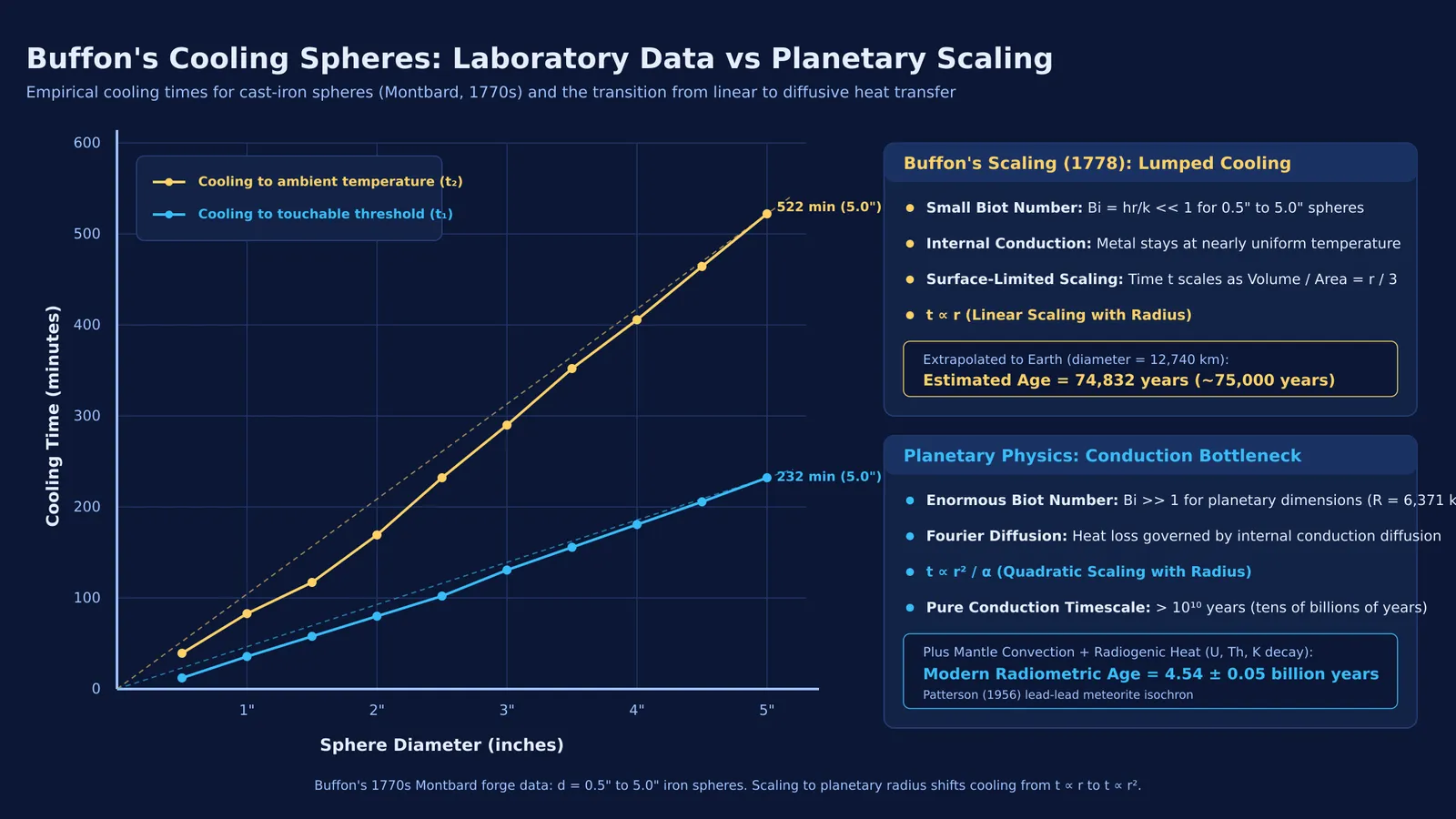
Time to touch: when the sphere could be held for half a second without burning skin (12 minutes for the 0.5-inch sphere; 232 minutes for the 5.0-inch sphere).
Time to ambient: when the sphere cooled to room temperature (39 minutes for the 0.5-inch sphere; 522 minutes for the 5.0-inch sphere).
Buffon also tested spheres of sandstone, marble, clay, and glass to model rocky crustal materials.
How did Buffon calculate the age of the Earth at 74,832 years?
Buffon observed that cooling times grew roughly linearly with diameter. Taking Earth's diameter as 2,865 French leagues (roughly 12,740 km or 470 million inches), he scaled his laboratory rates to planetary dimensions in The Epochs of Nature:
Epoch 2 (2,936 years): The molten globe consolidated into solid rock to its centre.
Epoch 3 (~34,270 years): Surface temperatures fell enough for water vapour to condense into oceans.
Epoch 7 (74,832 years): The planet reached its present thermal state, supporting human life.
Buffon calculated Earth would freeze in another 93,291 years. Privately, he suspected planetary time was vastly greater. In unpublished manuscripts cited by historians of earth science, he derived ages up to 3 million years from sedimentation rates, but published 74,832 years to avoid theological censure.
Why does a cooling planet scale with r² instead of r?
Small iron cannonballs have a low Biot number (Bi = hr/k ≪ 1): internal conduction is much faster than convective surface cooling. The sphere stays nearly uniform in temperature, so cooling time depends on volume divided by surface area (V/A = r/3), yielding linear scaling (t ∝ r).
For a planet with a radius of 6,371 km, the Biot number is vast. Heat transfer is limited by internal conduction, governed by Fourier's diffusion equation: t ≈ r² / α, where α is thermal diffusivity. As shown in Clair Patterson's 1956 geochronological research90036-9), which dated Earth to 4.55 billion years (refined today to 4.54 billion years), conductive cooling of a rocky Earth would require tens of billions of years. Lord Kelvin's cooling estimates of 20 to 400 million years also failed because Earth's mantle convects and radioactive decay generates heat.
Understanding cooling rates connects directly to Newton's law of cooling. Buffon's timeline inspired James Hutton's geological deep time and paved the path to Clair Patterson's radiometric dating.
What can students learn from Buffon's scaling model?
Buffon's experiment highlights essential lessons in dimensional analysis:
Surface-limited vs diffusion-limited cooling: When conduction outpaces surface loss (low Bi), cooling scales with radius r. When conduction is the bottleneck (high Bi), cooling scales with r².
Extrapolation across scales: Scaling laboratory results across orders of magnitude without checking non-dimensional numbers changes the physics.
When learning heat transfer, distinguishing surface loss from internal conduction takes practice. The Fermi Problem Library has worked problems with a step-by-step solver that explains the reasoning rather than printing an answer. The Fermi Simulation Lab provides interactive simulations for ideas that are easier to see than to read, letting students observe thermal diffusion directly. To explore thermodynamic scaling across disciplines, the Concept Library covers every concept in physics, chemistry, biology, mathematics and computing, each with its own lesson and its place in the map.


