

On this page
A fire in a room usually starts small: one chair, one bin, one sofa. For a few minutes it stays in one place, and the rest of the room is only warm. Then, quite suddenly, the carpet, the curtains and the furniture on the far side all catch fire within seconds of each other. Fire engineers call this moment flashover, and the physics behind it is the T⁴ law from Class 11.
What is flashover in a room fire?
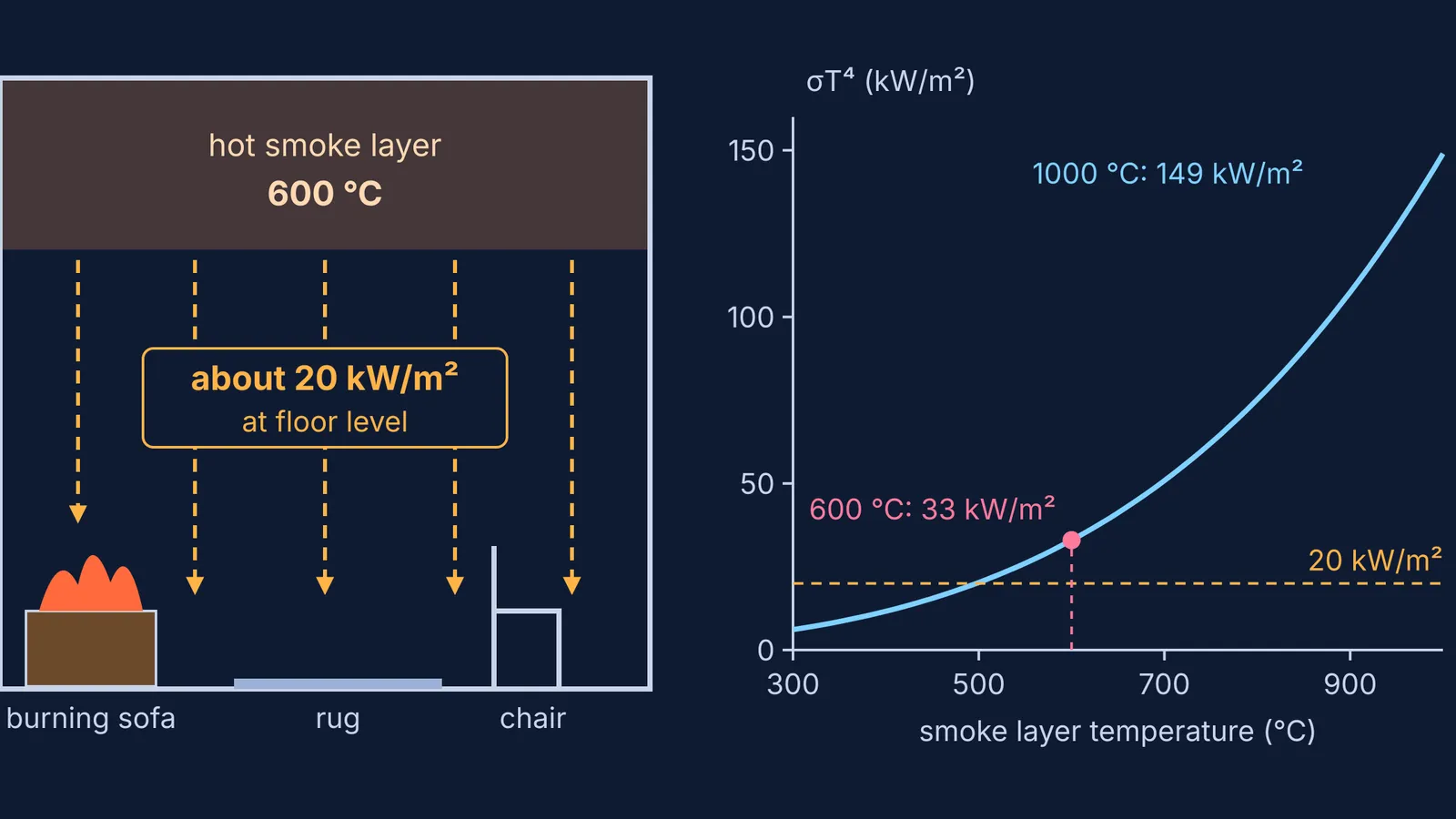
NIST's Fire Facts, following the NFPA 921 guide, describe flashover as a transition in a compartment fire in which surfaces exposed to thermal radiation reach their ignition temperature and fire spreads rapidly through the space, giving full involvement of the room (NIST Special Publication 1102, Fire Facts, 2009). US federal regulations give a working definition with two numbers: the upper gas layer reaches 600 °C and the heat flux at floor level exceeds 20 kW/m² (41 CFR § 102-80.145).
The same NIST fact sheets list gas temperatures of 400 °C or more at the start of room flashover, about 1000 °C in a room undergoing flashover, and about 80 kW/m² once flashover is established. So the "500–600 °C" you often hear is a rule of thumb from fire research, not a sharp line.
The key point: at flashover, the fire is no longer heating the room mainly by its flames. The smoke layer is doing it.
Why does the smoke layer heat the whole floor?
Hot smoke and gases rise and spread under the ceiling as a thick layer. That layer is hot, wide and opaque, so it acts like a giant radiant heater the size of the ceiling, pointing down.
Radiation from a hot surface follows the Stefan–Boltzmann law, q = εσT⁴, with σ = 5.67 × 10⁻⁸ W m⁻² K⁻⁴ and T in kelvin. You have used it for the Sun's surface in estimating the Sun's temperature from the solar constant, and the standard problem types are in black-body radiation: Stefan's law and Wien's law problems.
A layer covering the whole ceiling sends radiation to every part of the floor, not only to the area near the burning sofa.
How strong is the radiation at 500 °C and 600 °C?
Treat the layer as a black body (ε = 1) and convert to kelvin first.
500 °C = 773 K: σT⁴ = 5.67 × 10⁻⁸ × 773⁴ ≈ 20.3 kW/m²
600 °C = 873 K: σT⁴ ≈ 33.0 kW/m²
1000 °C = 1273 K: σT⁴ ≈ 149 kW/m²
For comparison, NIST gives about 1 kW/m² for clear-day sunlight at the Earth's surface. So a 600 °C layer, if it were a perfect black body, would pour roughly 33 times the strength of sunlight onto the floor. Going from 500 °C to 600 °C is only 13% more in kelvin, but (873/773)⁴ ≈ 1.63, so the flux rises by 63%.
A real smoke layer is not a perfect black body, and the floor does not "see" the full ceiling from every point; some of its view is walls and windows. Both effects cut the flux. That is why the regulatory pair is 600 °C with 20 kW/m², not 600 °C with 33 kW/m²: the effective factor is about 20/33 ≈ 0.6.
Why does 20 kW/m² matter? NIST's Fire Facts list 13 kW/m² as enough for wood volatiles to ignite with flame exposure, and 20 kW/m² as the floor-level flux at the start of flashover. Once every surface in the room is receiving that much, ordinary furnishings heat to the point of giving off flammable vapour together, and they ignite almost together.
Worked example: does distance from the fire protect you?
Before flashover, the main hot object is the burning item itself. After flashover, it is the ceiling. Compare the two.
Given (illustrative values): a fire releasing P = 1 MW, which NIST gives as the usual heat release rate for flashover of an average family room. Assume a radiant fraction χ = 0.3, a round illustrative value; the real fraction depends on the fuel. Treat the flame as a point source.
Radiated power. χP = 0.3 × 1 × 10⁶ W = 3.0 × 10⁵ W.
Inverse-square law. A point source spreads this over a sphere, so q = χP/(4πr²).
At r = 1 m. q = 3.0 × 10⁵ / (4π × 1²) ≈ 23.9 kW/m².
At r = 2 m. q ≈ 6.0 kW/m², one quarter of the 1 m value.
At r = 4 m. q ≈ 1.5 kW/m², one sixteenth.
Where does it drop to 4.5 kW/m²? NIST lists 4.5 kW/m² as enough for a second-degree burn to bare skin in about 30 s. Set χP/(4πr²) = 4500 W/m²: r = √(3.0 × 10⁵ / (4π × 4500)) ≈ 2.3 m.
After flashover. The smoke layer covers the ceiling. Its flux at the floor, at least 20 kW/m² and rising towards the 80 kW/m² NIST gives for established flashover, does not fall off with distance from the sofa, because the source is overhead everywhere.
So before flashover, moving a few metres away cuts the radiation by a factor of 4 to 16. After flashover, there is no corner of the room that is safe.
Why does flashover make early escape so important?
Physics explains why the window for escape is short: the T⁴ law turns a modest rise in smoke temperature into a large rise in radiation, and the smoke layer brings it to the whole floor at once. What to do about it is set by fire-safety authorities, not by a physics blog. Their advice:
FEMA's Ready.gov says a fire can become life-threatening in just two minutes, that heat is more threatening than flames, and that you should drop down and crawl low under any smoke to your exit (Ready.gov, Home Fires).
NFPA's fact sheet on home fire sprinklers says today's home fires can become deadly in as little as 2 minutes, and that smoke alarms warn you but do not put a fire out (NFPA, The Truth About Home Fire Sprinklers, 2024).
Ready.gov also says that if you cannot reach someone who needs help, you should leave the home and call the fire department.
The tandoor is a gentler example of the same idea: hot walls all around a roti cook it from every side at once, as in why a tandoor cooks so fast. For more radiation numericals of this type, the Fermi Problem Library has a step-by-step solver that explains the reasoning. If you are preparing for JEE, Fermi Test Prep offers personalised preparation for JEE Main & Advanced with an AI tutor, live classes, adaptive mocks, mentorship and a study plan that updates based on mastery.
Quick checklist
Flashover: radiation from the hot smoke layer ignites the whole room nearly at once.
Working definition: upper layer about 600 °C and at least 20 kW/m² at floor level (41 CFR § 102-80.145).
σT⁴ at 500 °C ≈ 20 kW/m²; at 600 °C ≈ 33 kW/m²; real layers radiate less than a black body.
Point source: q = χP/4πr², so distance helps before flashover; a ceiling-wide source removes that protection.
Always use kelvin in Stefan's law.
Escape advice comes from fire authorities: get low under smoke and get out early.


