

On this page
What is the solar constant?
The solar constant is the total radiant energy received per unit time per unit area at the top of Earth's atmosphere on a surface perpendicular to the Sun's rays, measured at Earth's mean orbital distance of one astronomical unit. According to satellite measurements analysed by Greg Kopp and Judith Lean (2011), the accepted value for this solar irradiance is 1361 W/m². In 2015, the International Astronomical Union formally adopted 1361 W/m² as the standard nominal solar irradiance in IAU 2015 Resolution B3.
In physics curricula, this parameter introduces thermal radiation under thermal properties of matter, commonly cited as 1360 W/m² or 1.4 kW/m² in textbook numericals. Students also practice calculating photons emitted per second to connect continuous macroscopic radiant flux with discrete quantum packets.
How does the inverse-square law reveal total solar luminosity?
Because interplanetary space is an effective vacuum, solar radiant energy does not dissipate into an absorbing medium. The Sun radiates electromagnetic waves outward in all radial directions, spreading energy over the surface of an expanding sphere.
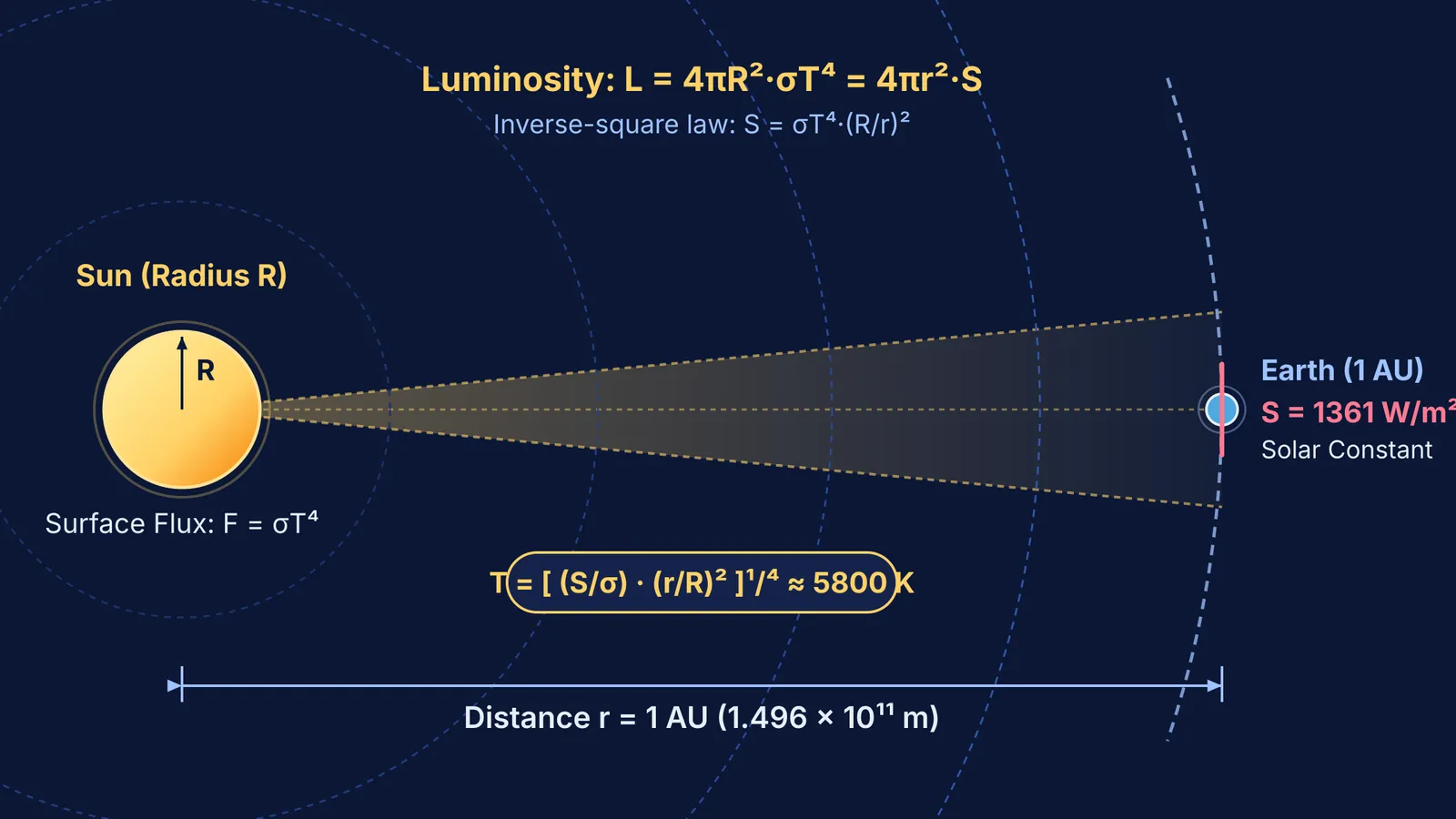
At Earth's mean orbital distance, the radius of this sphere is 1.496 × 10¹¹ m, as recorded in the NASA Sun Fact Sheet. The surface area of a sphere of radius r is Area = 4πr². Because the solar constant S represents the power passing through each square metre at this distance, the Sun's total radiant luminosity L equals the solar constant multiplied by the sphere's total area: L = 4πr² × S.
Substituting the measured parameters yields L = 4π × (1.496 × 10¹¹ m)² × 1361 W/m² ≈ 3.828 × 10²⁶ W, matching the nominal solar luminosity defined in IAU 2015 Resolution B3 and published by NASA.
How do you calculate the Sun's surface temperature using Stefan's law?
Once you know the total radiant luminosity, you can trace that power back to the solar surface. According to the NASA Sun Fact Sheet, the Sun has a volumetric mean radius R of 6.957 × 10⁸ m.
The Sun's physical surface area is 4πR², giving an emitted surface flux F = L / (4πR²) = S × (r / R)². The factor 4π cancels completely. With r / R = (1.496 × 10¹¹ m) / (6.957 × 10⁸ m) ≈ 215.0, squaring this ratio demonstrates that radiation at the solar surface is roughly 46,240 times more concentrated than at Earth: F = 1361 W/m² × 46,240 ≈ 6.293 × 10⁷ W/m².
Applying the Stefan-Boltzmann law, F = σT⁴, where the Stefan-Boltzmann constant σ is 5.670374 × 10⁻⁸ W/(m²·K⁴) according to the NIST Reference on Constants, Units, and Uncertainty, gives T = (F / σ)¹/⁴ ≈ 5774 K. Standard nominal parameters yield 5772 K; both round cleanly to 5800 K.
Students preparing for competitive examinations encounter related derivations in problems on black-body radiation and Stefan's law. To master these multi-step derivations, the Fermi Problem Library offers worked problems with a step-by-step solver that explains the reasoning rather than printing an answer.
Can you solve this using the Sun's angular diameter?
There is an elegant shortcut often favoured in physics competitions: using the Sun's observed angular diameter rather than memorising its physical radius and distance separately.
As recorded in the NASA Sun Fact Sheet, the Sun's apparent diameter from Earth is approximately 1919 arcseconds, or roughly 32 arcminutes (0.00931 radians). The angular radius α is half of that value: α ≈ 0.00465 radians. For small angles, the ratio of solar radius to orbital distance equals the angular radius: R / r ≈ α, which means r / R ≈ 1 / α.
Substituting this geometric relation into the surface flux equation gives F = S / α². Equating to Stefan's law gives σT⁴ = S / α², so T = [ S / (σ × α²) ]¹/⁴. With α = 0.00465 radians and S = 1361 W/m², this evaluates to T ≈ 5774 K, rounding to 5800 K.
Why does this calculation give an effective temperature rather than a uniform reading?
Because the Sun is a rotating ball of plasma without a solid boundary, it does not possess a single uniform temperature. The value of 5772 K defined in IAU 2015 Resolution B3 represents the Sun's "effective temperature"—the surface temperature of an idealized blackbody that radiates equivalent total luminosity. As recorded in the NASA Sun Fact Sheet, the visible photosphere spans from roughly 6600 K at its base down to 4400 K at its outer edge.
Decades after Stefan formulated his radiation law, Indian astrophysicist Meghnad Saha's work on thermal ionisation and stellar temperatures provided the theoretical tool needed to decipher stellar spectra. By linking spectral absorption lines to thermal ionisation states, Saha confirmed that the temperatures deduced from radiation laws matched the atomic states present in stellar atmospheres.
To build intuition across radiation thermodynamics and astrophysics, students can explore the Fermi Concept Library, which covers every concept in physics, each with its own lesson and its place in the map. When working through challenging numerical derivations, Fermi's AI tutor can work out what you already know and build a plan for the session, so you sit down to a clear next step.


