

On this page
Look up at the ceiling of a hotel corridor or a mall and you will often see a small brass fitting with a tiny glass bulb full of coloured liquid. That bulb is the trigger of a fire sprinkler. It holds a cap over the water outlet, and when hot gas from a fire heats it enough, the liquid inside expands, the glass shatters and water flows. Two bulbs with the same temperature rating can break at very different times, because what matters is how fast heat gets into the bulb. The number that captures this is the response time index, or RTI, and the physics behind it is Newton's law of cooling run in reverse.
How does a sprinkler bulb know there is a fire?
A fire sends a plume of hot gas up to the ceiling. When the plume hits the ceiling, it spreads sideways as a thin, fast layer called the ceiling jet. A technical article from the sprinkler maker Viking explains that convection from this heated air is the main way a sprinkler is activated, and that the element operates when it reaches its operating temperature (Viking, Automatic Sprinkler Thermal Sensitivity, 2006).
The bulb's colour tells you that temperature. Viking's bulb chart for standard-response 5 mm bulbs lists orange for 57 °C, red for 68 °C, yellow for 79 °C and green for 93 or 100 °C (Viking, Glass Bulb Identification Chart). The rating says nothing about how fast the bulb gets there. That is the job of the RTI.
What is the response time index of a sprinkler?
Treat the bulb as a small lump of mass m and specific heat c, sitting in gas at temperature T_g. Heat flows in by convection at a rate hA(T_g − T), where h is the heat transfer coefficient and A the surface area. So
mc dT/dt = hA(T_g − T)
This is the same equation as in Newton's law of cooling, except the body is warming instead of cooling. Its solution is an exponential approach to the gas temperature:
T_g − T = (T_g − T₀) e^(−t/τ), with τ = mc/(hA)
The time constant τ is the time to cover about 63% of the gap. You have met it for a thermometer in why a thermometer bulb has thin glass; a sprinkler bulb is a thermometer with a deadline.
The new piece is that h depends on how fast the gas moves. For small objects in a gas stream, h grows roughly as the square root of the gas speed u. So τ falls as 1/√u, and the product τ√u is a property of the bulb alone. That product is the RTI:
RTI = τ√u, measured in (m s)^½
Viking's article describes the test: the sprinkler is plunged into a hot air stream of fixed speed and temperature in a "plunge oven", the time for the element to cover about 63% of the temperature gap gives τ, and τ × √u gives the RTI.
What makes a sprinkler "quick response"?
According to the same article, NFPA 13 defines a fast-response thermal element as one with an RTI of 50 (m s)^½ or less, and a standard-response element as one with an RTI of 80 (m s)^½ or more. Quick-response sprinklers are one kind of fast-response sprinkler.
A low RTI means a small τ: a thin-walled, small bulb with little mass to heat (small mc) and a lot of surface (large A). This is the same design logic as a thin-glass thermometer bulb.
Worked example: how long until the bulb breaks?
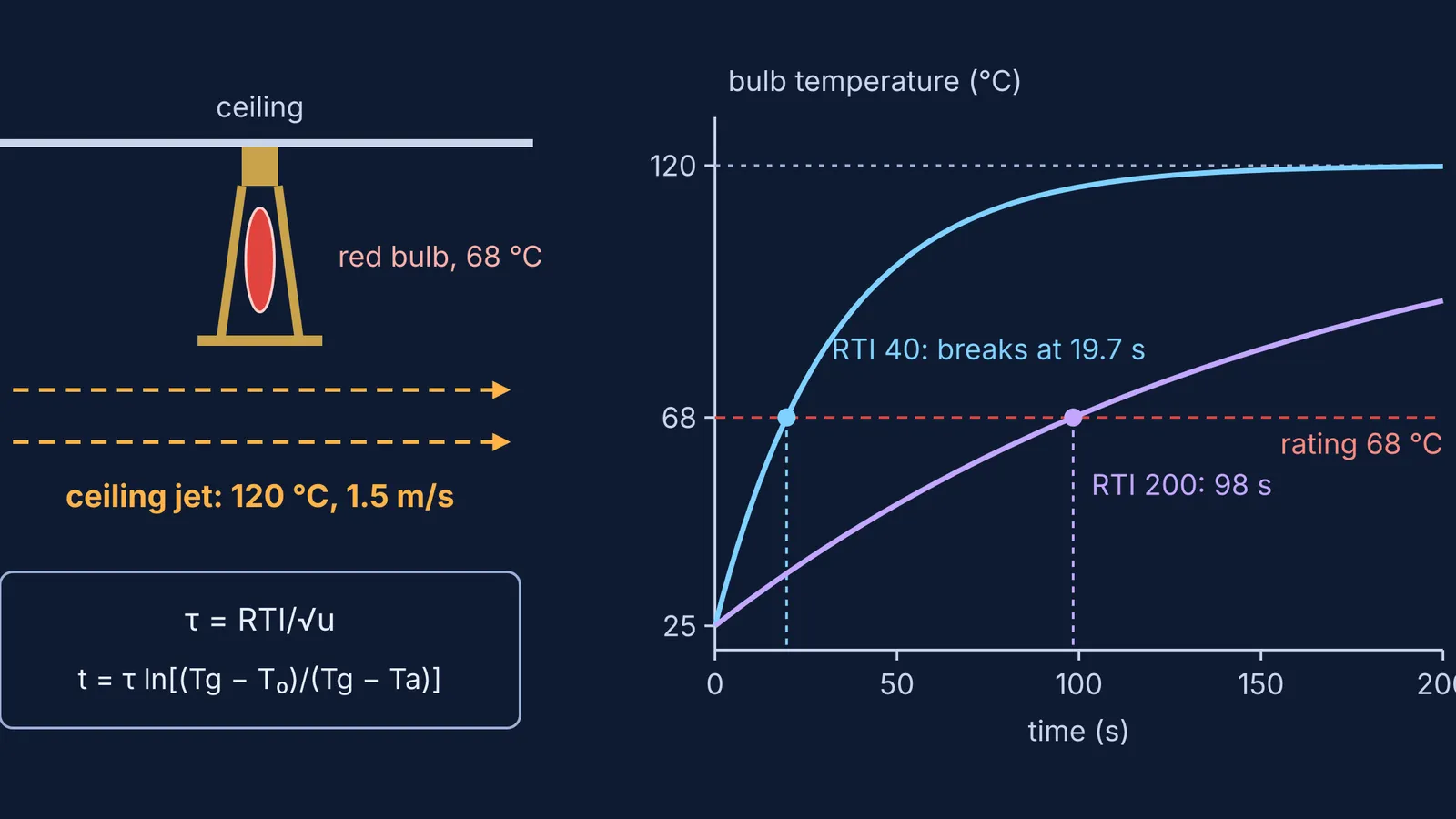
Given (illustrative values): a ceiling jet at T_g = 120 °C moving at u = 1.5 m/s; room and bulb initially at T₀ = 25 °C; bulb rated T_a = 68 °C (red). Compare a quick-response bulb with RTI 40 and a standard-response bulb with RTI 200. Both RTIs sit inside the NFPA 13 bands; the exact values are illustrative.
Time constants. τ = RTI/√u. √1.5 = 1.225. Quick: τ = 40/1.225 = 32.7 s. Standard: τ = 200/1.225 = 163 s.
Set the bulb temperature equal to the rating. T_g − T_a = (T_g − T₀) e^(−t/τ).
Solve for t. t = τ ln[(T_g − T₀)/(T_g − T_a)] = τ ln(95/52) = 0.603τ.
Quick response. t = 0.603 × 32.7 ≈ 19.7 s.
Standard response. t = 0.603 × 163 ≈ 98 s.
Faster gas. At u = 3.0 m/s, every τ falls by a factor of √2: 13.9 s and 69.6 s.
Check. RTI in (m s)^½ divided by √u in (m/s)^½ leaves seconds, as a time constant should.
Both bulbs carry the same "68 °C" label, yet one breaks about five times sooner. In a growing fire, that difference is more than a minute of extra burning before water arrives. The flashover post shows why a minute can matter.
Real fires do not heat the ceiling jet in one step; the gas warms gradually, so the step model gives a lower limit on the time. Full models also add heat lost to the sprinkler's metal frame.
Where does the force to break the glass come from?
The bulb is almost full of liquid, with a small vapour bubble. As the liquid warms, the bubble shrinks. Once it is gone, the liquid has nowhere to go, and its pressure rises fast. The increase is about Δp = BγΔT, where B is the bulk modulus and γ the volume expansion coefficient.
With illustrative values of B = 2 GPa and γ = 5 × 10⁻⁴ K⁻¹ (the real liquids are proprietary), Δp ≈ 2 × 10⁹ × 5 × 10⁻⁴ = 1 × 10⁶ Pa, about 1 MPa per kelvin, roughly ten atmospheres for every degree. A few degrees past the point where the bubble vanishes, the glass cannot hold.
Do all the sprinklers go off at once?
No, and this is a common film myth. Each bulb responds only to the gas around it. NFPA's fact sheet says home fire sprinklers operate independently, that typically only the sprinkler closest to the fire will activate, and that sprinklers do not operate in response to smoke, cooking vapours, steam or the sound of a smoke alarm (NFPA, The Truth About Home Fire Sprinklers, 2024). The physics agrees: a bulb far from the plume sits in cooler, slower gas, so its time is longer, or infinite if the gas never reaches the rating.
To practise exponential heating and cooling problems, the Fermi Problem Library has a step-by-step solver that explains the reasoning. For JEE, Fermi Test Prep offers personalised preparation for JEE Main & Advanced with an AI tutor, live classes, adaptive mocks, mentorship and a study plan that updates based on mastery.
Quick checklist
Bulb heating: T_g − T = (T_g − T₀)e^(−t/τ), Newton's law in reverse.
RTI = τ√u; NFPA 13: fast response at or below 50 (m s)^½, standard at or above 80.
Breaking time t = τ ln[(T_g − T₀)/(T_g − T_a)], not τ itself.
Faster gas, shorter τ: doubling u divides τ by √2.
Bulb colour gives the rating (red is 68 °C); RTI gives the speed.
Only sprinklers heated past their rating open.


