

On this page
Try this before you read on. Car A drives at 50 km/h into a concrete wall. Car B, identical, drives at 50 km/h into an identical car coming the other way, also at 50 km/h. Which driver takes the bigger hit? Pick one: A is worse, B is worse, or they are the same.
Most people pick B: the closing speed is 100 km/h, so it feels like a 100 km/h crash. That intuition is wrong, and the reason is a good Class 11 momentum exercise.
Is a head-on crash with an identical car worse than hitting a wall?
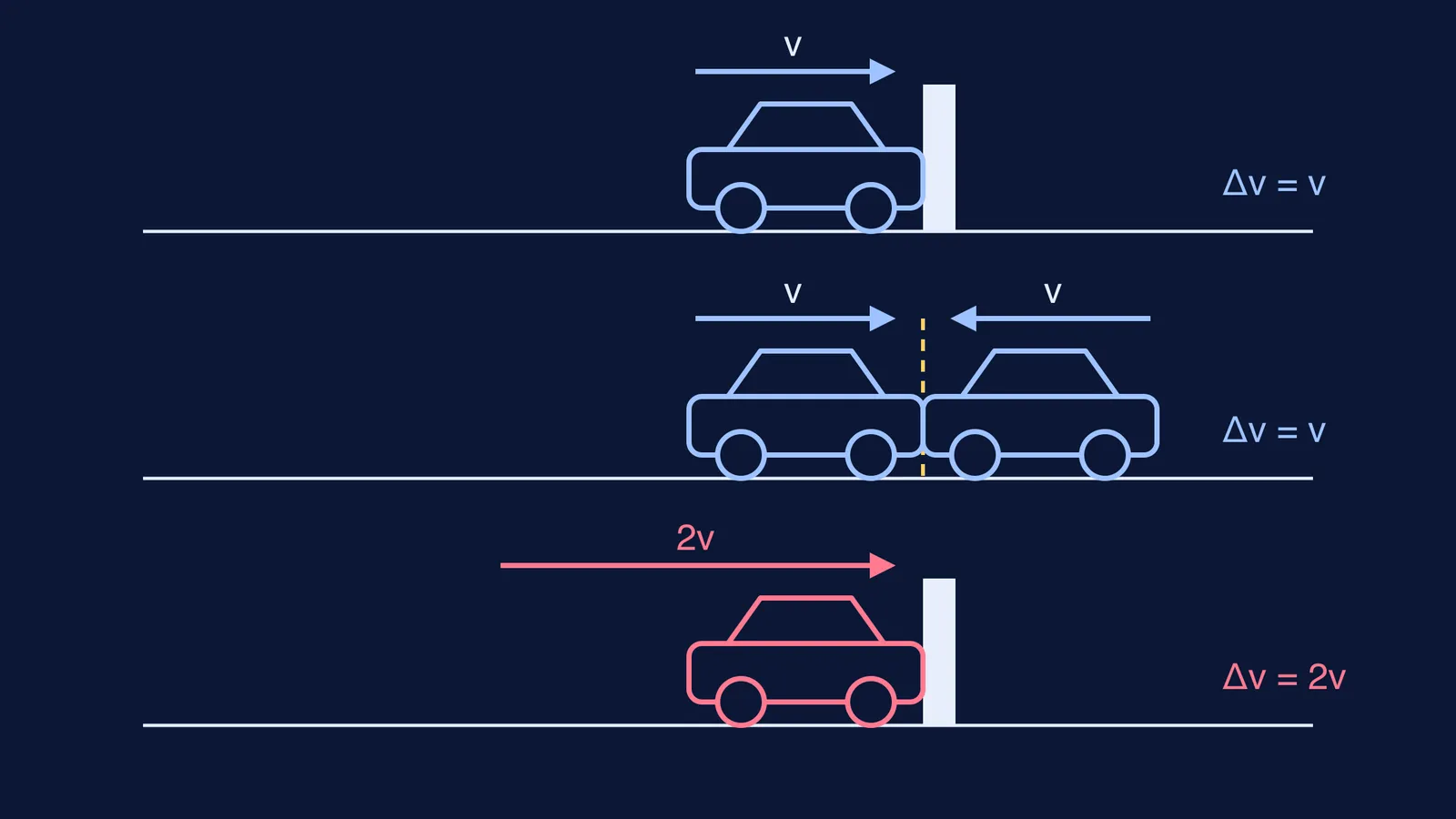
No. If the two cars have equal mass and speed and meet squarely, each car goes through the same crash as hitting a rigid wall at its own speed.
The quickest argument is symmetry. The plane where the two bumpers meet has a mirror image on either side, so it cannot move either way. To each car, it is a wall.
MythBusters tested this with real cars in Episode 143, aired on 5 May 2010: two cars colliding head-on at 50 mph each suffered damage matching a single car that hit a wall at 50 mph (MythBusters results archive).
Crash-test labs use the same idea. The Insurance Institute for Highway Safety says its original moderate overlap test, in which a car hits a stationary barrier at 40 mph, represents an offset crash between two vehicles travelling in opposite directions at a little under 40 mph each (IIHS test description).
How do you compare the forces?
Use the impulse-momentum theorem: average force equals change in momentum divided by the time it takes, F = Δp/Δt (OpenStax University Physics, section 9.2).
Take a 1,200 kg car at 50 km/h (13.9 m/s), and assume its front crumples by 0.5 m while it stops, with steady deceleration.
Wall at 50 km/h: the car goes from 13.9 m/s to 0. Deceleration a = v²/2d = 13.9² ÷ 1.0 ≈ 193 m/s², about 20 g. Stopping time 2d/v ≈ 0.072 s. Average force on the car ≈ 1,200 × 193 ≈ 230 kN.
Identical car, both at 50 km/h: the contact plane stays still, so each car still goes from 13.9 m/s to 0 over its own 0.5 m of crumple zone. Same Δp, same Δt, so the same 230 kN on each car. Each car pushes on the other equally hard; nobody feels a doubled force.
Wall at 100 km/h: the speed doubles to 27.8 m/s, so deceleration is 27.8² ÷ 1.0 ≈ 772 m/s², about 79 g, and the force is about 930 kN. That is four times the 50 km/h force, assuming the same 0.5 m crumple.
Energy agrees. The two-car crash has twice one car's kinetic energy, shared between two crumple zones, so each absorbs ½mv², as with the wall.
When is a head-on crash worse than a wall?
The answer assumes equal masses and a target that stays put.
Different masses. A 2,000 kg SUV and a 1,000 kg hatchback meet head-on at 50 km/h each and lock together. Momentum is conserved, so the wreck moves at (2,000 − 1,000) × 13.9 ÷ 3,000 ≈ 4.6 m/s in the SUV's direction. The SUV's speed changes by about 9.3 m/s; the hatchback's by about 18.5 m/s, worse than hitting a wall at 50 km/h. The forces are equal and opposite, but half the mass means twice the acceleration. As IIHS puts it, "the heavier vehicle will push the lighter one backward during the impact" (IIHS on vehicle size and weight).
A target that moves. Hit a parked identical car at 50 km/h and the pair moves off at 25 km/h. Each car's speed changes by only 25 km/h: milder than the wall.
To see where the lost energy goes in each case, work through our post on kinetic energy lost in a perfectly inelastic collision. If "equal and opposite forces but unequal damage" still feels odd, read how to spot Newton's third law pairs.
Why does this matter on Indian roads?
Head-on collisions accounted for 15.7% of road accident deaths in India in 2022, according to the Ministry of Road Transport and Highways report covered by IANS. The physics above shows why a lighter vehicle comes off worse in one.
How can you practise predicting collisions?
Use this routine on any collision question, including JEE Main numericals.
Write your prediction and one sentence of reasoning before you calculate anything.
Look for symmetry: is there a plane that does not move?
Find each object's change in velocity, not the closing speed.
Only then use F = mΔv/Δt and compare.
Then change one thing at a time: make one car a truck, or park the second car. Collisions are easier to see than to read; the Fermi Simulation Lab has interactive simulations for ideas like this, and our elastic and inelastic collisions simulation guide shows what to try. If your numbers differ from ours, the Fermi Problem Library has worked problems with a step-by-step solver that explains the reasoning rather than printing an answer.


