On this page
A steel box full of people glides up ten floors of your apartment block, pulled by a surprisingly modest motor. The reason is hidden in the shaft: a heavy block moving the opposite way, called the counterweight.
What does a lift counterweight actually do?
In a traction lift, steel ropes run from the top of the car, over a grooved wheel (the sheave) turned by the motor, and down to the counterweight. Car and counterweight hang on opposite sides of the wheel, like two buckets on a well pulley. When the car rises one floor, the counterweight falls one floor.
The counterweight's weight is set by the weight of the empty cab plus 40 to 50% of its rated passenger load, according to TK Elevator's guide to counterweights. The same page says a counterweight "gives balance to the elevator system" and "reduces the effort required by the lifting machine".
So the motor never lifts the car on its own. It only supplies the force for the imbalance: the heavier side minus the lighter side.
Why does a counterweight save energy?
Lifting a mass m through a height h at steady speed takes work W = mgh, and that work is stored as gravitational potential energy, as OpenStax College Physics explains.
With a counterweight, the car gains potential energy while the counterweight loses almost the same amount, so the motor provides only the difference, plus friction. Without one, the motor would supply the car's full mgh on every trip up, then brake the car on every trip down.
How much work does the motor do per floor?
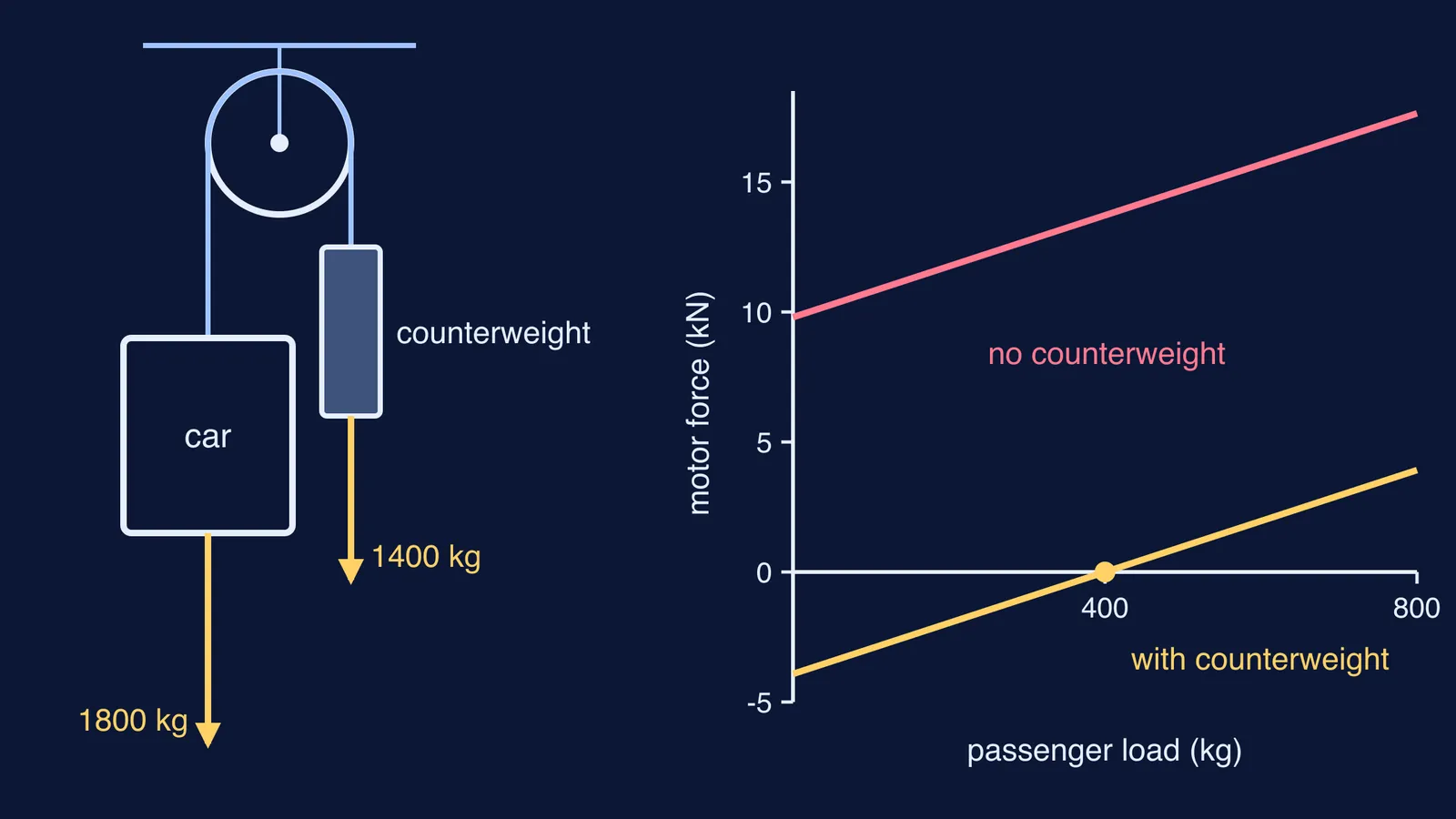
Take an imaginary lift with easy numbers (ours, for illustration): an empty car of 1,000 kg, a rated load of 800 kg, one floor of 3 m, and g = 9.8 m/s². Using a 50% balance, the top of the range above, the counterweight is 1,000 + 400 = 1,400 kg.
For one floor, the motor's work is mgh for the imbalance mass: mass × 9.8 × 3, or 29.4 J per kilogram of imbalance.
Empty car, no counterweight: 1,000 × 29.4 = 29,400 J, about 29 kJ.
Full car (1,800 kg), no counterweight: 52,920 J, about 53 kJ, with a rope pull of about 17.6 kN.
Half-full car (1,400 kg), with counterweight: imbalance 0, so almost no work apart from friction.
Full car, with counterweight: imbalance 400 kg, so 11,760 J, about 12 kJ, with a pull of about 3.9 kN.
Empty car, with counterweight: now the counterweight side is 400 kg heavier. The motor must hold the car back on the way up, and does about 12 kJ of work to bring the empty car down.
Across every load from empty to full, the largest force the motor must supply falls from about 17.6 kN to about 3.9 kN, roughly four and a half times smaller. The diagram above plots these two lines.
Case 5 is the surprise: a counterweighted lift spends energy bringing an empty car down. The trade is worth it because the worst case either way is far smaller. To turn these joules into a power rating and an electricity bill, see our worked guide to the energy a lift motor uses per floor.
Is balancing half the load always best?
Not always. In a 2016 conference paper, Toni Tukia and colleagues modelled lift energy use from passenger traffic in a case office building. Their abstract reports that a substantial share of the electricity went into things other than carrying passengers, mainly because average loads were low while counterbalances were heavy. With an optimally sized counterbalance, the modelled improvement "nearly equals the regenerative system with approximately 60% total savings in the case office building".
The lesson: the best balance point depends on the loads a lift usually carries, which can sit well below half its maximum.
How do you solve counterweight problems in exams?
Lift and counterweight questions are Atwood-machine questions in disguise. A checklist:
Draw one free-body diagram for each side, with the same tension T in the rope over an ideal, massless pulley.
Write Newton's second law for each side and add the two equations; T cancels and you are left with the weight difference driving both masses.
For energy, find the change in potential energy of the whole system: (car mass minus counterweight mass) × g × h.
Divide work by time for power, then by efficiency for the electrical input, as in these power and efficiency problems with motors, pumps and lifts.
Check the sign: if the counterweight is heavier, the motor brakes on the way up.
If two masses trading potential energy over a pulley is hard to picture, the Fermi Simulation Lab has interactive simulations for ideas that are easier to see than to read. If your method keeps going wrong, the Fermi Problem Library has worked problems with a step-by-step solver that explains the reasoning.
Counterweights solved the effort problem; safety was a separate invention. For that half of the story, read about Elisha Otis and the elevator that would not fall.