

On this page
If you step into an elevator, you might assume the motor on the roof has to lift your entire weight plus the heavy steel car. But an elevator is not just a box on a string. It is essentially one of the classic Atwood machine problems: tension, acceleration and three variations playing out in the real world.
There is a counterweight hidden in the shaft. Because of this balance, the active energy used to move you from the ground to your office is surprisingly small, but the total energy an elevator uses in a day is surprisingly large.
What is the energy used by a lift motor to raise people per floor?
To calculate the energy used for a trip, we first need to find the unbalanced mass.
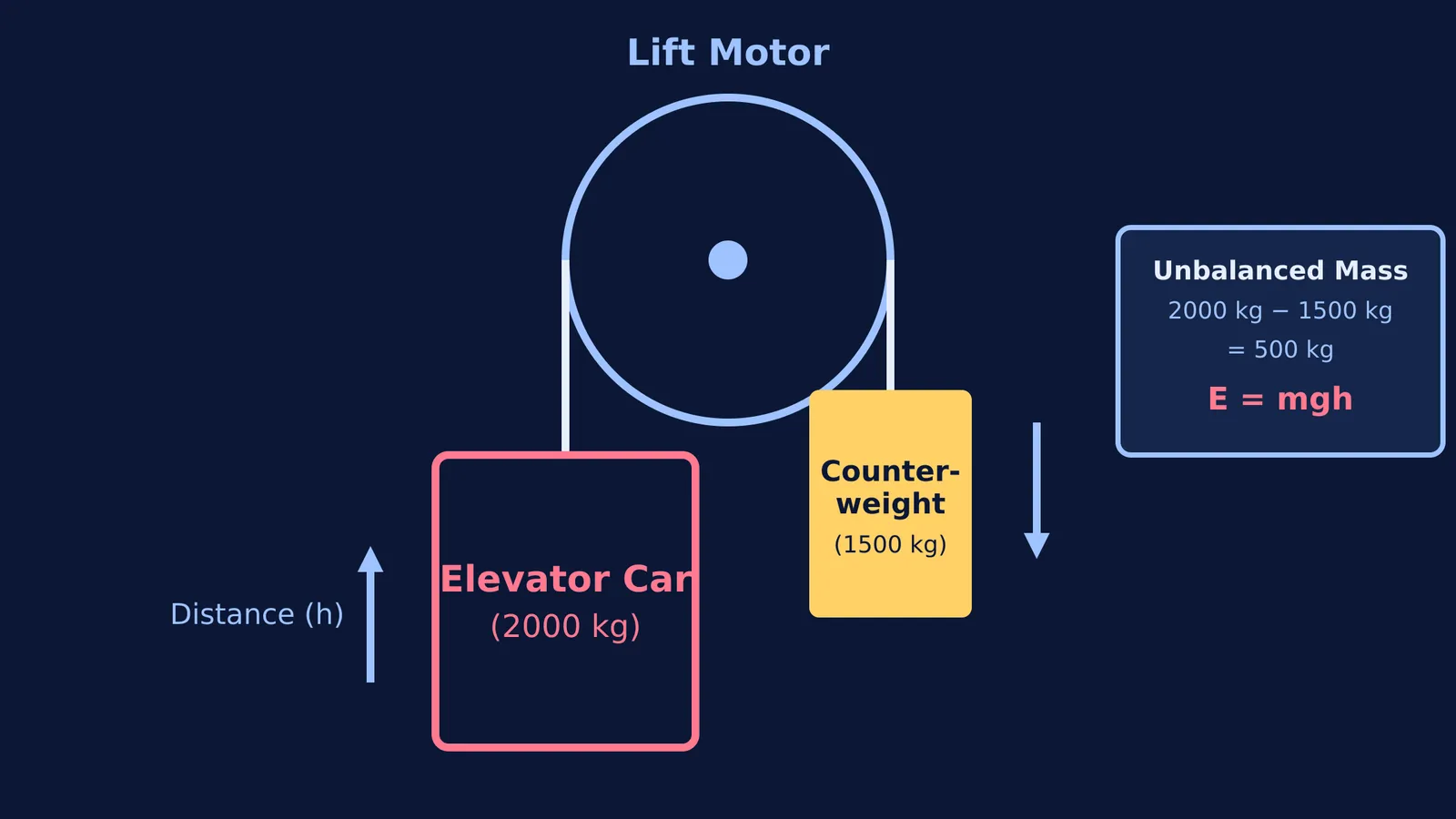
An elevator counterweight is usually set to equal the mass of the empty car plus 50% of its maximum passenger load. For a typical commercial lift, the empty car might have a mass of 1,000 kg, and the maximum load might be 13 people (about 1,000 kg). This makes the counterweight 1,500 kg.
If a fully loaded car (2,000 kg total) needs to go up, the heavy 1,500 kg counterweight falls downwards, naturally pulling the car up with it. The motor does not have to lift 2,000 kg; it only has to lift the unbalanced difference, which is 500 kg.
When analysing a lift, deciding When to use energy conservation instead of Newton's laws makes the math much faster. The work done against gravity is simply the change in potential energy.
The physics formula for this gravitational potential energy is E = mgh.
m (mass) = 500 kg
g (gravity) = 9.8 m/s²
h (height of one floor) = 3 metres
E = 500 × 9.8 × 3 = 14,700 Joules.
How do you convert mgh to kWh?
The result of the mgh formula is in Joules, but electricity is measured and billed in kilowatt-hours (kWh).
One kWh is equal to 3,600,000 Joules. To find the electrical energy needed for that one floor of travel, we divide the Joules by this conversion factor: 14,700 ÷ 3,600,000 = 0.00408 kWh.
However, elevator motors and their gearboxes are not perfectly efficient. Some energy is lost as heat due to friction and electrical resistance. If the motor operates at 80% efficiency, we divide the theoretical energy by the efficiency to find what the system actually draws from the grid: 0.00408 ÷ 0.80 = 0.0051 kWh.
A modern traction elevator motor uses about 0.005 kWh of electricity to raise a fully loaded car by one floor. If you need to calculate the Instantaneous power from force and velocity vectors, you would divide this energy by the seconds it takes to make the trip, but the total energy consumed per floor remains a tiny fraction of a unit.
If you are learning the physics of counterweights, pulleys, and energy conservation, the Fermi Problem Library has worked problems with a step-by-step solver that explains the reasoning rather than printing an answer.
Framework: Calculating Elevator Energy Use for a Science Project
If you are designing a physics project to model elevator efficiency, follow these four steps to calculate the energy profile:
Find the unbalanced mass: Subtract the counterweight mass from the total car mass (empty car plus passengers). The absolute value is the mass the motor must actively lift.
Calculate the Joules: Multiply the unbalanced mass by 9.8 m/s² and the total vertical distance in metres to find the work done (E = mgh).
Convert to kWh: Divide the Joules by 3,600,000 to match the units on an electricity bill.
Adjust for efficiency: Divide the result by the motor's efficiency (typically between 0.75 and 0.90) to find the true power drawn from the grid.
Why does an elevator use 20 kWh a day?
If lifting a heavy load up one floor takes just 0.005 kWh, you might expect an elevator's daily energy bill to be close to zero. But elevators are known as heavy power consumers in commercial buildings.
A comprehensive study published by the American Council for an Energy-Efficient Economy (ACEEE) found that a standard commercial elevator consumes about 7,600 kWh per year, which averages out to roughly 20 kWh per day.
If active lifting costs 0.005 kWh per floor, 20 kWh would be enough energy to travel 4,000 floors every day. A typical lift makes nowhere near that many trips. So where does the rest of the energy go?
The ACEEE study revealed that the vast majority of the electricity is used while the elevator is sitting completely idle. The standby power running the bright cabin lights, ventilation fans, floor displays, and electronic control panels often draws between 1 to 2 kW continuously. Over a 24-hour period, these idle systems drain far more power from the grid than the heavy motor does lifting people.
When a fully loaded car goes up, the motor works hard. But what happens when that same loaded car comes back down? The 2,000 kg car is heavier than the 1,500 kg counterweight. Gravity pulls the car down, and the motor does not need to pull; it only needs to brake. In modern elevators with regenerative drives, this braking action turns the motor into a generator, sending electricity back into the building's grid. The same generation happens when an empty car goes up, because the heavy counterweight is falling.


