

On this page
How do you find instantaneous power from force and velocity?
Power measures the rate at which an applied force transfers energy or performs work. When an external force F acts on a body undergoing an infinitesimal displacement dr over a time interval dt, the mechanical work done is dW = F · dr. Taking the time derivative of work yields the instantaneous power P = dW/dt = F · (dr/dt). Because dr/dt equals the instantaneous velocity v, power simplifies directly to the scalar dot product P = F · v.
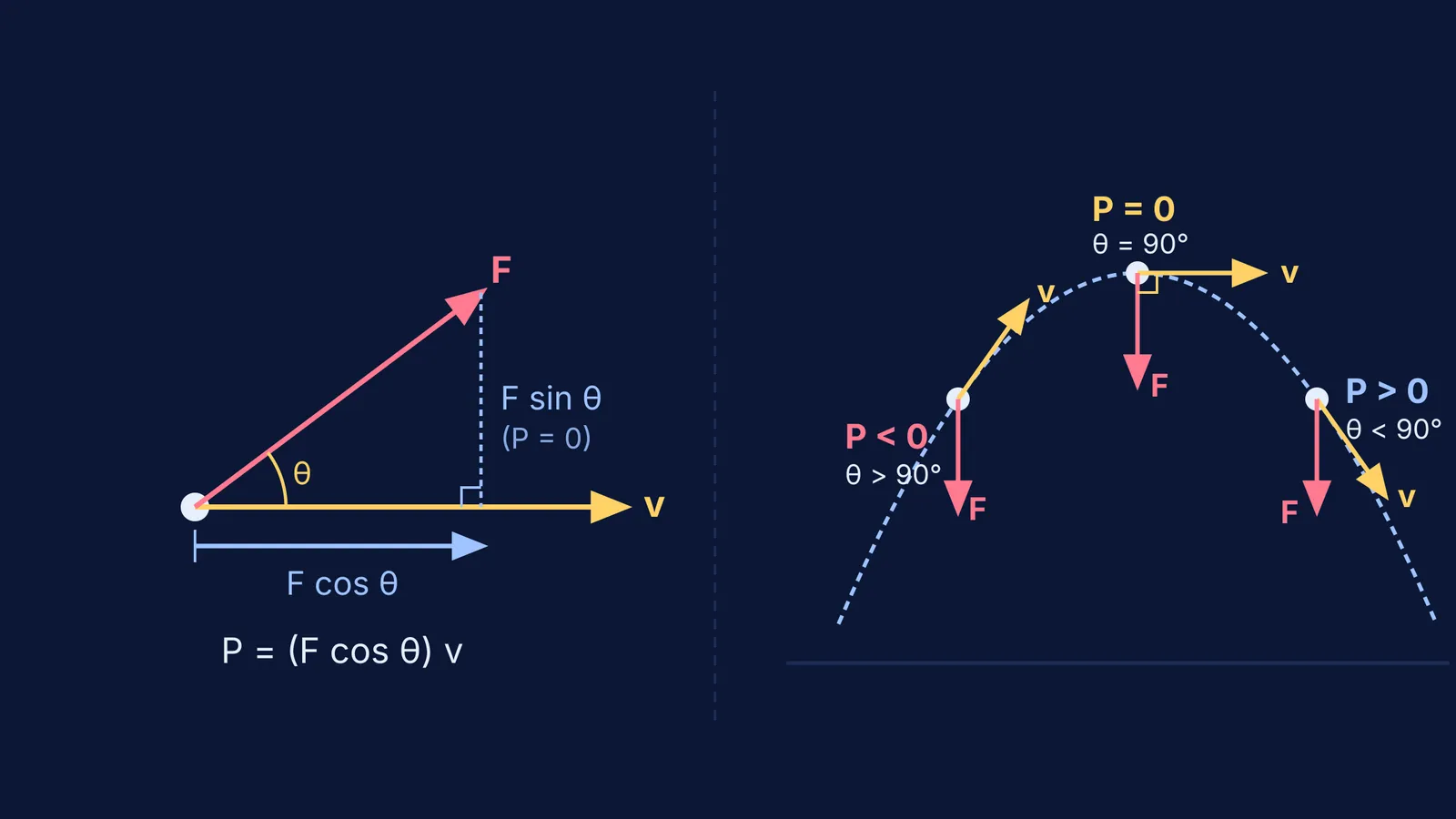
According to the NCERT Class 11 Physics textbook (Section 5.10), instantaneous power is a scalar quantity defined by P = F v cos θ, where θ is the angle between the force and velocity vectors. In three-dimensional Cartesian coordinates, this scalar product expands across each orthogonal axis:
P = F_x v_x + F_y v_y + F_z v_z
As specified in the NIST Guide to the SI (Special Publication 811) Table 3, the coherent SI derived unit of power is the watt (symbol W), defined as 1 joule per second (1 J/s) or 1 m² · kg · s⁻³ in SI base units. For students mastering multi-dimensional mechanics, the Fermi Concept Library maps every concept in physics and mathematics, each with its own lesson and its place in the map.
Why does a perpendicular force deliver zero instantaneous power?
As detailed in OpenStax University Physics Volume 1, when force and velocity are not parallel, resolve the force into components along and perpendicular to the direction of motion:
Tangential component (F_parallel = F cos θ): Lies along the velocity vector, directly changing the body's speed and kinetic energy.
Normal component (F_perp = F sin θ): Perpendicular to the velocity vector, changing only the direction of motion without performing work.
Because the angle between F_perp and v is 90°, cos 90° = 0, meaning perpendicular forces deliver zero instantaneous power. This geometric property explains why centripetal forces in uniform circular motion and magnetic Lorentz forces on charged particles do no work. The relative orientation θ completely dictates the sign and energetic role of the delivered power:
Acute angle (θ < 90°): cos θ > 0 and P > 0. The force accelerates the body and delivers positive power.
Right angle (θ = 90°): cos θ = 0 and P = 0. The force causes normal acceleration only, neither adding nor removing kinetic energy.
Obtuse angle (θ > 90°): cos θ < 0 and P < 0. The force opposes motion and drains kinetic energy from the object.
Consider a projectile launched into the air under gravity, as explored in our guide to motion in a plane from position vectors. On the upward trajectory, downward gravity forms an obtuse angle with upward velocity, delivering negative power and slowing the object down. At the apex, velocity is strictly horizontal, making it perpendicular to gravity (θ = 90°), so the instantaneous power delivered by gravity is exactly 0 W. During descent, θ is acute, delivering positive power that increases kinetic energy.
How do you calculate average power when velocity varies over time?
While instantaneous power captures the energy transfer rate at a specific instant, average power measures the aggregate work done over an extended duration. As detailed in OpenStax University Physics Volume 1 Section 7.4, average power P_avg over an elapsed time interval from t = 0 to t = T is given by:
P_avg = W / Δt = (1 / T) ∫₀ᵀ P(t) dt
When evaluating the resultant force acting on a particle, the work-energy theorem provides an alternative route that bypasses time integrals. Because net work equals the total change in kinetic energy (W_net = ΔK = (1/2) m v_f² − (1/2) m v_i²), the average power delivered by the resultant force simply equals ΔK / Δt.
This distinction is crucial when comparing variable acceleration with motion at constant power or evaluating curves under work from force-displacement graphs.
How do you solve a variable force and velocity problem step by step?
Standard mechanics problems in competitive examinations require combining vector differentiation, scalar dot products, and time integration, following the NCERT Class 11 Physics curriculum.
Problem: A particle of mass m = 2 kg moves in the xy-plane with position vector r(t) = (3 t² i + 2 t³ j) meters. Find the instantaneous power at t = 1 s and the average power delivered by the resultant force from t = 0 to t = 2 s.
Velocity vector: Differentiating position r(t) with respect to time yields velocity v(t) = dr/dt = (6 t i + 6 t² j) m/s.
Resultant force vector: Differentiating velocity yields acceleration a(t) = dv/dt = (6 i + 12 t j) m/s², so by Newton's second law F(t) = m a(t) = (12 i + 24 t j) newtons.
Instantaneous power function: Compute the scalar product P(t) = F · v = F_x v_x + F_y v_y = (12)(6 t) + (24 t)(6 t²) = 72 t + 144 t³ watts.
Instantaneous power at t = 1 s: Substituting t = 1 s yields P(1) = 72(1) + 144(1)³ = 216 W. Notice that at t = 1 s, v = (6 i + 6 j) m/s and F = (12 i + 24 j) N. Because their components are not proportional, F and v are not parallel, yet P = F · v yields the exact rate.
Average power from t = 0 to t = 2 s: Integrating power gives total work W = ∫₀² (72 t + 144 t³) dt = [36 t² + 36 t⁴]₀² = 36(4) + 36(16) = 144 + 576 = 720 J. Dividing by Δt = 2 s yields P_avg = 720 J / 2 s = 360 W.
Work-energy verification: At t = 0, speed is 0 m/s and K = 0 J. At t = 2 s, v(2) = (12 i + 24 j) m/s, so |v|² = 12² + 24² = 720 m²/s². Final kinetic energy is (1/2) (2 kg) (720 m²/s²) = 720 J. Thus ΔK = 720 J, confirming P_avg = 720 J / 2 s = 360 W.
Taking the naive arithmetic mean (P(0) + P(2)) / 2 gives (0 + 1296) / 2 = 648 W, an 80% error that severely overestimates energy delivery. The Fermi Problem Library provides worked problems with a step-by-step solver that explains the reasoning rather than printing an answer, helping students master multi-dimensional vector dynamics.


