

On this page
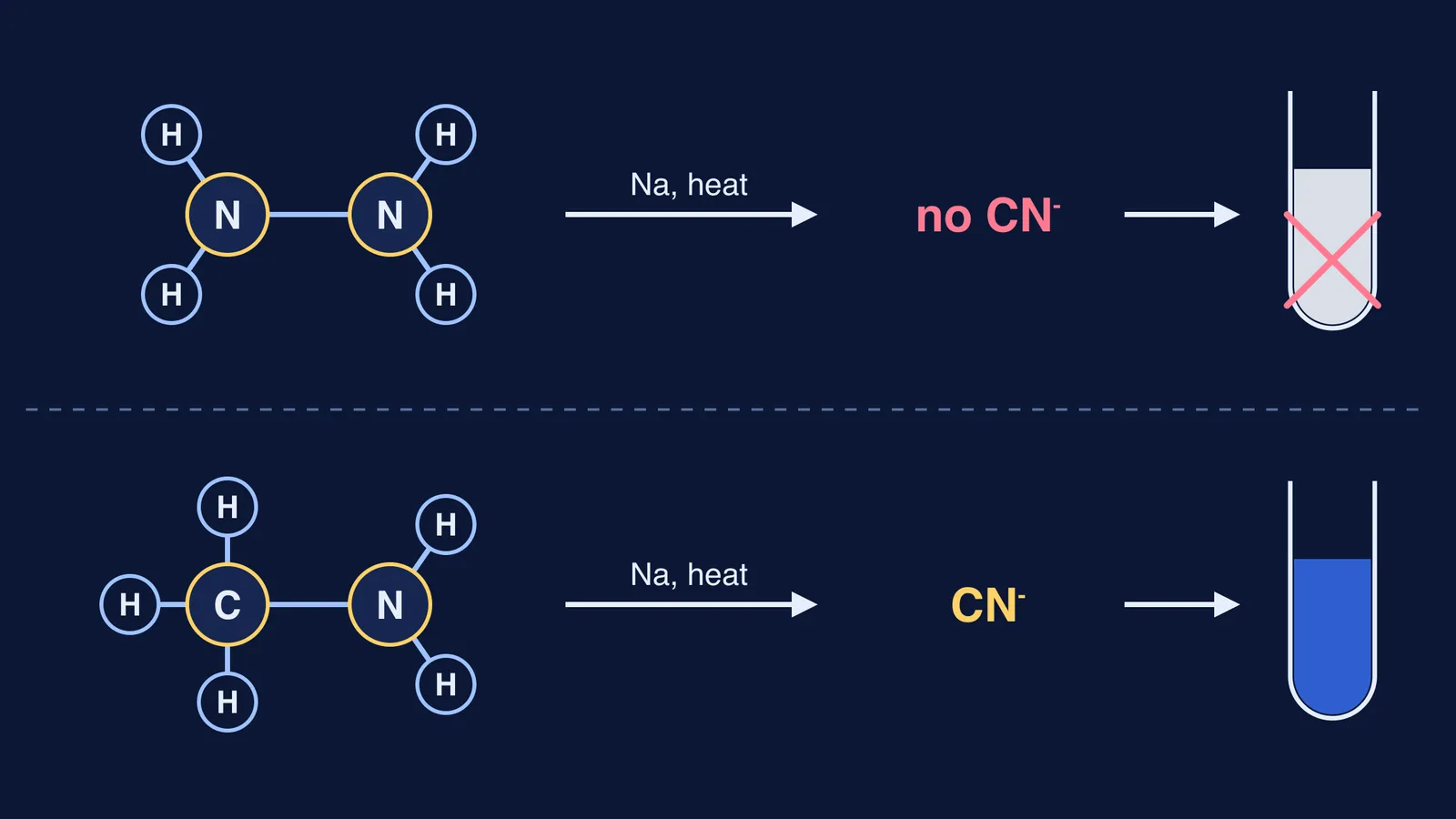
Hydrazine is a classic trick option in exam questions on Lassaigne's test. It clearly contains nitrogen, yet the test says “no nitrogen”. The reason is not a mistake in the lab. The test never looks for nitrogen directly. It looks for cyanide, and cyanide needs carbon.
Why does hydrazine not give Lassaigne's test for nitrogen?
In Lassaigne's test you fuse the compound with sodium metal, so that the elements in it change from covalent to ionic form. NCERT's Class 11 chemistry, Unit 8 writes the nitrogen step as Na + C + N → NaCN, and notes that the C and N both come from the organic compound.
PubChem's record for hydrazine (CID 9321) gives its molecular formula as H4N2, usually written N2H4 or NH2NH2. It has two nitrogen atoms and four hydrogen atoms, and no carbon at all.
No carbon means no cyanide ion, and no cyanide ion means no Prussian blue. As BYJU'S summary of the test puts it, both C and N are needed to form the CN⁻ ion, so NH2NH2 does not answer the test despite having nitrogen.
What does the Prussian blue step actually detect?
According to NCERT Unit 8, section 8.9.2, you boil the sodium fusion extract with iron(II) sulphate and then acidify it with concentrated sulphuric acid. Sodium cyanide first forms sodium hexacyanidoferrate(II). On heating with the acid, some iron(II) is oxidised to iron(III), which reacts with it to give iron(III) hexacyanidoferrate(II), the Prussian blue.
Every step needs CN⁻. So whenever you meet a “nitrogen present but test negative” question, ask one thing: could this compound have delivered cyanide ions to the extract? If you want to revise the full sodium fusion scheme first, our explainer on how Lassaigne's test detects nitrogen, sulphur and halogens walks through the tests.
Which other compounds give a false negative?
The same “where is the cyanide?” question explains the other usual exceptions.
Nitrogen compounds with no carbon. Hydrazine is the textbook case. The logic applies to any compound that has N but no C, as BYJU'S notes.
Diazonium salts. They decompose and give off nitrogen gas on heating, so the nitrogen leaves before it can form cyanide (BYJU'S).
Compounds with both nitrogen and sulphur. Fusion can form sodium thiocyanate instead. It gives a blood red colour with iron(III) and no Prussian blue, because there are no free cyanide ions (NCERT Unit 8). This is not truly a negative: the red colour shows both elements. NCERT adds that fusing with excess sodium breaks thiocyanate down into cyanide and sulphide, which then give their usual tests.
Very volatile compounds. A 1969 review of the technique in the Journal of Chemical Education by R. P. Gower and I. P. Rhodes warns that a very volatile sample can be lost from the ignition tube before it reacts with sodium.
Nitro compounds with little carbon. The same review notes that highly substituted nitro compounds with low carbon content give better results when a little liquid paraffin is left on the sodium, which supplies carbon to form cyanide.
Lab technique can also hide a real positive. Gower and Rhodes report that the blue colour is held back when the pH is only just below 7 and when the solution is hot, so they advise excess acid and cooling.
How do you answer a Lassaigne's test question in an exam?
Use this four-question check on each option, in order.
Does the formula contain carbon? If not, no NaCN can form: negative for nitrogen.
Is it a diazonium salt? If yes, nitrogen escapes as N2 on heating: negative.
Does it contain sulphur as well as nitrogen? If yes, expect blood red (thiocyanate), not Prussian blue, unless excess sodium is used.
If none of these apply, expect Prussian blue.
Worked example. Which of these gives Prussian blue in Lassaigne's test with the usual amount of sodium: aniline (C6H5NH2), hydrazine (NH2NH2), thiourea (NH2CSNH2) or benzenediazonium chloride?
Aniline: has C and N, no S. Step 4 applies, so Prussian blue. This is the answer.
Hydrazine: fails step 1, no carbon.
Thiourea: has C, N and S, so step 3 predicts blood red rather than Prussian blue.
Benzenediazonium chloride: fails step 2.
Writing “no C, so no CN⁻” next to the hydrazine option takes a few seconds and stops you from picking it just because it contains nitrogen. The halogen test has its own trap, explained in why nitric acid is added before silver nitrate.
If questions like this keep catching you, go back to the idea behind the test rather than memorising more exceptions. The Fermi Concept Library covers every concept in chemistry, each with its own lesson and its place in the map. For practice, the Fermi Problem Library has worked problems with a step-by-step solver that explains the reasoning rather than printing an answer.
Next time you see NH2NH2 in an option, look for the carbon first.


