

On this page
In the systematic salt analysis of basic radicals, the dimethylglyoxime test provides a striking visual confirmation of the Ni²⁺ ion.
What is the dimethylglyoxime test for nickel?
The standard confirmatory test for the Ni²⁺ ion relies on an organic reagent called dimethylglyoxime (DMG)). To perform the test, you add a few drops of an ethanolic solution of DMG to the suspected nickel salt solution, followed by ammonium hydroxide. The immediate formation of a voluminous, bright rosy red precipitate confirms nickel.
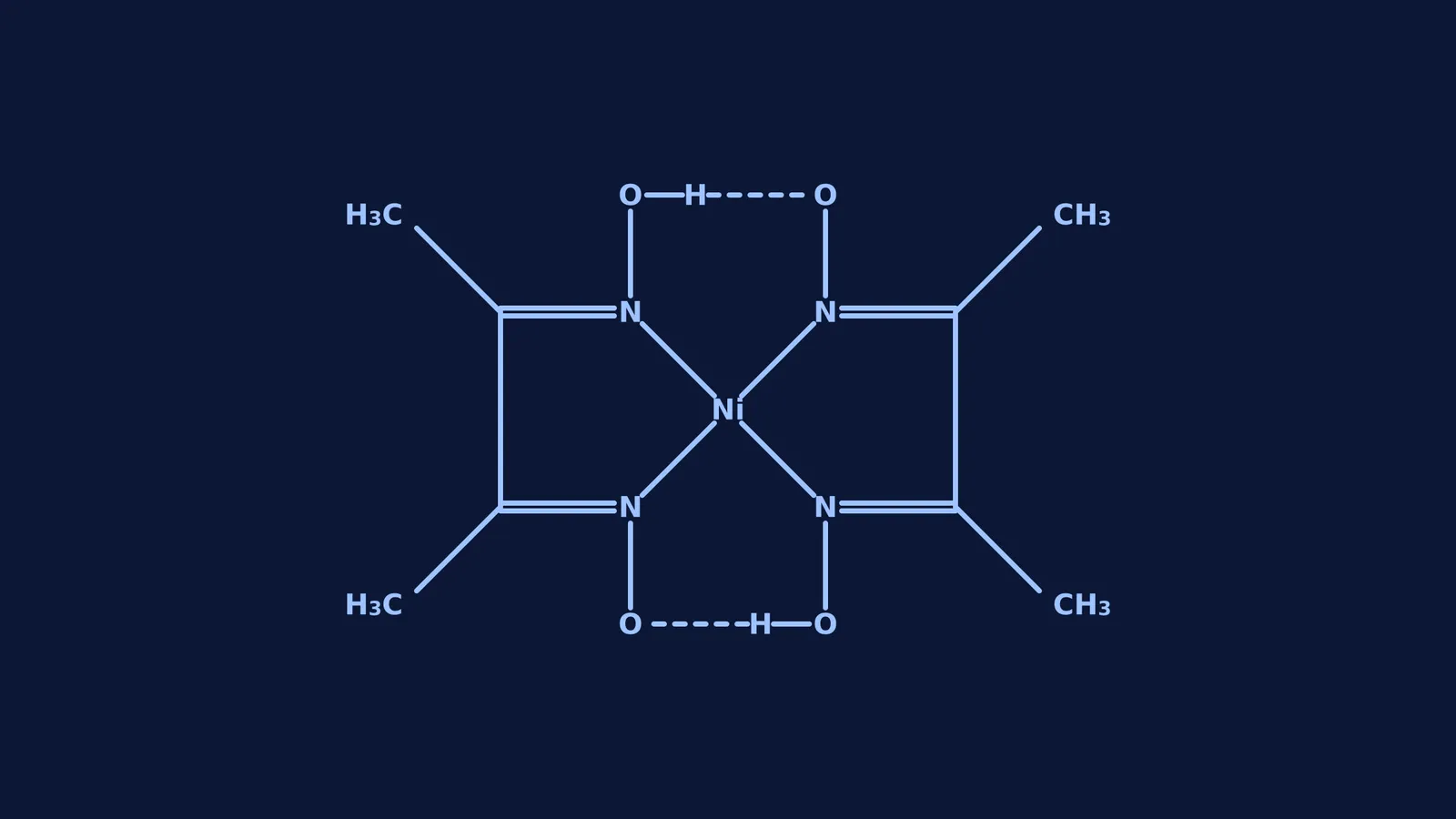
This reaction is highly selective. The rosy red solid is an insoluble coordination complex known as bis(dimethylglyoximato)nickel(II).
Why is ammonium hydroxide added in the DMG test?
The reaction between Ni²⁺ and the DMG ligand) releases hydrogen ions (H⁺). If the solution becomes too acidic, the chemical equilibrium shifts backward, and the red precipitate will dissolve.
Adding ammonium hydroxide (NH₄OH) makes the medium slightly alkaline. This basic medium neutralises the released protons, driving the complex formation forward so the precipitate drops out completely.
What is the structure of the nickel DMG complex?
The structure of Ni(dmgH)₂) is a frequent topic in competitive exams because of its unique chemical features.
Geometry: The nickel(II) ion has a 3d⁸ electron configuration. In the presence of the DMG ligands, it forms a square planar complex.
Chelation: Each DMG molecule acts as a bidentate ligand. It binds to the central nickel atom through its two nitrogen atoms, forming stable five-membered rings.
Hydrogen bonding: The complex achieves remarkable stability through intramolecular hydrogen bonds. The oxygen atom of one DMG ligand forms a hydrogen bond with the hydroxyl group (-OH) of the opposite ligand. This creates a large, planar macrocyclic ring that stacks neatly in the solid state, which is why it is highly insoluble in water.
If geometry and chelation rules feel overwhelming, Fermi's AI tutor can work out what you already know and build a plan for the session, guiding you through the geometry of d⁸ systems step by step. You can also explore the complete map of coordination compounds in the Fermi Concept Library.
How to answer DMG test questions
When you face a question about this test, you need to clearly state the reagent, the medium, the observation, and the nature of the complex. Use this checklist for your answer:
State that the test confirms the Ni²⁺ radical.
Emphasise that the reaction requires a basic medium (NH₄OH).
Note the observation: a bright rosy red precipitate.
Describe the complex: square planar geometry.
Mention the intramolecular hydrogen bonding that stabilises the structure.
Linking this to other practical chemistry concepts can strengthen your exam readiness. For instance, reviewing Counting ionisable chlorides in complexes with AgNO3 and conductivity builds your intuition for coordination compounds. In organic analysis, tests are equally visual; see Tollens' and Fehling's tests: which carbonyl compounds pass them and the Iodoform test: spotting which compounds give the yellow solid.


