

On this page
A car on a curve leans on the road. An aircraft has no road, so to turn it tilts its wings and lets the lift do the work. That tilt is the bank angle. Bank more and the aircraft turns tighter, but the wing must also make more lift, everyone on board feels heavier, and the speed at which the wing stalls goes up. This post works out all three from Newton's second law, and shows why airliners turn with gentle banks of about 25° while aerobatic aircraft go much steeper.
How does a banked aircraft turn?
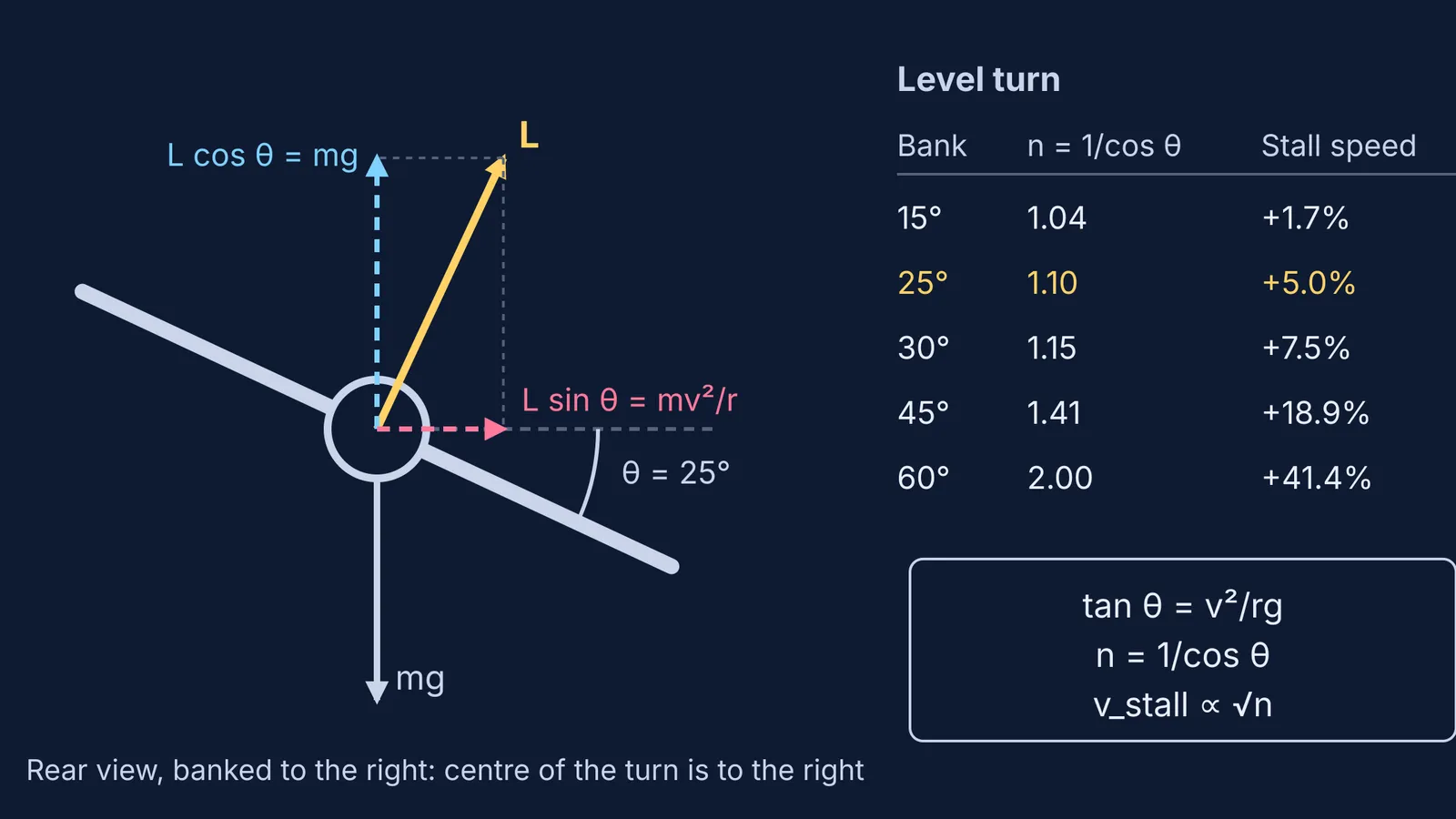
Lift acts at right angles to the wings. In level flight it points straight up and balances the weight. When the aircraft rolls to a bank angle θ, the lift tilts with it, an idea that goes back to George Cayley's lift, drag and thrust. Split the tilted lift L into two parts:
Vertical part: L cos θ. In a level turn, with no climb or descent, this must equal mg.
Horizontal part: L sin θ. Nothing balances it, so it is the centripetal force: L sin θ = mv²/r.
Divide the second equation by the first and the lift and mass cancel:
tan θ = v²/(rg)
This is the same result as for a car on a banked road with no friction. The post on why the banking angle depends on speed, not mass covers that road case, and the same reasoning holds here: a jumbo jet and a small trainer at the same speed and bank fly circles of the same radius.
What is load factor, and why does a 60° bank double your weight?
From L cos θ = mg, the lift in a level turn is L = mg/cos θ. Pilots call the ratio L/mg the load factor, n:
n = 1/cos θ
At 60°, cos θ = 0.5, so n = 2. The wing carries twice the aircraft's weight. The FAA's Pilot's Handbook of Aeronautical Knowledge, chapter 5 gives the same figure: a coordinated level turn at 60° bank means a load factor of 2 G.
You feel this too. The seat pushes on you with a force n × mg, so a 70 kg passenger at 60° bank feels like 140 kg. At 25° the factor is only 1.10. In a well-flown turn the push is along the line from your head to your feet, not sideways. That is why the tea in your cup stays level relative to the tray: the apparent gravity in the cabin is tilted by exactly the bank angle, along with the cabin.
Why does the stall speed go up in a turn?
A wing makes its largest lift just before it stalls. At that point L = ½ρv²SC_L,max, where S is the wing area and C_L,max is the largest lift coefficient the wing can reach. In a turn the wing must make n × mg. At the same air density and wing setting, the lowest speed that still gives enough lift rises as
v_stall (turn) = v_stall (level) × √n
The FAA handbook states it the same way: stalling speed increases in proportion to the square root of the load factor. This holds only if flap setting and configuration stay the same; flaps change C_L,max and so the stall speed itself.
Here is how it grows, from n = 1/cos θ and √n:
15° bank: n = 1.04, stall speed up 1.7%.
25° bank: n = 1.10, up 5.0%.
30° bank: n = 1.15, up 7.5%.
45° bank: n = 1.41, up 18.9%.
60° bank: n = 2.00, up 41.4%.
The numbers stay small up to about 30°, then climb fast. That is the physics behind gentle banks for passenger flights: a modest bank turns the aircraft well, keeps the load on the passengers near 1, and keeps a wide gap above the stall speed.
Worked example: a jet at 720 km/h banked at 15°
An aircraft flies a level circle at 720 km/h with its wings banked at 15°. Find the radius, the time for a full circle, and the apparent weight of a 70 kg passenger. Take g = 9.81 m/s².
Convert the speed. v = 720 ÷ 3.6 = 200 m/s.
Use tan θ = v²/(rg). r = v²/(g tan θ) = 200² / (9.81 × 0.2679) ≈ 15,200 m, about 15.2 km.
Time for one circle. T = 2πr/v = 2π × 15,217 / 200 ≈ 478 s, about 8 minutes. That is a rate of turn of 360/478 ≈ 0.75° per second.
Load factor. n = 1/cos 15° ≈ 1.035.
Apparent weight. N = nmg = 1.035 × 70 × 9.81 ≈ 711 N, compared with 687 N in level flight. The passenger feels like about 72.5 kg.
Check units. v²/g has units (m²/s²)/(m/s²) = m, and tan θ has none, so r is in metres.
A 15° bank at 200 m/s makes a very wide circle. To turn tighter at that speed you need more bank, and so more load factor.
What is a rate one turn, and why does the bank depend on speed?
Air traffic procedures often use a standard rate of turn of 3° per second, which takes 2 minutes for a full circle. The rate of turn is ω = v/r. Put r = v²/(g tan θ) into it:
ω = g tan θ / v, so tan θ = ωv/g
For ω = 3° per second (0.0524 rad/s):
At 140 knots (72 m/s): tan θ = 0.0524 × 72.0 / 9.81, so θ ≈ 21°, with a radius of about 1.4 km.
At 250 knots (129 m/s): θ ≈ 34.5°.
The same answers come from the FAA handbook's rule of thumb, rate of turn = 1,091 × tan θ / (speed in knots). So a fixed rate of turn needs steeper banks at higher speeds. The FAA's Aeronautical Information Manual, section 5-3 handles this for holding patterns by asking for 3° per second, 30° of bank, or 25° of bank when a flight director is used, whichever needs the least bank.
At 250 knots and 25° of bank, ω = 9.81 × tan 25° / 128.6 ≈ 0.0356 rad/s, or 2.0° per second. A full circle takes about 177 s, with a radius of about 3.6 km.
You can practise more circular-motion problems like these in the Fermi Problem Library, which has a step-by-step solver that explains the reasoning. For the force split itself, the same road-and-friction ideas appear in maximum safe speed on a banked road with friction.
Quick checklist
In a level turn: L cos θ = mg and L sin θ = mv²/r, so tan θ = v²/(rg).
Load factor n = L/mg = 1/cos θ; a 60° bank gives n = 2.
Stall speed rises as √n at the same wing setting: 5% at 25°, 41% at 60°.
Rate of turn ω = g tan θ / v, so a fixed rate needs more bank at higher speed.
The push of the seat on you is n × mg, along the cabin floor's normal, not sideways.


