

On this page
Why are propane and butane naturally odourless?
When you turn the valve on a domestic liquefied petroleum gas (LPG) cylinder, the fuel is primarily a mixture of propane and butane. In Class 10 and 11 chemistry, these saturated alkanes share the general formula CₙH₂ₙ₊₂. The structural isomers of butane in Class 10 and carbon compounds and homologous series highlight their physical traits: in their pure chemical states, both hydrocarbons are colourless and completely odourless.
This absence of scent stems from molecular symmetry. Propane (C₃H₈), documented at 44.10 g/mol in the NIST Chemistry WebBook, and butane (C₄H₁₀) contain only non-polar C-C and C-H bonds. Because carbon and hydrogen have close electronegativities (2.55 and 2.20 on the Pauling scale), the electron cloud is balanced. Lacking dipole moments or reactive lone pairs, they interact only through weak dispersion forces. Human olfactory receptors require polar or coordination interactions to send nerve impulses; non-polar alkanes slip past without triggering any smell.
What gives LPG its distinctive rotten-cabbage smell?
Because escaping odourless gas poses a severe fire hazard, distributors add a stenching agent. The standard additive is ethanethiol (ethyl mercaptan). The PubChem compound record notes that ethanethiol (CH₃CH₂SH, CID 6343) boils at 35 °C with a penetrating rotten-cabbage stench. The CDC NIOSH Pocket Guide to Chemical Hazards lists its ceiling exposure limit at 0.5 ppm.
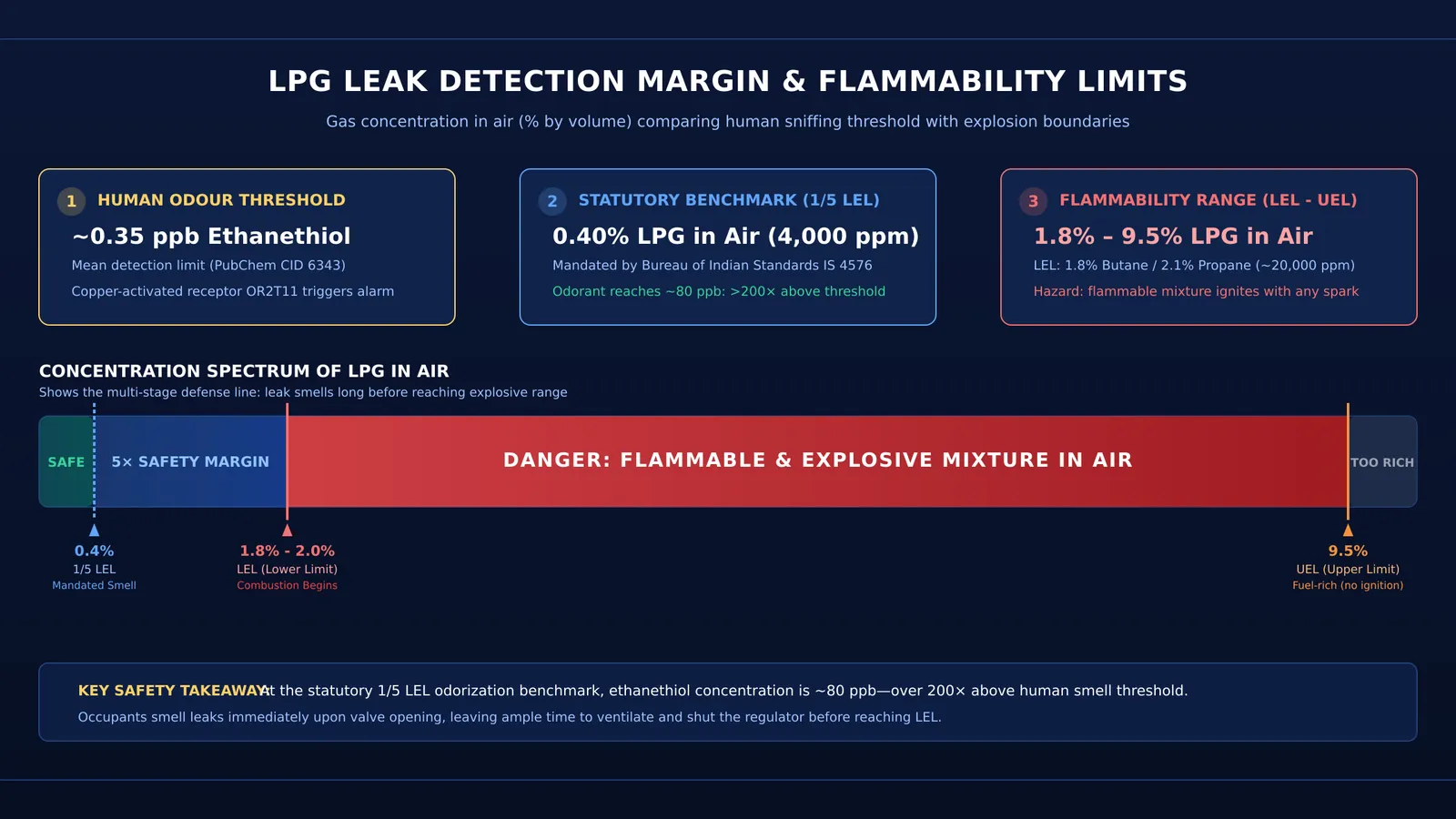
Replacing oxygen in ethanol with sulphur changes human perception completely. While ethanol requires thousands of parts per million (ppm) to smell strong, PubChem records ethanethiol's mean olfactory threshold at 0.00035 ppm—just 0.35 parts per billion (ppb). In 2016, a research team led by Shengju Li discovered that human olfactory receptor OR2T11 relies on copper ions in its binding pocket (Li et al., 2016). Divalent sulphur binds tightly to this copper site, triggering an immediate sensory alarm.
How much ethyl mercaptan is added to LPG cylinders?
The Bureau of Indian Standards specification, IS 4576:1999, mandates at least 20 ppm of ethyl mercaptan (roughly 1 kg per 100 cubic metres of liquid gas) at dispatch. The rule requires that escaping gas be detectable when its air concentration reaches one-fifth (20%) of its Lower Explosive Limit (LEL). For LPG, the LEL is roughly 2.0% (around 1.8% for butane and 2.1% for propane), setting the warning threshold at 0.4% gas in air (4,000 ppm).
The arithmetic guarantees an early warning:
Safety threshold (1/5 LEL): 20% of 2.0% LEL equals 0.40% LPG in air (4,000 ppm).
Odorant concentration: At 4,000 ppm LPG, fuel with 20 ppm odorant yields 0.080 ppm (80 ppb) ethanethiol.
Safety buffer: Since humans smell ethanethiol at 0.00035 ppm (0.35 ppb), the odorant level at one-fifth LEL is over 200 times the sniffing threshold.
In the Fermi Simulation Lab, interactive simulations show how molecular mass affects gas dispersal in enclosed spaces. Our guide to calculating the average molar mass of a gas mixture explains the underlying arithmetic.
What should you do if you smell an LPG leak?
Because heavy LPG vapour pools at floor level, suspected leaks require fast action:
Avoid electrical switches: Do not flip lights, fans, or appliances ON or OFF; switch contacts can spark and ignite pooled vapour.
Extinguish open flames: Put out stove burners, candles, and incense sticks immediately.
Shut the regulator: Turn the regulator switch clockwise to the horizontal 'OFF' position.
Ventilate at ground level: Open doors and low windows wide so heavy vapour escapes outside.
Cap the cylinder: If hissing continues, remove the regulator and snap the safety cap over the valve.
Evacuate and call: Step outside to a safe distance and dial 1906.
According to safety guidance from Hindustan Petroleum, never search for leaks with a flame; technicians apply soap solution across joints and inspect for bubbles.
How does this chemistry link to competitive exam questions?
Questions on fuel chemistry and organic mechanisms appear regularly in chemistry examinations. Students are often asked to compare alcohol and thiol acidities or calculate combustion stoichiometry.
Because sulphur has a larger atomic radius than oxygen, orbital overlap in the S-H bond is weaker (bond enthalpy roughly 363 kJ/mol versus 464 kJ/mol for O-H), making thiols more acidic despite forming weaker hydrogen bonds. For step-by-step reasoning on organic reaction pathways and stoichiometry, the Fermi Problem Library explains each step rather than merely showing final equations. You can also explore functional group trends in the Fermi Concept Library to see how atomic radius and electronegativity dictate macroscopic behaviour.


