

On this page
Zeise's salt was one of the first organometallic compounds ever reported: a metal holding an alkene. If you are preparing for JEE or a board exam, it is also the cleanest example of synergic bonding you will meet, and questions on it come down to the same three ideas: the formula, the shape and the two-way bond.
What is Zeise's salt and why is it famous?
Zeise's salt is K[PtCl3(C2H4)]·H2O, a potassium salt of a platinum complex that carries one ethene molecule (Wikipedia).
The Danish chemist William Christopher Zeise made it by reacting K2PtCl4 with ethanol; LibreTexts dates this to 1827 (LibreTexts/06%3A_Organometallic_Chemistry/6.02%3A_Synthesis_and_Stability/6.2.06%3A_Complexes_of_bound_Ligands/6.2.6.01%3A_Metal_Alkene_Complexes)), while Wikipedia gives 1830. Either way, it is described as the first metal-olefin complex (LibreTexts/06%3A_Organometallic_Chemistry/6.02%3A_Synthesis_and_Stability/6.2.06%3A_Complexes_of_bound_Ligands/6.2.6.01%3A_Metal_Alkene_Complexes); Wikiversity) and one of the first organometallic compounds to be reported (Wikipedia).
The puzzle was how a neutral hydrocarbon with no lone pair could bind to a metal at all.
What is the structure of Zeise's salt?
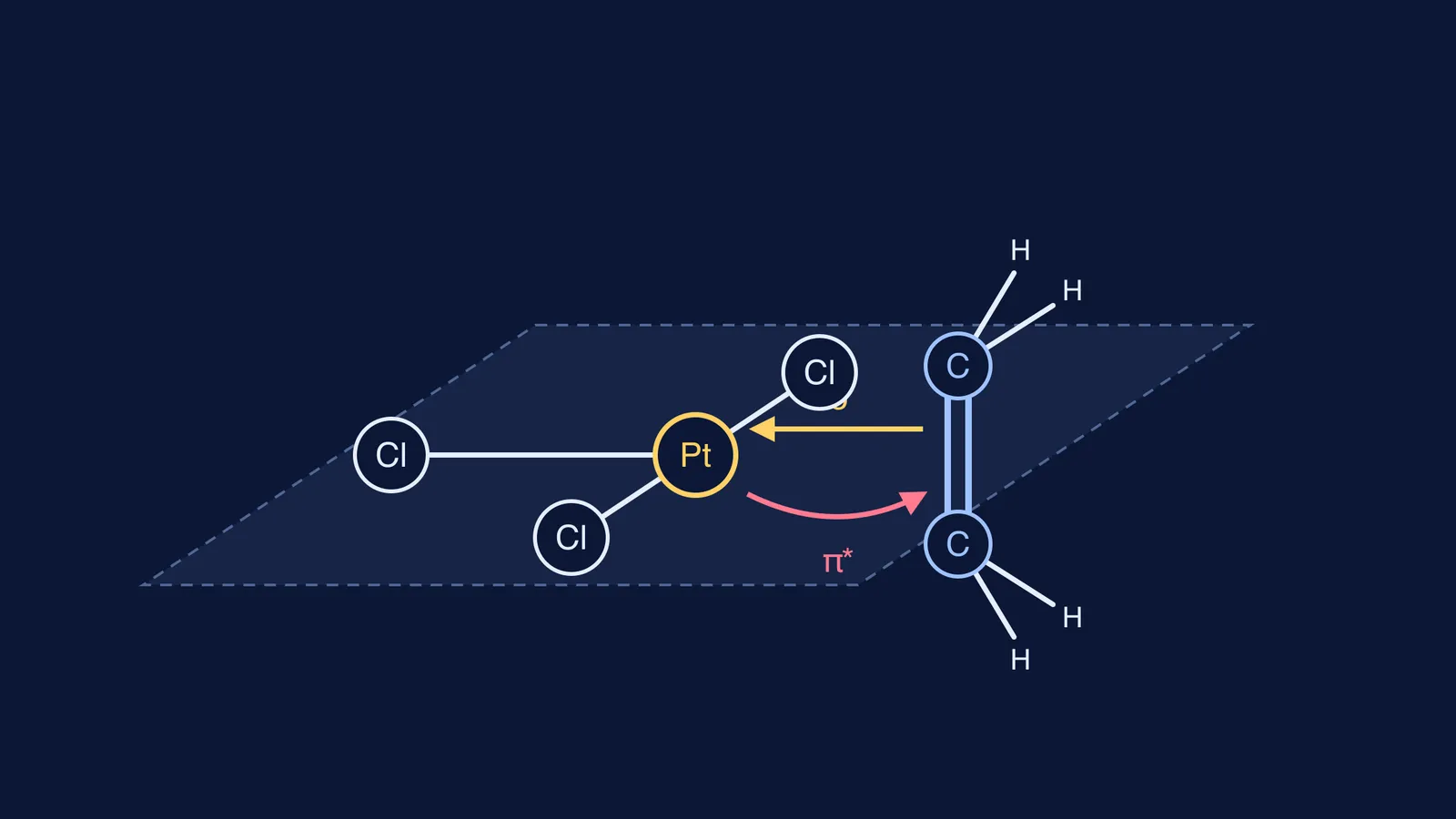
The anion [PtCl3(C2H4)]- is square planar around platinum. Three chlorides and the middle of the C=C bond occupy the four corners of the square.
The PtCl3 group is nearly planar and bisects the C=C bond, with the ethene standing perpendicular to that plane (Wikipedia). Both carbons bond to platinum at once, which is written η2 ("eta-two").
The Pt-Cl bond opposite (trans to) the ethene is 234 pm long, while the other two Pt-Cl bonds are near 230 pm (Wikipedia). That small stretch is usually explained as the trans influence of ethene, and it makes a good one-line exam question. Wikipedia takes these distances from a neutron diffraction study of the salt published in Inorganic Chemistry in 1975 (Love et al., 1975).
How does ethene bond to platinum in Zeise's salt?
The accepted picture is the Dewar-Chatt-Duncanson model, named after Michael Dewar, whose work appeared in 1951, and Joseph Chatt and L. A. Duncanson, who published in 1953 (Chatt and Duncanson, 1953; Wikipedia). It has two parts that work together:
Sigma donation. The filled pi orbital of the C=C bond pushes electron density into an empty platinum orbital. Ethene acts as a donor, even though it has no lone pair.
Pi back-donation. A filled platinum d orbital pushes electron density back into the empty pi* (antibonding) orbital of ethene. Ethene now acts as an acceptor.
The two flows strengthen each other, which is why the bond is called synergic. The cost is paid by the C=C bond: its bond order falls, so it lengthens, its vibrational frequency drops, and the carbons shift from sp2 towards sp3, which shows up as the hydrogens bending back away from the metal (Wikipedia; Wikiversity).
If the gap between "donation" and "back-donation" still feels like words rather than pictures, the orbital ideas behind it (pi and pi* orbitals, hybridisation, square planar complexes) each have their own lesson in the Fermi Concept Library.
How do you answer a Zeise's salt question in an exam?
Questions on Zeise's salt usually test one of four things. Work through them in this order.
Oxidation state. Potassium is +1, so the complex ion is -1. Three chlorides give -3 and ethene is neutral, so Pt is +2. LibreTexts gives the same answer, Pt(II) (LibreTexts/24%3A_Organometallic_chemistry-_d-block_elements/24.02%3A_Common_Types_of_Ligand_-_Bonding_and_Spectroscopy/24.2E%3A_(pi)-bonded_Organic_Ligands)).
d-electron count and shape. Platinum is in group 10, so Pt(II) is d8. Four-coordinate Pt(II) complexes are square planar, which matches the structure above.
Bonding mode. Ethene is η2: both carbons bond to the metal, through the pi bond, not through a lone pair.
Effect on ethene. Back-donation puts electron density into pi*, so the C=C bond order falls below two: longer bond, lower stretching frequency, partial sp3 character.
A quick self-check: count the electrons around platinum. Pt(II) brings 8, three chlorides bring 2 each and ethene brings 2, for 16 in all. Sixteen electrons is typical of square planar d8 complexes, so the count agrees with the shape.
If you get one of these steps wrong on a practice question, the Fermi Problem Library has worked problems with a step-by-step solver that explains the reasoning, so you can see where your method went off.
Final test: explain Zeise's salt aloud in four sentences (formula, shape, two-way bond, effect on C=C) without notes.


