

On this page
Neopentyl bromide (1-bromo-2,2-dimethylpropane) is a classic trap in organic chemistry. Because the bromine atom is attached to a primary carbon, you might expect it to race through an SN2 substitution.
Instead, it barely reacts at all. When forced under different conditions to undergo SN1, it still drags its feet—and then gives you a completely different product than you started with. Here is why the structure of the neopentyl group causes so much trouble.
Why is neopentyl bromide slow in SN2?
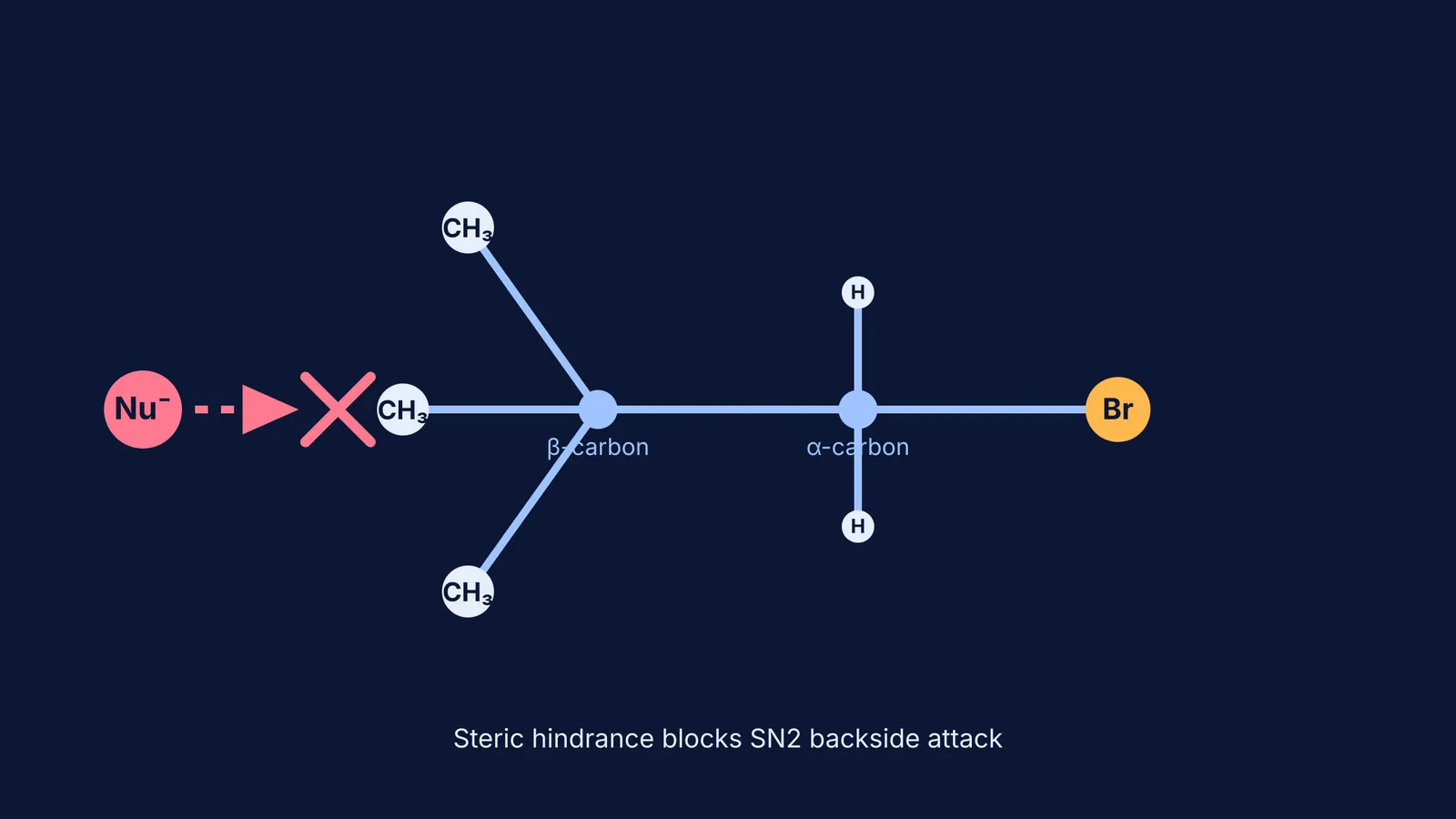
The SN2 mechanism relies on a backside attack. The nucleophile must approach the electrophilic carbon exactly 180° away from the leaving group. As the new bond forms, the old bond breaks in a single, concerted step. This means the transition state involves five groups crowded around the central carbon atom.
In neopentyl bromide, the alpha-carbon (the one holding the bromine) is primary, which usually leaves plenty of room. However, the adjacent beta-carbon is quaternary: it is bonded to three bulky methyl groups. This tert-butyl group acts like a massive umbrella. As the nucleophile tries to come in from the back, it crashes directly into these methyl groups.
This steric hindrance raises the activation energy so high that the reaction effectively stops. Studies show that neopentyl bromide reacts significantly slower than ethyl bromide in an SN2 reaction. Even though both are primary alkyl halides, the difference in the beta-carbon's structure completely changes their reactivity.
Why does it struggle with SN1?
If the backside is blocked, you might think the molecule could simply react via SN1 by dropping the bromine first. However, SN1 reactions require forming a stable carbocation intermediate. The leaving group must depart on its own, taking its electrons and leaving behind a positive charge on the carbon.
Because neopentyl bromide is a primary halide, losing the bromine would create a primary carbocation. Primary carbocations are extremely unstable because they lack sufficient alkyl groups to donate electron density through hyperconjugation. Without resonance to help—unlike allylic and benzylic halides—this primary carbocation requires too much energy to form. The high activation energy for this first step makes a direct SN1 reaction just as unlikely as SN2.
How the 1,2-methyl shift saves the reaction
When neopentyl bromide does react (usually when heated in a polar protic solvent like water or ethanol), it takes a detour. It undergoes a Wagner-Meerwein rearrangement, completely changing its carbon skeleton.
As the bromine leaves, the molecule avoids forming the unstable primary carbocation. Instead, a methyl group from the crowded beta-carbon shifts over to the alpha-carbon, taking its bonding electrons with it. This happens almost simultaneously with the bromine leaving.
This carbocation rearrangement converts the doomed primary carbocation into a highly stable tertiary carbocation (the tert-amyl cation). The new positive charge rests on what used to be the beta-carbon, which is now bonded to three other carbons.
Once the tertiary carbocation forms, the nucleophile finally attacks. Because the carbon skeleton has changed, you get a rearranged product. If the reaction happens in water, you yield 2-methyl-2-butanol instead of the expected primary alcohol, 2,2-dimethyl-1-propanol.
Comparing primary, secondary and tertiary halides
The bizarre behaviour of neopentyl bromide highlights why rules of thumb in chemistry have limits. Students are often taught a simple trend for alkyl halides:
Primary halides usually favour SN2 reactions due to low steric hindrance.
Tertiary halides favour SN1 reactions because they form stable tertiary carbocations.
Secondary halides can undergo either pathway depending on the solvent and the strength of the nucleophile.
Neopentyl bromide breaks this simple rule because it proves that steric hindrance does not just happen at the alpha-carbon. Branching at the beta-carbon can be just as restrictive. It is a vital exception that tests your understanding of the underlying principles—activation energy, transition states and intermediate stability—rather than just your ability to memorise a trend.
Tracing reaction mechanisms
Memorising exceptions like neopentyl bromide is hard, but drawing the mechanism makes the steric block and the rearrangement obvious. Once you see the bulky methyl groups in a 3D sketch, the failure of the backside attack makes perfect sense.
If you are struggling to spot when a molecule will rearrange, the Fermi Concept Library has every concept in chemistry, each with its own lesson and its place in the map. It breaks down the rules of carbocation stability, hyperconjugation, and steric effects so you can predict these reactions.
You can also try tracing the mechanism step-by-step in the Fermi Problem Library. Instead of leaving you stuck, the AI tutor teaches through the problem—it holds a line of reasoning across a whole session, notices where you are stuck, and decides whether to explain, ask, or show the next step.


