

On this page
"Transition metals form alloys because their sizes are similar" is correct, but a good answer also says why the sizes are similar and how similar is similar enough. You can check it with three subtractions, for steel, nichrome and brass.
Why do transition metals form alloys easily?
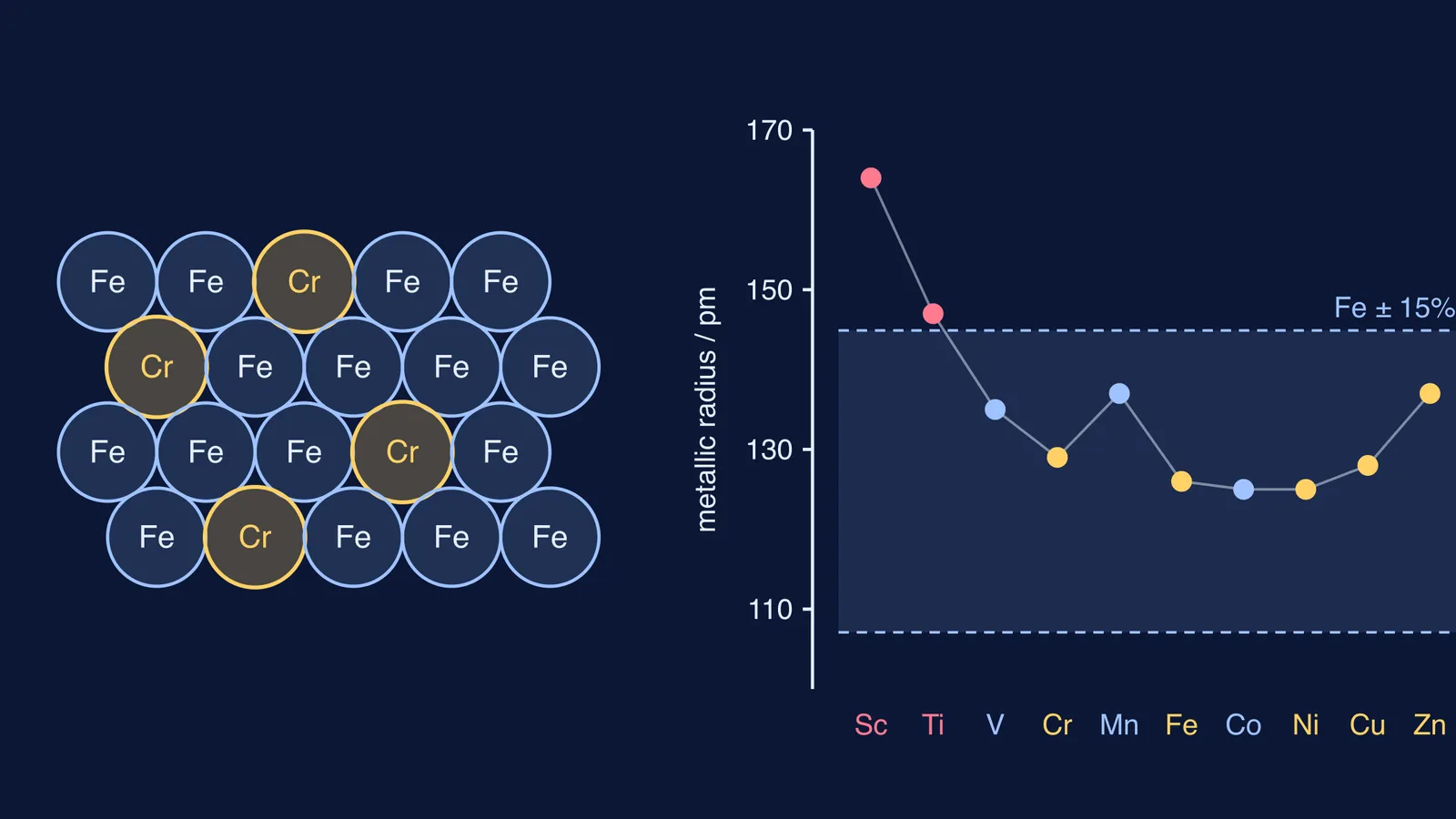
The NCERT Class 12 Chemistry chapter on the d- and f-block elements says alloys "may be homogeneous solid solutions in which the atoms of one metal are distributed randomly among the atoms of the other." The same section gives the condition: such alloys form between atoms with metallic radii within about 15 percent of each other. It then adds that "because of similar radii and other characteristics of transition metals, alloys are readily formed by these metals."
Think of a metal crystal as an egg tray. An atom of almost the same size can take over a slot without bending the tray. A much bigger or smaller atom strains its neighbours, which limits how much of it the crystal accepts.
Why are the sizes so close? The same NCERT chapter explains that across a transition series each new electron enters an inner d orbital while the nuclear charge rises by one. A d electron does not shield the outer electrons very well, so the radius changes only a little from one element to the next. NCERT's Table 4.2 lists metallic radii of 129 pm for chromium, 126 pm for iron, 125 pm for cobalt and nickel, and 128 pm for copper.
What is the 15 percent rule for alloys?
Metallurgists call it the first of the Hume-Rothery rules for substitutional solid solutions: the solute and solvent radii should differ by no more than 15%. The others ask for similar crystal structures, similar electronegativity and, for complete solubility, the same valency. So size is necessary but not enough on its own, which is why NCERT says "similar radii and other characteristics".
The size check is one line:
percentage difference = (r of added metal − r of host metal) ÷ r of host metal × 100
Worked example: steel, nichrome and brass
All radii below come from NCERT Table 4.2 in the d- and f-block chapter.
Stainless steel (chromium in iron): (129 − 126) ÷ 126 × 100 = 2.4%. Well inside 15%. Worldstainless states that all stainless steels contain a minimum of 10.5% chromium by mass.
Nichrome (chromium in nickel): (129 − 125) ÷ 125 × 100 = 3.2%. A-grade nichrome is 80% nickel and 20% chromium by mass, and is used for heating elements in toasters, kettles and space heaters.
Brass (zinc in copper): (137 − 128) ÷ 128 × 100 = 7.0%. Cartridge brass, alloy C26000, contains 68.5 to 71.5% copper with zinc making up most of the rest, according to AZoM's data sheet.
A contrast (scandium in nickel): (164 − 125) ÷ 125 × 100 = 31.2%. That is more than twice the limit, so the size rule predicts that only a little scandium can replace nickel.
Brass has a twist. NCERT does not count zinc as a transition metal, because its d subshell is full in the atom and in its common ion. So NCERT lists brass (copper-zinc) and bronze (copper-tin) as alloys of a transition metal with a non-transition metal. The size argument still works, because zinc's radius is close to copper's.
Is the carbon in steel mixed in the same way?
No. Carbon atoms are much smaller than iron atoms, so they sit in the gaps between lattice sites instead of taking them over. NCERT describes interstitial compounds as forming "when small atoms like H, C or N are trapped inside the crystal lattices of metals." Our explainer on interstitial compounds of transition metals goes into their properties.
In neither case do the atoms combine in a fixed ratio, which is why an alloy counts as a mixture, as we explain in why an alloy is a mixture and not a compound.
How do you answer an alloy question in CBSE or JEE Main?
Use this checklist before you write:
Name the type: substitutional (similar size) or interstitial (small atom in the gaps).
Give the reason: similar metallic radii, explained by poor d-electron shielding.
State the number: radii within about 15 percent (NCERT).
Add one example with both metals named, such as chromium in iron.
If the question names brass, mention that zinc is not counted as a transition metal.
If the size trend itself is the shaky part, the Fermi Concept Library gives every chemistry concept its own lesson and shows where it sits in the map. If you understand the idea but lose marks on numericals, the Fermi Problem Library has worked problems with a step-by-step solver that explains the reasoning rather than printing an answer.
For the everyday side, read common alloys and their uses, from brass to solder.


