

On this page
In inorganic chemistry, transition metals form a vast array of compounds that do not follow normal valency rules. These are known as interstitial compounds.
In short
Interstitial compounds are formed when small atoms like hydrogen, carbon or nitrogen are trapped inside the crystal lattices of transition metals. Because the small atoms fit into the gaps (interstices) without changing the metal's structure, the resulting compounds are typically non-stoichiometric, very hard, and retain metallic conductivity.
What are interstitial compounds?
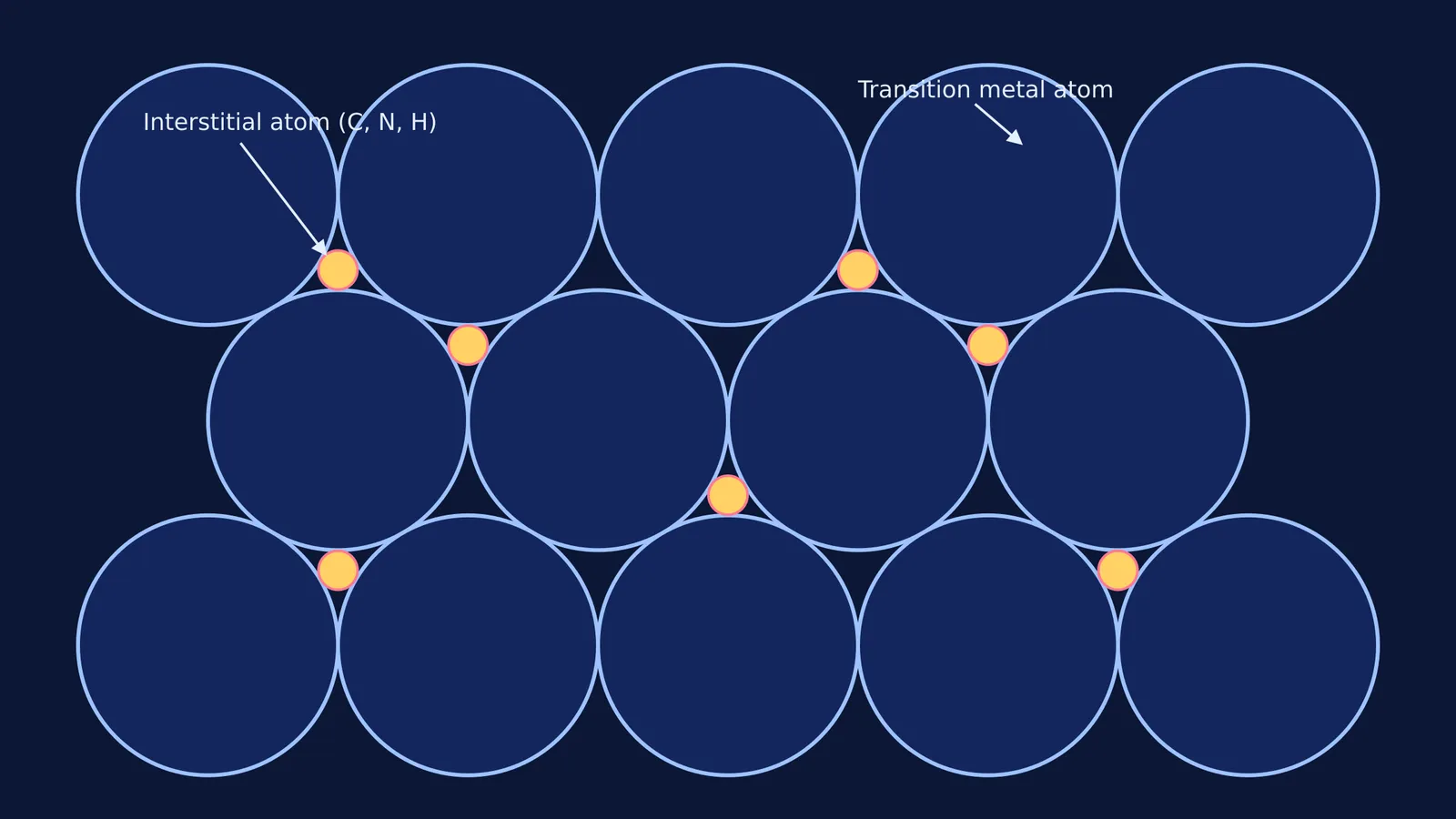
Transition metals naturally form large, close-packed crystal lattices. Because the metal atoms are spherical, they cannot pack together perfectly without leaving empty spaces between them. These empty spaces are called tetrahedral and octahedral voids, depending on how many metal atoms surround them.
When small atoms—typically hydrogen, carbon, nitrogen or boron—get trapped inside these voids, they form interstitial compounds. The metal lattice is essentially unaffected by the small guest atoms. For example, carbon atoms fit into octahedral interstices when the metal atom radius is greater than approximately 135 pm. Common examples include titanium carbide (TiC), manganese nitride (Mn₄N) and iron hydride (Fe₃H). The small atoms just slide into the gaps without pushing the host metal atoms apart.
Why are they non-stoichiometric?
Unlike simple salts like sodium chloride (NaCl) or covalent molecules like water (H₂O), interstitial compounds are non-stoichiometric. This means their chemical formulas feature unusual or fractional ratios, such as TiH₁.₇ or VH₀.₅₆.
They are non-stoichiometric because their composition depends purely on how many physical gaps in the lattice happen to be filled by small atoms, rather than on the sharing or transfer of electrons. The number of trapped atoms can vary depending on the conditions under which the compound was formed. As a result, they are neither truly ionic nor truly covalent. This physical trapping mechanism is also why zinc, cadmium and mercury are not called transition elements in this context; their completely filled d-orbitals and specific lattice types do not readily accommodate these kinds of defects in the same way.
What are the properties of interstitial compounds?
Because the small atoms fill the gaps and reinforce the metal lattice like mortar in a brick wall, interstitial compounds share a distinct set of physical properties that make them highly useful in industry.
High hardness: Many interstitial compounds are extremely hard because the presence of small atoms prevents the layers of metal atoms from sliding over each other. Some borides even approach the hardness of diamond. Titanium carbide and tungsten carbide are so tough they are widely used to coat industrial cutting tools and drill bits.
High melting points: The reinforced lattice means they have melting points that are typically much higher than those of the pure parent transition metals.
Metallic conductivity: Because the parent lattice of the transition metal remains structurally intact and the metallic bonds are largely preserved, interstitial compounds retain metal-like electrical conductivity.
Chemical inertness: Filling the voids makes the metal lattice more rigid and far less reactive than the pure metal. They do not easily undergo chemical reactions with acids or bases under normal conditions.
Checklist: Spotting interstitial compounds in exams
If you are facing a multiple-choice question in a competitive exam like JEE or NEET, use this checklist to identify an interstitial compound quickly:
The ingredients: Look for a transition metal (like titanium, tungsten, manganese, or iron) paired with a very small non-metal atom (hydrogen, carbon, nitrogen, or boron).
The formula: The compound will often have fractional subscripts (like VH₀.₅₆) or unusual whole-number ratios (like Mn₄N) that do not match standard oxidation states.
The properties: The question will describe a substance that is chemically inert, has a very high melting point, is noticeably harder than the pure metal, but still conducts electricity.
How to master transition metals
The chemistry of the d- and f-block elements: configurations, colour and magnetism can feel like an endless list of exceptions to memorise. From variable oxidation states of transition metals to their catalytic properties and complex ion formations, the key is picturing the physical structure.
If you struggle to visualise how these atoms pack together or why octahedral voids form, try the Fermi Concept Library. Fermi's AI tutor works out what you know and builds a plan for the session, drawing the figures and checking your understanding as it goes, so you can connect the structure of an atom directly to its real-world physical properties.


