

On this page
Finding the solubility product (Ksp) of a sparingly soluble salt like silver chloride (AgCl) by measuring its dissolved ions directly is difficult because the concentrations are so incredibly small. Instead, electrochemistry gives us a clever workaround: we can "build" a cell whose overall reaction is exactly the dissolution of the salt.
By finding the standard electromotive force (EMF) of this cell, we can calculate Ksp directly using the Nernst equation. This is one of the most reliable ways to measure tiny equilibrium constants in physical chemistry.
How to set up the two half-cells?
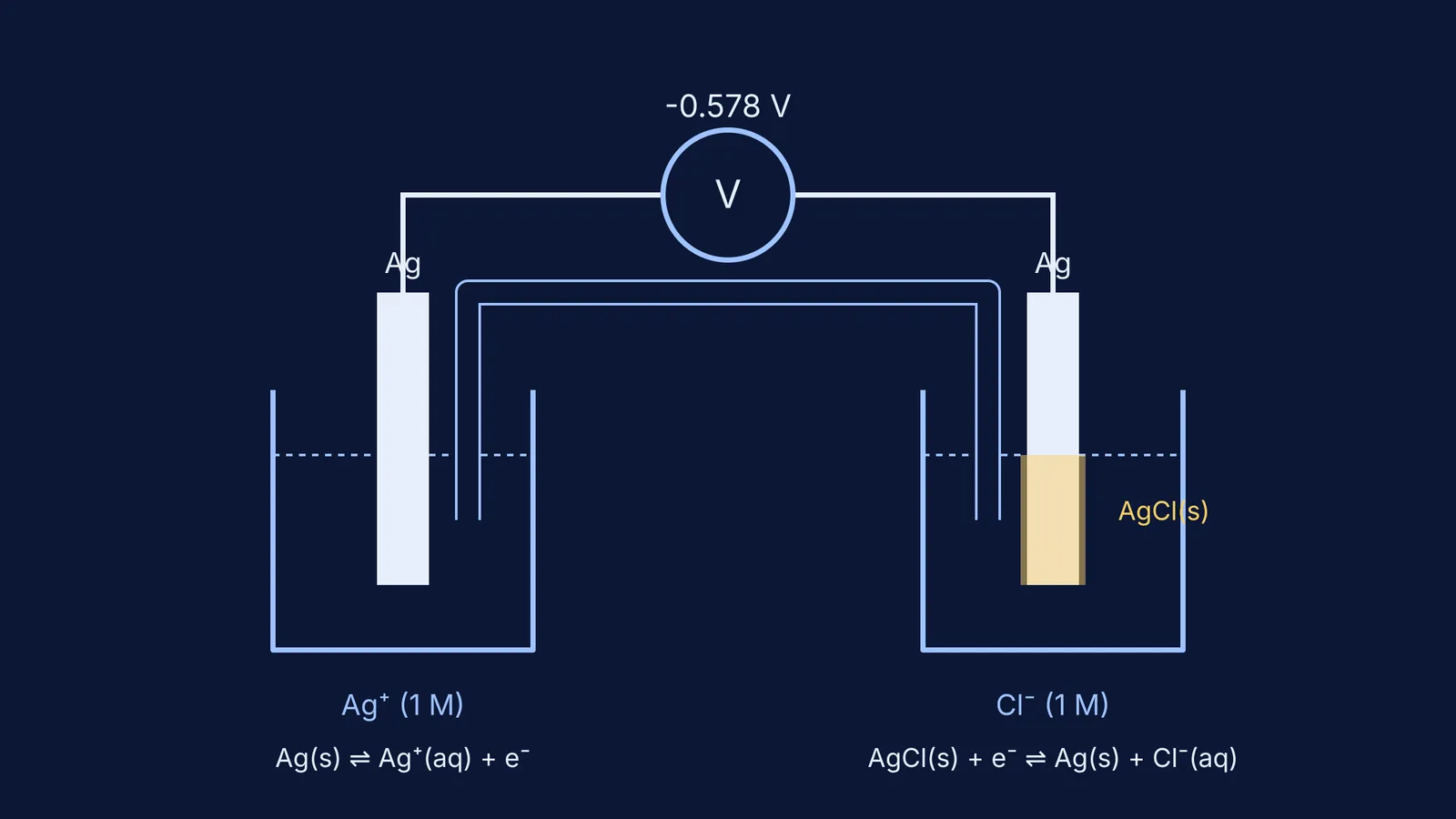
To get the dissolution of AgCl as our final equation, we need to choose two half-reactions that add up to AgCl(s) ⇌ Ag⁺(aq) + Cl⁻(aq).
We use two different silver electrodes for this setup:
The Cathode (Reduction): A silver-silver chloride electrode placed in a 1 M chloride (Cl⁻) solution.
AgCl(s) + e⁻ ⇌ Ag(s) + Cl⁻(aq) The standard reduction potential here is E°_cathode = 0.222 V (LibreTexts).
The Anode (Oxidation): A pure silver electrode placed in a 1 M silver ion (Ag⁺) solution.
Ag(s) ⇌ Ag⁺(aq) + e⁻ The standard reduction potential of Ag⁺/Ag is 0.800 V. Since this is an oxidation, we effectively reverse the sign, or simply use the standard formula E°_cell = E°_cathode − E°_anode.
How do you find the standard cell EMF?
When we add the two half-reactions together, the solid silver (Ag(s)) and the transferred electrons (e⁻) cancel out perfectly:
Cathode: AgCl(s) + e⁻ ⇌ Ag(s) + Cl⁻(aq) Anode: Ag(s) ⇌ Ag⁺(aq) + e⁻ Overall: AgCl(s) ⇌ Ag⁺(aq) + Cl⁻(aq)
This overall reaction is exactly the solubility equilibrium for AgCl. The standard cell potential (E°_cell) for this process is the difference between the two standard reduction potentials (LibreTexts): E°_cell = E°_cathode − E°_anode E°_cell = 0.222 V − 0.800 V = −0.578 V
Because E°_cell is negative, the forward reaction (dissolving the salt) is non-spontaneous under standard conditions (where all ions are at 1 M concentration). This makes complete sense, as AgCl is only sparingly soluble and prefers to remain a solid. For a broader look at calculating thermodynamic values from potentials, see our guide on going from cell EMF to ΔG° and K.
How do you calculate Ksp using the Nernst equation?
At equilibrium, the cell potential drops to zero, and the reaction quotient Q vs K tells us that Q becomes the equilibrium constant Ksp. The standard Nernst equation at 25 °C (298 K) simplifies to relate the standard cell potential to the equilibrium constant (LibreTexts/Electrochemistry/Nernst_Equation)):
E°_cell = (0.0592 / n) log Ksp
Here, n = 1 because exactly one mole of electrons is transferred in our balanced half-reactions. Plugging in our calculated E°_cell:
−0.578 = (0.0592 / 1) log Ksp
Solving for log Ksp: log Ksp = −0.578 / 0.0592 ≈ −9.764 Ksp = 10^-9.764 = 1.7 × 10⁻¹⁰
This method works for any sparingly soluble salt, provided you can find the standard reduction potentials for the metal ion and the corresponding metal-insoluble salt electrode. Remember that the solid salt itself does not appear in the Ksp expression, a strict rule governed by the principles of heterogeneous equilibria.
How does this connect electrochemistry to equilibrium?
In physical chemistry exams like JEE Main and NEET-UG, problems often hide equilibrium questions inside electrochemistry setups. Being able to quickly spot that combining an Ag/Ag⁺ and Ag/AgCl electrode gives you a solubility product is a crucial shortcut that saves precious time on test day. The core trick is recognising that any combination of half-cells that cancels out everything except the solid and its constituent ions will yield the Ksp reaction.
If you are struggling to map half-reactions to equilibrium constants, the Fermi Concept Library has a lesson for every concept in physics, chemistry, biology and mathematics, each with its place in the map. When you are ready to test your understanding with exam-level questions, the Fermi Problem Library provides worked problems with a step-by-step solver that explains the reasoning rather than printing an answer.


