On this page
Carp ponds in India, stocked with rohu, catla and mrigal, slowly fill with ammonia from fish excretion and uneaten feed. A water-test kit reports one number, total ammonia nitrogen (TAN). But the same TAN reading can be nearly harmless on a cool, slightly acidic morning and a real problem on a hot afternoon when the pH has risen. The reason is a Class 11 equilibrium, and you can calculate it with one formula and a temperature correction.
Why is un-ionised ammonia the dangerous form?
Ammonia in water exists in two forms that convert into each other:
NH₄⁺ ⇌ NH₃ + H⁺
TAN counts both. The ammonium ion, NH₄⁺, is charged. The un-ionised molecule, NH₃, is small and neutral, and neutral molecules cross the lipid membranes of gill cells far more easily than ions do. That is why fisheries chemists calculate the un-ionised NH₃ separately: it is the main toxic form. NH₄⁺ is much less toxic, not harmless.
One naming point: dissolved ammonia is NH₃(aq), not a molecule called NH₄OH. The reason is in why NH₄OH does not exist as a molecule.
How do you calculate the fraction of ammonia present as NH₃?
Treat NH₄⁺ as a weak acid. When the pH is set by the pond (its CO₂, its buffers, the lime added to it), the fraction present as NH₃ is:
f = 1/(1 + 10^(pKa − pH))
Here pKa refers to NH₄⁺. This is the same rearranged Henderson–Hasselbalch result explained in how to find the fraction of a weak acid ionised at any pH, so it is not derived again here.
At 25 °C you can get the pKa from the NCERT value of Kb for ammonia, 1.8 × 10⁻⁵. pKb = 4.74, so pKa = 14 − 4.74 = 9.26. Then:
pH 7: f = 1/(1 + 10^2.245) = 0.57%
pH 8: f = 5.4%
pH 9: f = 36%
(These use pKa = 9.245, the value the formula in the next section gives at 25 °C.) Below the pKa, each pH unit multiplies the NH₃ share by about ten. A pond going from pH 7 to pH 8 has almost ten times as much toxic ammonia with no change in TAN.
Why does warm water make ammonia more toxic?
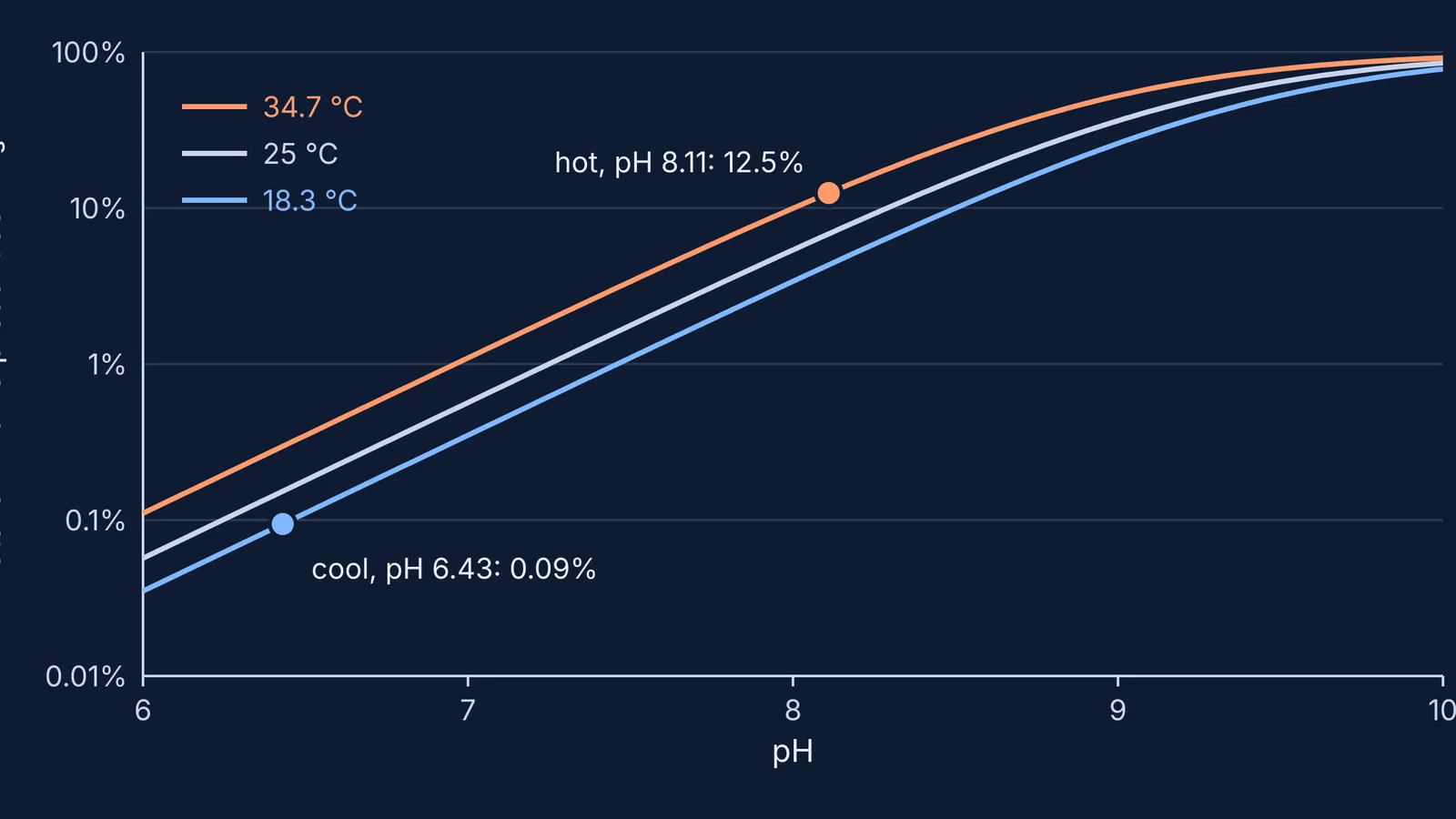
The pKa of NH₄⁺ falls as the water warms. The Florida Department of Environmental Protection's standard method, Calculation of un-ionized ammonia in fresh water, gives this fit for 0–50 °C and pH 6–10:
pKa = 0.0901821 + 2729.92/T, with T = °C + 273.2
Calculated values:
18.3 °C: pKa = 9.455
25 °C: pKa = 9.245
34.7 °C: pKa = 8.956
A lower pKa means a larger NH₃ fraction at the same pH. The chemistry is Le Chatelier's principle. The equation has the van 't Hoff form, pKa = ΔH/(2.303RT) + constant, so its slope gives ΔH = 2.303 × 8.314 × 2729.92 ≈ +52 kJ/mol. The dissociation of NH₄⁺ is endothermic, so heating pushes it to the right, towards NH₃.
The same document works its own example: at 18.5 °C and pH 8.3, 6.63% of the ammonia is un-ionised. With TAN = 2.20 mg/L, that is 0.146 mg/L as nitrogen, or 0.18 mg/L as NH₃. You can reproduce the 6.63% with the formula above.
Why are hot afternoons the risky time in a pond?
Two things happen during a sunny day.
The pH rises. Dissolved CO₂ makes water acidic (CO₂ + H₂O ⇌ H⁺ + HCO₃⁻). Algae and other phytoplankton use up CO₂ in photosynthesis, so the pH climbs through the day. At night respiration adds CO₂ back.
The water warms, which lowers the pKa.
An ICAR study shows the other side of the picture. Bag, Moulick and Mal (Indian Journal of Fisheries, 2016) grew Indian major carps for 300 days in lined ponds at IIT Kharagpur, at three stocking densities. They found:
TAN was highest at dawn and lowest at dusk, a difference of 0.05–0.1 mg/L, probably because phytoplankton take up ammonia in daylight.
TAN "should be less than 1 mg l⁻¹ for good growth", and it went above 1 mg/L in the two more crowded treatments in some months.
pH tended to fall in the crowded ponds because of respired CO₂ and organic load, so they limed the ponds to keep pH between 6 and 9.
So total ammonia dips by the afternoon, but the fraction that is NH₃ rises much faster. The paper did not record pH by time of day, so treat the next example as illustrative.
Worked example: the same pond at its extremes
For the most crowded treatment, the paper reports temperature 18.3–34.7 °C, pH 6.43–8.11 and TAN 0.19–1.83 mg/L. These extremes may not have occurred on the same day; we use the top and bottom of each range to show the size of the effect. Take TAN = 1.83 mg/L as nitrogen.
Case A: cool water, low pH (18.3 °C, pH 6.43)
pKa = 0.0901821 + 2729.92/291.5 = 9.455
pKa − pH = 3.025, and 10^3.025 = 1060
f = 1/1061 = 0.00094, or 0.094%
NH₃-N = 1.83 × 0.00094 = 0.0017 mg/L
Case B: hot water, high pH (34.7 °C, pH 8.11)
pKa = 0.0901821 + 2729.92/307.9 = 8.956
pKa − pH = 0.846, and 10^0.846 = 7.02
f = 1/8.02 = 0.125, or 12.5%
NH₃-N = 1.83 × 0.125 = 0.228 mg/L
As NH₃: 0.228 × 17.03/14.01 = 0.277 mg/L
The total ammonia is identical, but Case B has about 130 times as much NH₃. Temperature alone matters too: at pH 8.11 and 25 °C, f is 6.8%, so the extra 9.7 °C nearly doubles it.
We did not find an Indian standard limit for un-ionised NH₃ in the sources we read, so this post does not quote one.
What should you write in the exam?
Write the equilibrium as NH₄⁺ ⇌ NH₃ + H⁺ and name NH₃ as the toxic, un-ionised form.
Give the fraction as 1/(1 + 10^(pKa − pH)) and state the pKa you used.
Explain the temperature effect with Le Chatelier: the dissociation is endothermic, so a higher temperature gives more NH₃.
Explain the pH effect: fewer H⁺ ions push the equilibrium to the right.
If you are preparing for JEE, Fermi Test Prep is JEE Main and Advanced preparation with an AI tutor. For more numericals like the worked example, the Fermi Problem Library has a step-by-step solver that explains the reasoning. Oxygen is the other killer in warm ponds; that side is covered in why fish die in hot ponds.
Quick checklist
TAN = NH₄⁺ + NH₃; only the NH₃ part is the main toxic form.
Fraction NH₃ = 1/(1 + 10^(pKa − pH)); about tenfold per pH unit.
pKa of NH₄⁺ is about 9.25 at 25 °C and falls as water warms.
Higher pH and higher temperature both raise the NH₃ share.
Convert mg NH₃-N to mg NH₃ with 17.03/14.01.