

On this page
Every salt-analysis scheme you learn says the same thing for group III: add solid NH₄Cl, then NH₄OH. The reagent bottle may be labelled "ammonium hydroxide" or "liquor ammonia". The shorthand works, and examiners accept it. But no one has ever isolated a substance, or found a stable molecule, with the formula NH₄OH. A 2021 article in the Swiss journal Chimia puts it plainly: "Ammonium hydroxide does not exist, but it is commercially available" (Cosandey, Chimia, 2021). Here is what the bottle really holds, what the NH₄OH shorthand stands for, and what to write in your answers.
What is actually in a bottle of ammonia solution?
Mostly neutral NH₃ molecules, each surrounded by water molecules and hydrogen-bonded to them. A small fraction reacts with water:
NH₃ + H₂O ⇌ NH₄⁺ + OH⁻, Kb = 1.8 × 10⁻⁵ at 25 °C
The NH₄⁺ and OH⁻ ions that form move about separately, as ions do in any solution. They meet often, and when they do, a proton can jump back to give NH₃ and H₂O. That is just the reverse reaction of the equilibrium. What never forms is a long-lived NH₄OH unit that you could point to.
Look at the Kb expression: Kb = [NH₄⁺][OH⁻] / [NH₃]. The denominator is dissolved NH₃. When a textbook writes NH₄OH ⇌ NH₄⁺ + OH⁻ and uses the same Kb, its "[NH₄OH]" simply means the total un-ionised ammonia. The arithmetic is identical. Only the picture of the solute is wrong.
Does NH₄OH exist as a solid when ammonia solution freezes?
Ammonia and water do crystallise together at low temperature, and one of the solids, ammonia monohydrate, has the formula NH₃·H₂O. That has exactly the atoms of NH₄OH, so it is a fair test. Olovsson and Templeton worked out its crystal structure by X-ray diffraction at −95 °C and −160 °C. They found "planar chains of water molecules connected by hydrogen bonds", crosslinked "by the ammonia molecules" through O–H···N and N–H···O hydrogen bonds (Olovsson and Templeton, Acta Crystallographica, 1959).
So even the solid, at ordinary pressure, is built from whole NH₃ and H₂O molecules, not from NH₄⁺ and OH⁻ ions. It is a hydrate of ammonia, not a hydroxide of ammonium. Ammonia forms other hydrates with different NH₃ : H₂O ratios too, but the 1 : 1 solid is the one that matters for the name.
How much of the ammonia is ionised? (worked example)
Take 0.10 M aqueous ammonia at 25 °C, Kb = 1.8 × 10⁻⁵.
Let x = [OH⁻] = [NH₄⁺]. Since Kb is small, [NH₃] ≈ 0.10 M.
x = √(Kb × C) = √(1.8 × 10⁻⁵ × 0.10) = √(1.8 × 10⁻⁶) = 1.34 × 10⁻³ M.
Degree of ionisation α = 1.34 × 10⁻³ / 0.10 = 0.013, or 1.3%.
pOH = −log(1.34 × 10⁻³) = 2.87, so pH = 14 − 2.87 = 11.13.
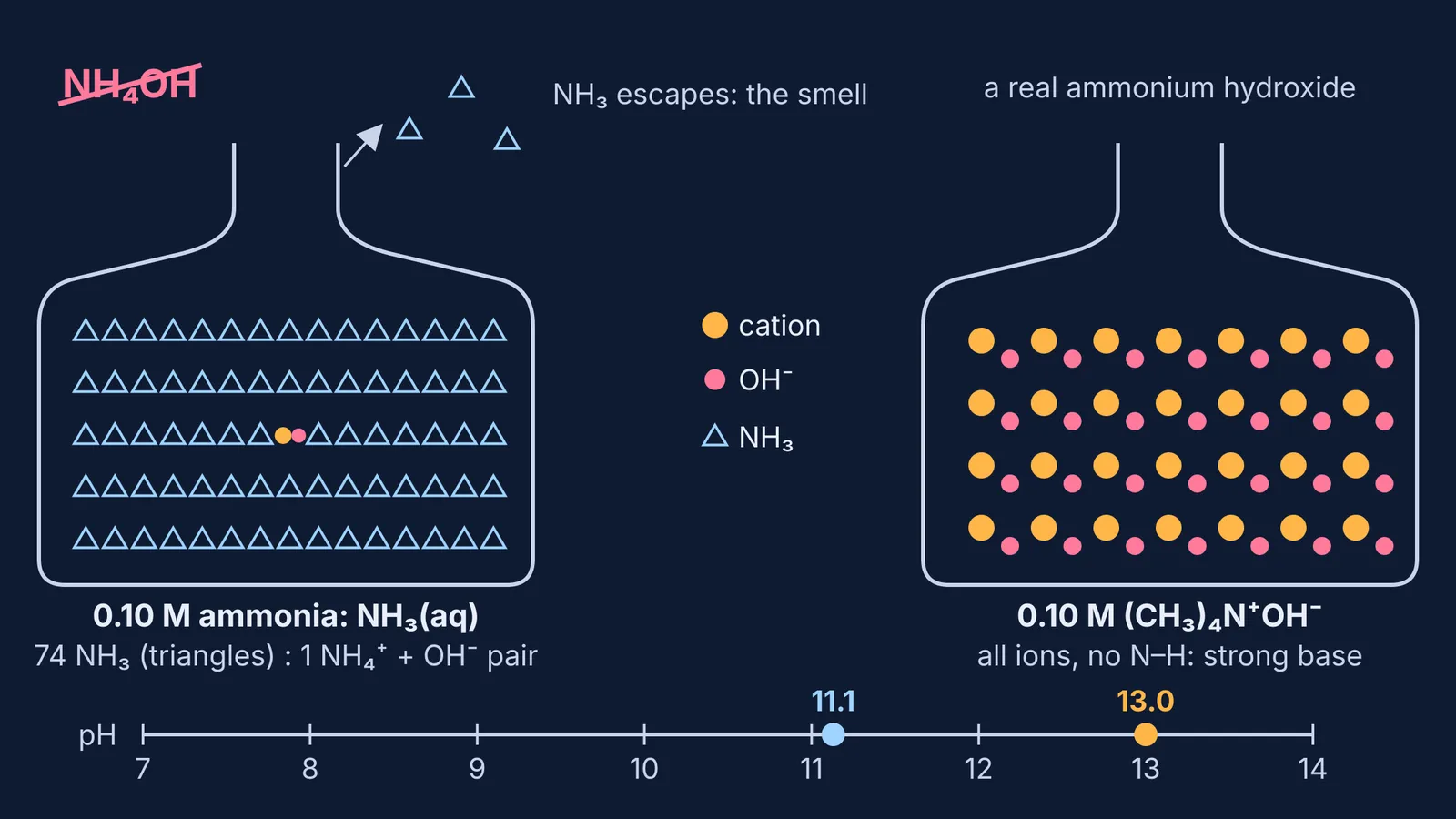
In each litre, 0.0987 mol stays as NH₃ molecules and only 0.0013 mol becomes NH₄⁺ + OH⁻. That is about 74 NH₃ molecules for every ion pair.
The same Kb arithmetic, with the Ka trap to avoid, is in finding the pH of a weak base like ammonia.
Now run it backwards. For NH₄⁺ + OH⁻ → NH₃ + H₂O, K = 1/Kb = 1/(1.8 × 10⁻⁵) = 5.6 × 10⁴. That large value is why warming any ammonium salt with NaOH drives off ammonia gas, the standard test for NH₄⁺:
NH₄Cl + NaOH → NaCl + NH₃ + H₂O
Why does ammonia solution smell but NaOH solution doesn't?
Because the main solute in ammonia solution is a gas. By Henry's law, dissolved NH₃ is in equilibrium with NH₃ in the air above the liquid, so some escapes every time you open the bottle. Warm the solution and gas solubility falls, so more escapes. A bottle left open slowly loses strength.
Sodium hydroxide solution contains only Na⁺ and OH⁻ ions. Nothing in it is volatile, so it has no smell. If ammonia solution really were an ionic hydroxide, NH₄⁺OH⁻, it would behave like NaOH: odourless and fully ionised. It is neither, which is the everyday evidence that most of the solute is neutral NH₃.
Is there any real ammonium hydroxide?
Yes, when all four hydrogens on nitrogen are replaced by carbon groups. Tetramethylammonium hydroxide, (CH₃)₄N⁺OH⁻, is a quaternary ammonium hydroxide. Its cation has no N–H bond, so it cannot hand a proton back to OH⁻ and turn into a neutral amine. The OH⁻ ions stay free, and the compound is a strong base, comparable with NaOH. It is also corrosive and toxic.
Compare two solutions with the same nominal formula pattern, at 0.10 M:
(CH₃)₄NOH is fully ionised: [OH⁻] = 0.10 M, pOH 1.0, pH 13.0.
"NH₄OH" (really NH₃) gives [OH⁻] = 1.34 × 10⁻³ M, pH 11.1.
The difference in [OH⁻] is 0.10 / 1.34 × 10⁻³ ≈ 75-fold. You meet these quaternary hydroxides in Class 12 amines, where moist Ag₂O turns R₄N⁺I⁻ into R₄N⁺OH⁻ before heating; see Hofmann elimination of quaternary ammonium hydroxides.
What should you write in exams?
The NCERT lab manual and the ICSE syllabus both use "ammonium hydroxide" and NH₄OH, so it is fine in salt-analysis answers. In the group III step, adding NH₄Cl before NH₄OH works through the common-ion effect exactly as taught; read NH₄OH there as NH₃(aq).
In equilibrium problems, writing NH₃ + H₂O ⇌ NH₄⁺ + OH⁻ is more accurate and is always accepted. Use Kb = 1.8 × 10⁻⁵ either way. If a question asks why ammonia solution is a weak base, the answer is that NH₃ only partly accepts protons from water, so [OH⁻] stays small.
If the idea of a weak base and its conjugate acid still feels loose, the Concept Library gives each concept its own lesson, from Kb to the common-ion effect.
Quick checklist
No stable NH₄OH molecule or compound has been isolated; the solute is NH₃(aq).
The equilibrium is NH₃ + H₂O ⇌ NH₄⁺ + OH⁻, Kb = 1.8 × 10⁻⁵.
At 0.10 M, about 1.3% is ionised; pH ≈ 11.1.
Solid NH₃·H₂O is hydrogen-bonded NH₃ and H₂O molecules (Olovsson and Templeton, 1959).
The smell comes from free NH₃ escaping, by Henry's law.
Real ammonium hydroxides are quaternary, like (CH₃)₄N⁺OH⁻, and are strong bases.
NH₄OH is accepted in exams as shorthand for NH₃(aq).


