

On this page
Most eliminations in Class 12 follow Saytzeff (Zaitsev): the more substituted alkene wins. Hofmann elimination is the exception you must explain, and a reaction chemists once used to find where nitrogen sits in an unknown amine.
What is Hofmann elimination of a quaternary ammonium hydroxide?
Hofmann elimination is the E2-like elimination of a quaternary ammonium hydroxide on heating, which gives an alkene and a tertiary amine (LibreTexts, Smith map/23%3A_Amines/23.03%3A_Hofmann_Elimination)). It runs in three steps:
Exhaustive methylation. Treat the amine with excess methyl iodide until nitrogen carries four groups, giving a quaternary ammonium iodide. Methyl is chosen because it has no β-hydrogens, so it cannot compete in the elimination (LibreTexts/21%3A_Amines_and_Their_Derivatives/21.08%3A_Quaternary_Ammonium_Salts%3A__Hofmann_Elimination)).
Moist silver oxide. Ag2O with water swaps the iodide for the more basic hydroxide ion; silver iodide drops out.
Heat. The hydroxide salt is heated to 100–200 °C, and hydroxide pulls off a β-hydrogen as N(CH3)3 leaves (LibreTexts/21%3A_Amines_and_Their_Derivatives/21.08%3A_Quaternary_Ammonium_Salts%3A__Hofmann_Elimination)).
The reaction is named after August Wilhelm von Hofmann, whose paper "Researches into the molecular constitution of the organic bases" appeared in the Philosophical Transactions of the Royal Society in 1851 (Crossref record).
Do not confuse it with Hofmann bromamide degradation, which turns an amide into an amine with one carbon fewer.
Why does Hofmann elimination give the less substituted alkene?
The tendency of Hofmann eliminations to give the less substituted alkene is called the Hofmann rule, and it "contrasts strikingly with the Zaitsev Rule" (LibreTexts/21%3A_Amines_and_Their_Derivatives/21.08%3A_Quaternary_Ammonium_Salts%3A__Hofmann_Elimination)). LibreTexts points to a combination of two factors:
Acidity. The positive charge on nitrogen pulls electron density inductively, making the β-hydrogens more acidic. The base attacks the least substituted set of β-hydrogens, which LibreTexts describes as the least hindered and most acidic: in practice, a CH3 rather than a CH2 or CH.
Crowding. N(CH3)3 is a big leaving group. E2 needs the β-hydrogen anti-periplanar to it, and the conformation that leads to the Zaitsev alkene has two gauche interactions with that bulk (Master Organic Chemistry).
The anti-periplanar idea is unpacked in our post on the E2 anti-periplanar requirement. For how bulky bases flip the result in ordinary alkyl halides, see Hofmann vs Saytzeff with a bulky base.
Worked example: butan-2-amine
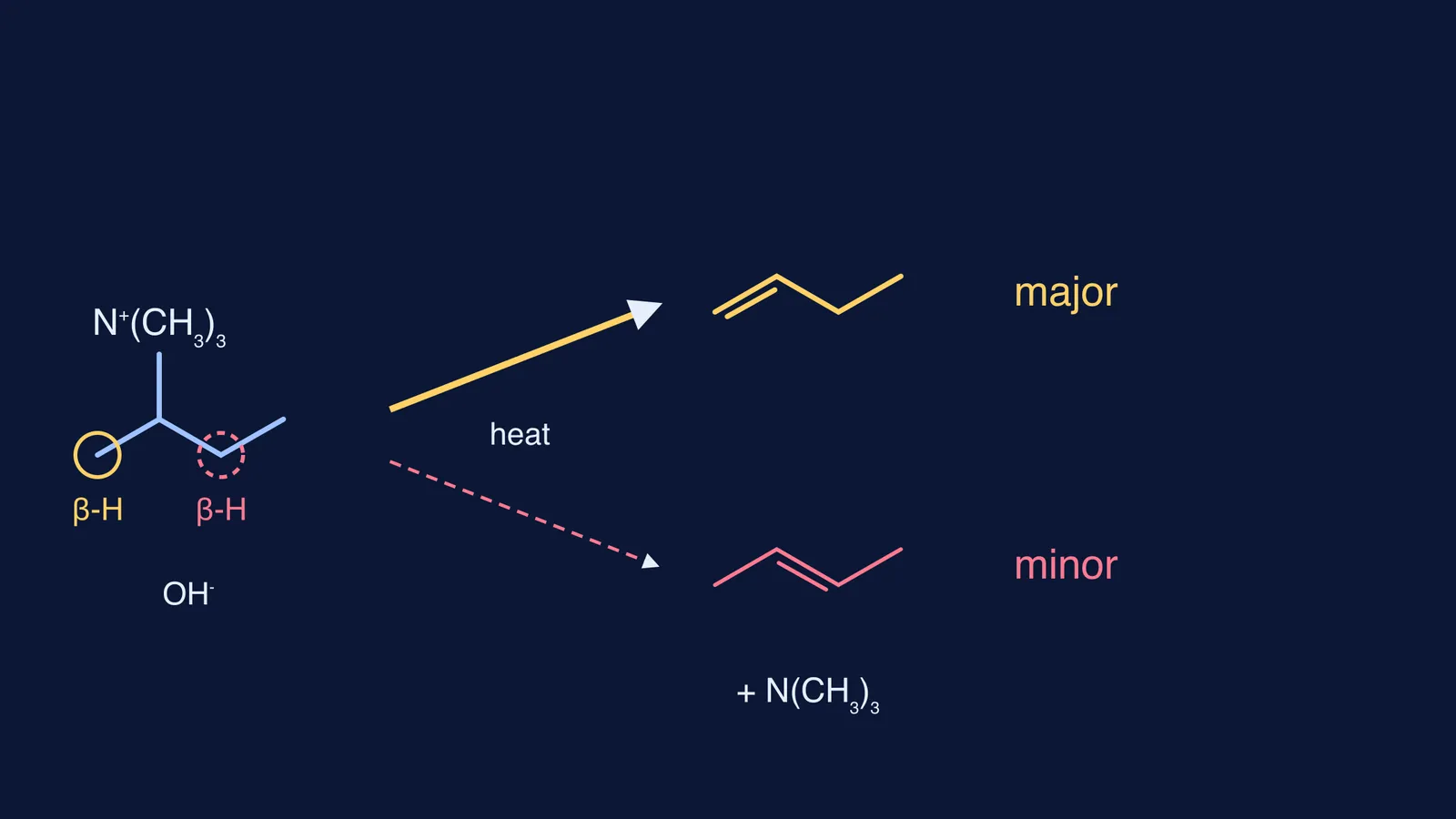
CH3CH(NH2)CH2CH3 takes three CH3I to become CH3CH(N+(CH3)3)CH2CH3 I−.
Moist Ag2O gives the hydroxide salt.
On heating, there are two kinds of β-hydrogen: three on the C1 methyl, two on the C3 CH2.
Removing a C1 hydrogen gives but-1-ene (CH2=CHCH2CH3). That is the major product.
Removing a C3 hydrogen gives but-2-ene, the Saytzeff product. That is the minor one.
How does Hofmann elimination locate nitrogen in an amine?
When few techniques for analysing complex molecules existed, one way to work out an unknown structure was degradation: break the molecule into simpler pieces and look for clues in the fragments (Master Organic Chemistry). Hofmann elimination does this for amines. Use this three-question framework:
How many CH3I does the first methylation take? Three means a primary amine, two secondary, one tertiary.
How many rounds before nitrogen leaves? For an open chain, one round releases a tertiary amine. If nitrogen is in a ring, one round does not remove it, so a second round is needed; a nitrogen that belongs to two rings takes three repetitions (LibreTexts/21%3A_Amines_and_Their_Derivatives/21.08%3A_Quaternary_Ammonium_Salts%3A__Hofmann_Elimination)).
Where are the double bonds in the nitrogen-free product? Each new C=C includes a carbon that was bonded to nitrogen, so the positions point back to where nitrogen was attached.
Worked example: piperidine
Piperidine, a six-membered ring with one NH, takes two CH3I. The first round opens the ring, giving CH2=CHCH2CH2CH2N(CH3)2, which takes one more CH3I. The second round gives penta-1,4-diene plus trimethylamine. Two CH3I at the start, two rounds, and a double bond at each end of a five-carbon chain: the nitrogen was secondary and closed a ring.
Coniine from hemlock shows how degradation and synthesis worked together: Hofmann degraded it in 1884, and the proposed structure, 2-n-propylpiperidine, was confirmed by synthesis in 1886 (University of Bristol).
What should you practise next?
Work one problem backwards (from alkene plus trimethylamine to the starting amine) and one ring example such as pyrrolidine. If a product keeps coming out wrong, the Fermi Problem Library has worked problems with a step-by-step solver that explains the reasoning rather than printing an answer, so you can see the step where your β-hydrogen choice slipped. To revise E2, carbocation stability and amine basicity together, the Fermi Concept Library gives each concept its own lesson and its place in the map.


