

On this page
When you are given an unknown salt mixture in a chemistry laboratory, the goal of qualitative analysis is to separate and identify the metal ions systematically group by group. In Group 3, you are specifically hunting for iron (Fe³⁺), aluminium (Al³⁺) and chromium (Cr³⁺). A thorough understanding of salt analysis in the chemistry practical requires knowing why each group reagent is tailored to separate specific ions without interfering with others.
However, your unknown solution may also contain metals from later analytical groups, such as zinc, manganese, nickel and cobalt (Group 4), barium and calcium (Group 5), or magnesium. To separate them cleanly, you need a reagent that forms insoluble solid precipitates with Group 3 cations while ignoring the rest. Hydroxide ions (OH⁻) are the standard reagent for this step, as described in standard protocols for qualitative inorganic analysis. But there is a crucial catch: if the hydroxide ion concentration is too high, cations from Group 4 and magnesium will also precipitate as hydroxides at the same time, ruining the separation.
How does the common ion effect control hydroxide concentration?
Ammonium hydroxide (NH₄OH) is a weak base that only partially ionises in aqueous solution: NH₄OH ⇌ NH₄⁺ + OH⁻
If you were to add aqueous NH₄OH alone to your sample, its degree of dissociation would release enough hydroxide ions to precipitate both Group 3 and Group 4 metals simultaneously. To prevent this, solid ammonium chloride (NH₄Cl) is added first and dissolved completely. Ammonium chloride is a strong electrolyte that dissociates fully: NH₄Cl → NH₄⁺ + Cl⁻
This dissolution floods the solution with a high concentration of ammonium ions (NH₄⁺). According to Le Chatelier's principle, this massive excess of NH₄⁺ shifts the weak base equilibrium sharply to the left. This phenomenon is known as the common ion effect. The common ammonium ion suppresses the ionisation of NH₄OH, drastically lowering the equilibrium concentration of free OH⁻ in the test tube. Our detailed guide on solubility product, common ion effect and precipitation explains how common ions control ionic equilibria.
Why do Group 3 and Group 4 hydroxides need different pH levels?
Why does a suppressed hydroxide concentration separate Group 3 from Group 4 so cleanly? The physical reason lies in their solubility product constants (Ksp). Precipitation begins only when the ionic product (Q) of the cation and hydroxide ions exceeds the Ksp of that hydroxide.
The difference in solubility between Group 3 and Group 4 hydroxides is enormous. According to Periodni's solubility product table:
Group 3 hydroxides have extraordinarily tiny solubility products. Iron(III) hydroxide, Fe(OH)₃, has a Ksp of roughly 2.8 × 10⁻³⁹, aluminium hydroxide, Al(OH)₃, is around 3.0 × 10⁻³⁴, and chromium(III) hydroxide, Cr(OH)₃, is approximately 6.3 × 10⁻³¹.
Group 4 hydroxides are substantially more soluble. Zinc hydroxide, Zn(OH)₂, has a Ksp of about 3.0 × 10⁻¹⁷, nickel(II) hydroxide, Ni(OH)₂, is 5.5 × 10⁻¹⁶, and manganese(II) hydroxide, Mn(OH)₂, is 2.0 × 10⁻¹³.
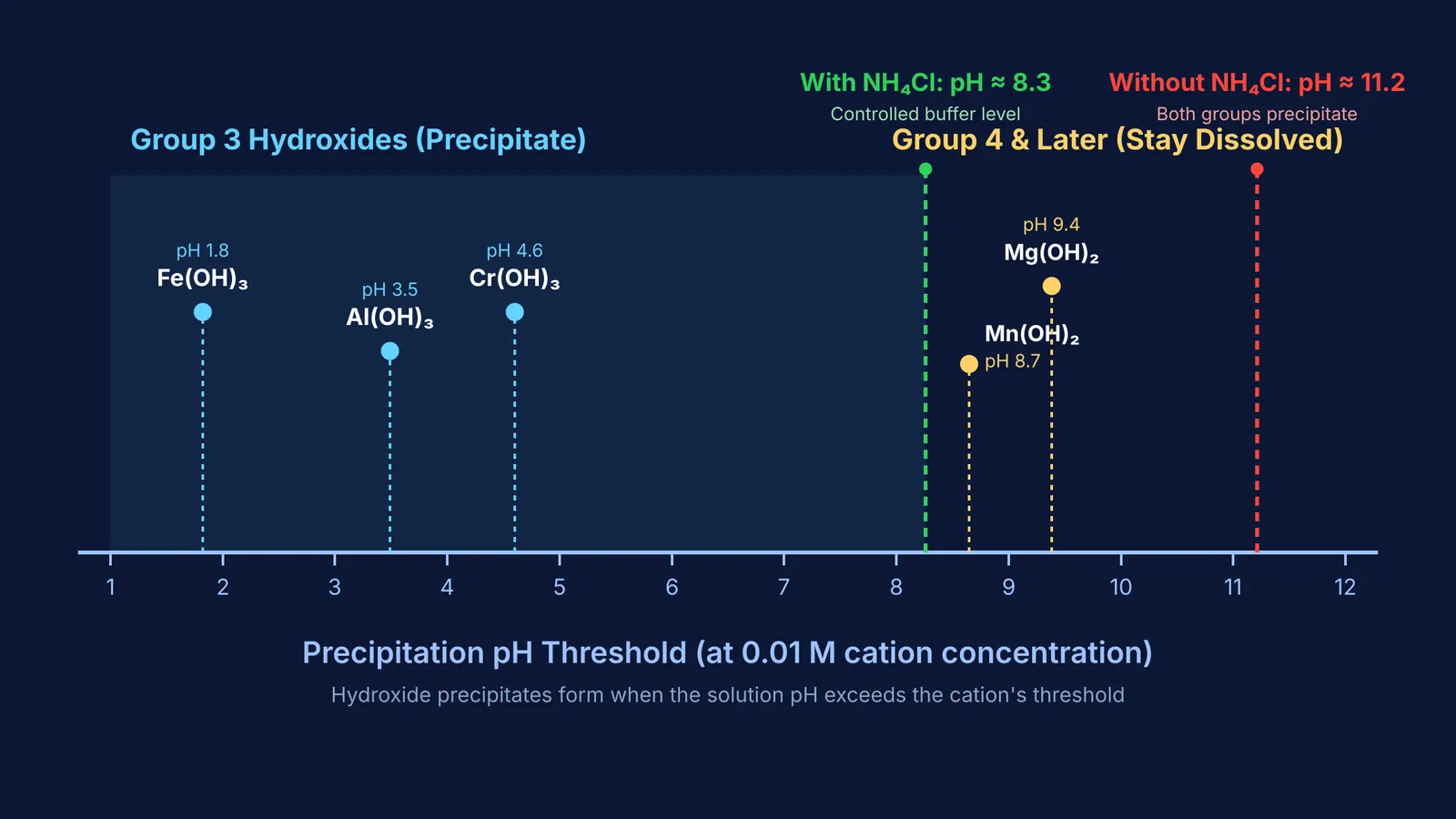
The gap between the Ksp of iron(III) hydroxide and manganese(II) hydroxide spans 26 orders of magnitude. For a typical cation concentration of 0.01 M, Fe(OH)₃ begins precipitating at a pH as low as 1.8, Al(OH)₃ at pH 3.5, and Cr(OH)₃ at pH 4.6. By contrast, Mn(OH)₂ requires a pH above 8.6, and magnesium hydroxide requires a pH above 9.3.
The NH₄Cl and NH₄OH buffer maintains the solution pH around 8.2 to 8.4, providing a hydroxide concentration of roughly 2 × 10⁻⁶ M. This concentration easily exceeds the threshold for Group 3, producing the characteristic reddish-brown Fe(OH)₃, gelatinous white Al(OH)₃, and green Cr(OH)₃ precipitates. At the same time, it stays strictly below the concentration needed to precipitate Mn(OH)₂. Furthermore, metals such as zinc, nickel and cobalt remain in solution because they form soluble ammine complexes with un-ionised ammonia in the reagent.
To work through selective precipitation problems, the Fermi Problem Library has worked problems with a step-by-step solver that explains the reasoning rather than printing an answer.
Why is nitric acid added before ammonium chloride?
Before adding solid NH₄Cl in the laboratory, standard procedures instruct you to add a few drops of concentrated nitric acid (HNO₃) to the filtrate from Group 2 and boil it. This step is essential if iron is present in the mixture.
In many salt mixtures, iron exists partly or entirely in the ferrous state (Fe²⁺) rather than the ferric state (Fe³⁺). Iron(II) hydroxide, Fe(OH)₂, has a Ksp of roughly 8.0 × 10⁻¹⁶, which is comparable to Group 4 hydroxides rather than Group 3. Under the low hydroxide concentration of the NH₄Cl and NH₄OH buffer, Fe²⁺ will not precipitate completely.
Boiling with concentrated nitric acid oxidises Fe²⁺ to Fe³⁺: 3 Fe²⁺ + NO₃⁻ + 4 H⁺ → 3 Fe³⁺ + NO + 2 H₂O
Converting iron to the Fe³⁺ state ensures that its solubility product drops from 8.0 × 10⁻¹⁶ to 2.8 × 10⁻³⁹, guaranteeing immediate, complete precipitation as ferric hydroxide when the buffer is introduced.
What happens if you skip ammonium chloride?
If you forget to add solid ammonium chloride first and add ammonium hydroxide directly to the test tube, the hydroxide ion concentration shoots up unchecked. In a 0.1 M NH₄OH solution without added ammonium salt, the hydroxide concentration is approximately 1.3 × 10⁻³ M, producing a basic pH above 11.
At pH 11, the ionic products for zinc, nickel, cobalt and especially manganese far exceed their solubility products. Manganese precipitates as a muddy brownish-white hydroxide, while magnesium from Group 6 precipitates as white magnesium hydroxide alongside iron and aluminium. The precipitate becomes an unidentifiable mixture of multiple groups, invalidating the analysis.
Careful control of solution equilibria makes qualitative analysis both elegant and reliable. By using the common ion effect to set a precise chemical boundary, you separate the least soluble metal hydroxides while keeping later groups intact in solution. For a deeper look at the thermodynamics of solids in solution, read about heterogeneous equilibria and why solids drop out of equilibrium expressions.


