

On this page
When you are asked to calculate the pH of a weak acid, the steps feel natural. You find the hydrogen ion concentration, take the negative logarithm, and you are done. But when the question switches to a weak base like ammonia, students often stumble.
The most common mistake is taking the acid dissociation constant (Kₐ) and plugging it into the weak acid formula. This gives a highly acidic pH for a substance that is a known base. To find the right answer, you need a different path: the pOH route.
Here is how to calculate the pH of a weak base, why the Kₐ trap catches so many students, and how you can check your work using the Fermi Concept Library.
How to calculate pH of weak base like ammonia?
Ammonia (NH₃) is a classic weak base. When dissolved in water, it does not release hydrogen ions. Instead, it accepts a proton from water, leaving behind a hydroxide ion (OH⁻) and forming the ammonium ion (NH₄⁺). The chemical equilibrium is written as: NH₃ + H₂O ⇌ NH₄⁺ + OH⁻
Because we are dealing with hydroxide ions, we cannot find the pH in one step. We must first find the hydroxide concentration and the pOH.
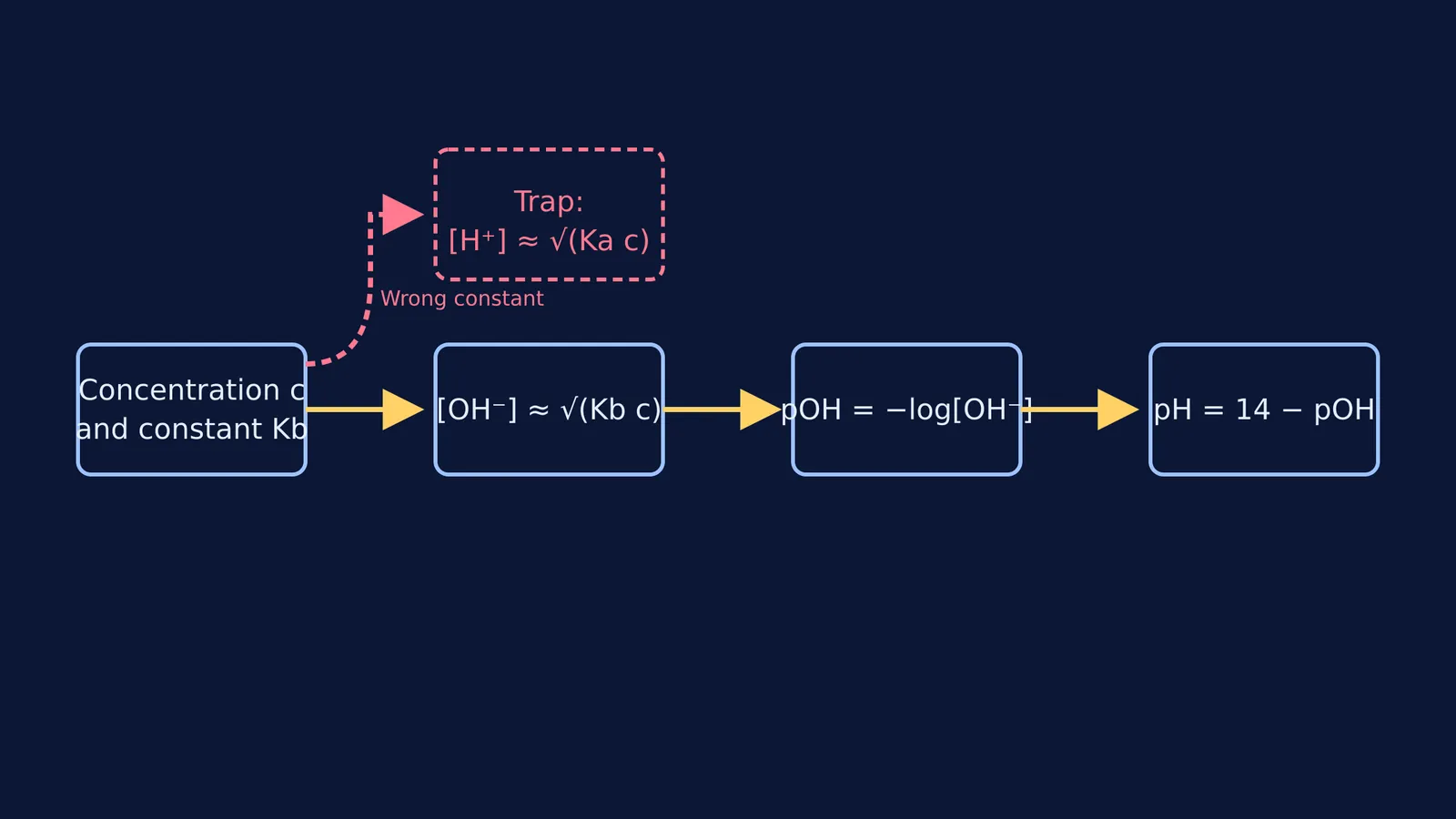
Here is the three-step framework for a typical problem, such as calculating the pH of a 0.1 M ammonia solution at 25 °C:
Find the hydroxide concentration [OH⁻]. For a weak base with initial concentration c and base dissociation constant K_b, the simplified formula is [OH⁻] ≈ √(K_b c). This is derived from the equilibrium expression K_b = [NH₄⁺][OH⁻] / [NH₃]. Since each molecule of NH₃ that reacts produces one NH₄⁺ and one OH⁻, we can say [NH₄⁺] ≈ [OH⁻]. If the dissociation is small, the equilibrium concentration of NH₃ remains roughly equal to c. At 25 °C, the K_b of ammonia is approximately 1.8 × 10⁻⁵. Plugging in our 0.1 M concentration gives [OH⁻] ≈ √(1.8 × 10⁻⁵ × 0.1) = √(1.8 × 10⁻⁶) ≈ 1.34 × 10⁻³ M.
Calculate the pOH. The pOH is the negative base-10 logarithm of the hydroxide concentration: pOH = −log₁₀(1.34 × 10⁻³) ≈ 2.87.
Convert pOH to pH. At standard room temperature (25 °C), the sum of pH and pOH is exactly 14. So, pH = 14 − 2.87 = 11.13.
The result is 11.13, which is strongly alkaline. This perfectly matches what we expect from a 0.1 M solution of ammonia.
If you are dealing with bases that are not fully dissolved, remember that heterogeneous equilibria: why solids and pure liquids drop out of K applies here too. The concentration of liquid water is considered constant and is therefore excluded from the K_b expression.
Why does pH + pOH = 14 at 25 °C?
The rule that pH and pOH add up to exactly 14 comes from the self-ionization of water. Even in pure, neutral water, a tiny fraction of water molecules collide and split into H⁺ and OH⁻ ions.
The product of their concentrations is called the ion product of water (K_w). At 25 °C, experimental measurements show that K_w is exactly 1.0 × 10⁻¹⁴. When you take the negative logarithm of both sides of the equation K_w = [H⁺][OH⁻], you get pK_w = pH + pOH. Since −log₁₀(1.0 × 10⁻¹⁴) is 14, the relationship pH + pOH = 14 holds true for all aqueous solutions at this temperature.
This relationship is entirely temperature-dependent. If the temperature increases, water dissociates more easily, and K_w increases. Neutral pH is not always 7: how Kw changes with temperature explains this in detail, but for standard exam problems without a specified temperature, you can safely assume 25 °C and use 14.
Why is using the acid constant a trap?
Many exams deliberately test your understanding by giving you the Kₐ of the conjugate acid (ammonium, NH₄⁺) instead of the K_b of the base (ammonia, NH₃). For ammonia at 25 °C, the Kₐ of its conjugate acid is 5.6 × 10⁻¹⁰.
If you mistakenly plug this Kₐ directly into the weak acid formula √(Kₐ c), you will calculate a hydrogen ion concentration of √(5.6 × 10⁻¹⁰ × 0.1) = 7.48 × 10⁻⁶ M. Taking the negative logarithm gives a pH of 5.12. You have just calculated that a solution of household ammonia is acidic. In the pressure of a timed exam, students often write this down without a second thought.
To avoid this trap, always check which constant you have been given. If you are given Kₐ for a weak base problem, convert it to K_b first using the relationship Kₐ × K_b = K_w. Since K_w is 1.0 × 10⁻¹⁴, you can easily find the base constant: K_b = (1.0 × 10⁻¹⁴) / (5.6 × 10⁻¹⁰) = 1.8 × 10⁻⁵.
If you find yourself routinely falling for these wrong-method mistakes in chemistry, the step-by-step solver in the Fermi Problem Library can help. It explains the underlying reasoning behind each mathematical step, ensuring you understand why a particular formula is used rather than just printing a final answer.
How can you avoid weak base mistakes?
Before you start calculating, run through this quick mental checklist to ensure you are on the right path:
Identify the substance: Is the substance a weak acid or a weak base? Ammonia and organic amines are bases.
Check the constant: Did the question provide K_b or Kₐ? If it gave Kₐ for a basic solution, convert it to K_b immediately using K_w.
Verify the temperature: Are you working at 25 °C? If yes, you can confidently use the self-ionization equation pH = 14 − pOH to find the final pH.
Treating a base like an acid is a fast way to lose marks. By pausing to identify the substance and ensuring you are using the K_b value to find the pOH first, you will consistently arrive at the correct alkaline pH.


