On this page
A roadster cycle with a three-speed hub has no derailleur, yet it has three gears. A hybrid car can run its engine at 2,000 rpm while the car stands still, and keep it there as the car speeds up. Both tricks come from the same small box of gears, the epicyclic (planetary) gear set, and from one line of relative angular velocity that you can derive in Class 11.
What is inside a planetary gear set?
There are three parts that can turn about one axis:
Sun: a small gear in the middle, with Z_s teeth.
Ring: a large gear with teeth on the inside, with Z_r teeth.
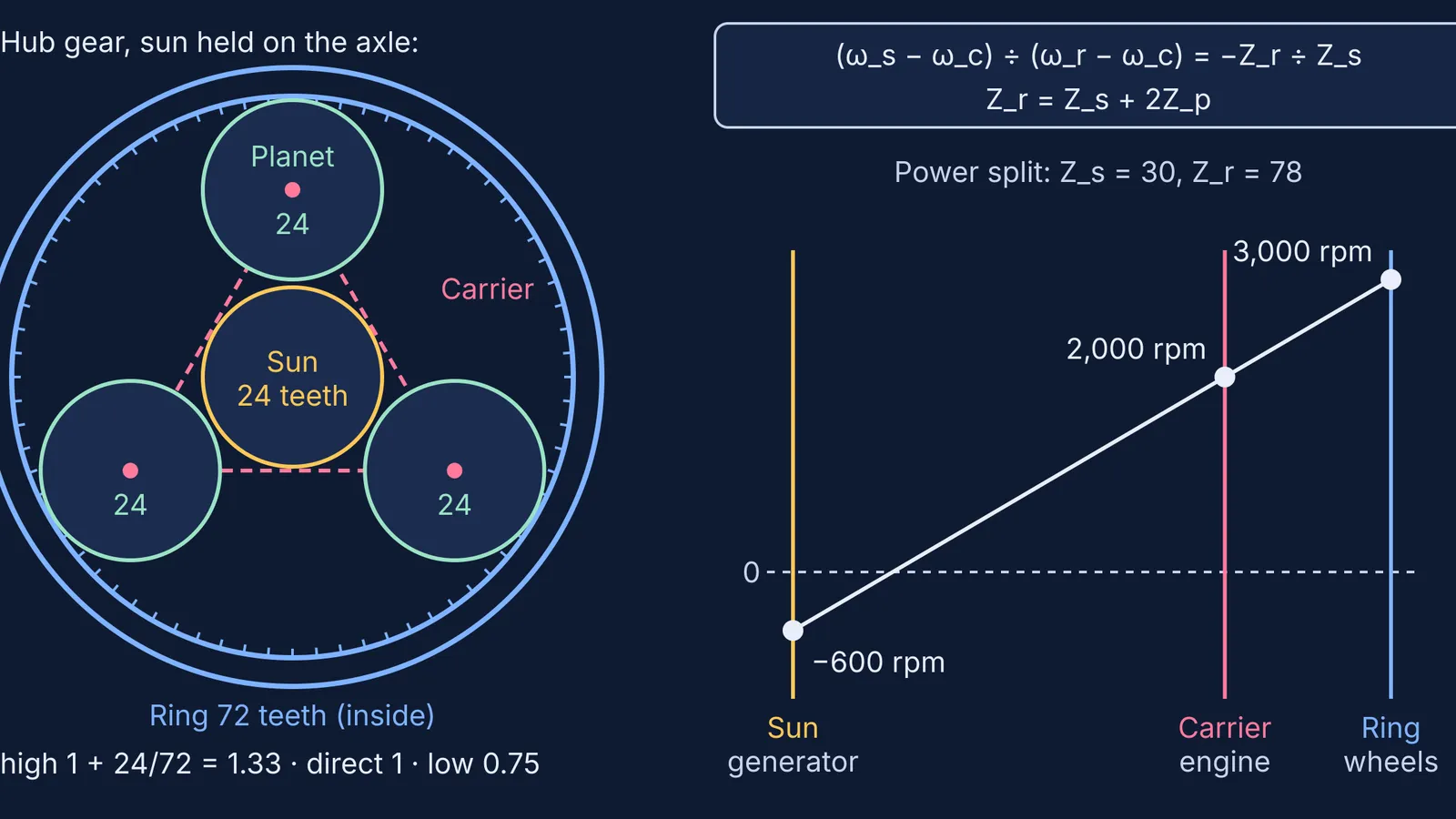
Carrier: a frame that holds three or four small planet gears. Each planet meshes with the sun on one side and the ring on the other, and the carrier turns as the planets go round.
The planets must fit across the gap, so Z_r = Z_s + 2Z_p, where Z_p is the planets' tooth count. For equally spaced planets, Z_s + Z_r must divide evenly by their number.
A car's differential is a cousin of this set. How a car differential works shows its carrier turns at the average of two equal side gears. That is the equal-gear special case. Here the sun and ring are different sizes, and that difference is what makes gear ratios.
How do you find the speeds of the sun, carrier and ring?
Ride along on the carrier. In that frame the planets' axles stand still, so the set is an ordinary fixed gear train: sun drives planet, planet drives ring. Relative to the carrier, sun and ring turn opposite ways, at speeds in the inverse ratio of their teeth. Every speed seen from the carrier is the true speed minus ω_c, so:
(ω_s − ω_c) ÷ (ω_r − ω_c) = −Z_r ÷ Z_s
The planets' tooth count drops out. Rearranged:
Z_s ω_s + Z_r ω_r = (Z_s + Z_r) ω_c
So the carrier speed is a weighted average of the sun and ring speeds, with the ring weighted more because it has more teeth. With two of the three speeds known, the third is fixed.
How does a three-speed hub give 0.75, 1 and 1.33?
In a classic three-speed cycle hub the sun is fixed to the axle, so ω_s = 0. Sturmey-Archer's AW three-speed hub specification gives the three gears as 75%, 100% (direct drive) and 133%, an overall range of 177%.
Put ω_s = 0 into the rule: Z_r ω_r = (Z_s + Z_r) ω_c, so ω_r ÷ ω_c = 1 + Z_s ÷ Z_r. A 133% top gear therefore needs Z_s ÷ Z_r = 1/3. Our illustrative tooth counts are a sun of 24, a ring of 72 and planets of (72 − 24) ÷ 2 = 24. They fit, but we have not checked them against a real hub.
High gear (sprocket drives the carrier, ring drives the wheel). ω_r = (1 + 24/72) ω_c = 1.333 ω_c. The wheel turns a third faster than the sprocket.
Low gear (sprocket drives the ring, carrier drives the wheel). ω_c = ω_r ÷ 1.333 = 0.75 ω_r. The wheel turns at three quarters of the sprocket speed.
Normal gear (sprocket drives the ring, ring drives the wheel). Ratio 1, direct drive.
Worked numbers. Say the sprocket turns at 120 rpm and the wheel's circumference is 2.2 m (round illustrative values). The wheel turns at 160, 120 or 90 rpm. That is 160 × 2.2 ÷ 60 = 5.87 m/s (21.1 km/h), 4.40 m/s (15.8 km/h) or 3.30 m/s (11.9 km/h). Top over bottom is 1.333 ÷ 0.75 = 1.78, the 177% range. The chainring and sprocket still set the overall ratio, as in bicycle gears tested sprocket by sprocket; the hub multiplies it by one of three numbers.
What does the power split device in a hybrid car do?
The hybrid car explainer lists a "power split device" without opening it. It is one planetary set. In the Toyota Hybrid System the engine drives the carrier, a generator sits on the sun and the ring goes to the wheels and to the drive motor. Liu, Peng and Filipi's model of the Toyota Hybrid System (IEEE/ASME AIM 2005) uses exactly this layout and the speed rule above. Oak Ridge National Laboratory's teardown of the 2004 Prius drive shows a sun of 30 teeth and a ring of 78.
Worked example: choosing the engine speed
With Z_s = 30 and Z_r = 78, solve the rule for the generator (sun) speed:
ω_s = [(Z_s + Z_r) ω_c − Z_r ω_r] ÷ Z_s = (108 ω_c − 78 ω_r) ÷ 30
Hold the engine (carrier) at 2,000 rpm and let the ring speed rise as the car moves off. Ring speeds here are before the final reduction to the wheels.
Car standing, ring 0 rpm. ω_s = 108 × 2,000 ÷ 30 = 7,200 rpm.
Ring 2,000 rpm. ω_s = (216,000 − 156,000) ÷ 30 = 2,000 rpm. The whole set turns as one block.
Ring 3,000 rpm. ω_s = (216,000 − 234,000) ÷ 30 = −600 rpm. The generator now turns backwards.
Engine off, ring 3,000 rpm. ω_s = −78 × 3,000 ÷ 30 = −7,800 rpm. The car drives on its motor while the generator idles backwards.
Check case 3 with the weighted average: (30 × −600 + 78 × 3,000) ÷ 108 = 2,000 rpm.
So the engine speed is not tied to the road speed. The controller picks a speed where the engine runs efficiently, and the generator's speed takes up the difference. The set acts as a continuously variable transmission with no belts.
How is the engine's torque shared?
Take the planets as light and frictionless. The tooth force F between a planet and the sun equals the force between that planet and the ring. So the sun feels a torque F × S and the ring F × R, where S and R are their radii, proportional to the tooth counts. The carrier carries both, F × (R + S). The engine's torque therefore splits in a fixed ratio:
To the sun (generator): 30 ÷ 108 = 28%.
To the ring (wheels): 78 ÷ 108 = 72%.
Power splits differently, because power is torque × ω. In case 3 the sun's torque is 28% of the engine's, but its speed is −600 rpm. Its power, 0.278 × (−600) per unit engine torque, is negative, so the generator has to put power in as a motor. The ring gets 0.722 × 3,000 = 2,167 units against the engine's 2,000, and the extra 167 comes in through the sun. Energy is conserved; the electrical path runs backwards.
To see a turning set and its speeds side by side, open the Simulation Lab. For relative angular velocity and torque balance, the Concept Library has each idea on its own page.
Quick checklist
Name the three members: sun, carrier, ring. Check Z_r = Z_s + 2Z_p.
Use (ω_s − ω_c) ÷ (ω_r − ω_c) = −Z_r ÷ Z_s, or Z_s ω_s + Z_r ω_r = (Z_s + Z_r) ω_c.
Sun held: ring turns 1 + Z_s ÷ Z_r times the carrier.
Torque splits as Z_s : Z_r between sun and ring; power splits by torque × ω.
Keep the signs: a negative speed means the part turns backwards.