

On this page
At a red light in Pune, a hybrid's engine falls silent, and when the light turns green the car can creep off on its motor alone. That quiet is a big part of the trick, and it runs on physics you already study: kinetic energy, work and efficiency.
How does a hybrid car work?
A hybrid electric vehicle is powered by an internal combustion engine and one or more electric motors that use energy stored in batteries, according to the US Department of Energy's Alternative Fuels Data Center. You cannot plug an ordinary hybrid in: the same page says its battery is charged instead through regenerative braking and by the engine.
fueleconomy.gov's guide to how hybrids work lists three features that save fuel:
Regenerative braking: when you slow down, the wheels turn the motor, which generates electricity and helps slow the car. Energy that would normally be lost in braking goes back into the battery.
Electric motor assist: the motor helps the engine when you accelerate, overtake or climb, so a smaller, more efficient engine can be used. In some hybrids the motor alone moves the car at low speeds, where petrol engines are least efficient.
Automatic stop-start: the engine switches off when the car stops and restarts when you press the accelerator, which cuts the energy wasted on idling.
What is the difference between series and parallel hybrids?
The AFDC's hybrid basics page describes two layouts for full hybrids.
Parallel hybrid: the engine and the electric motor are both connected to the wheels through mechanical coupling, so both drive the wheels directly. AFDC calls this the most common hybrid design.
Series hybrid: only the electric motor drives the wheels. AFDC notes that series designs are more common in plug-in hybrids.
fueleconomy.gov's diagram of a full hybrid shows five main parts: the engine, an electric motor, a generator, a power split device and a high-capacity battery.
Why do hybrids get better mileage in the city?
Start with where an ordinary petrol car's fuel goes. Only about 12% to 30% of the fuel's energy moves a conventional car down the road, depending on how it is driven, according to fueleconomy.gov's energy breakdown for conventional cars. For city stop-and-go driving, the same page estimates that 14% to 20% reaches the wheels and about 6% is lost to idling.
For hybrids, the matching breakdown for hybrids puts the share that moves the car at about 24% to 38%, with idle losses near zero in the city. On the highway the advantage shrinks: that page notes there is little braking there, so regenerative braking offers little advantage over a conventional car.
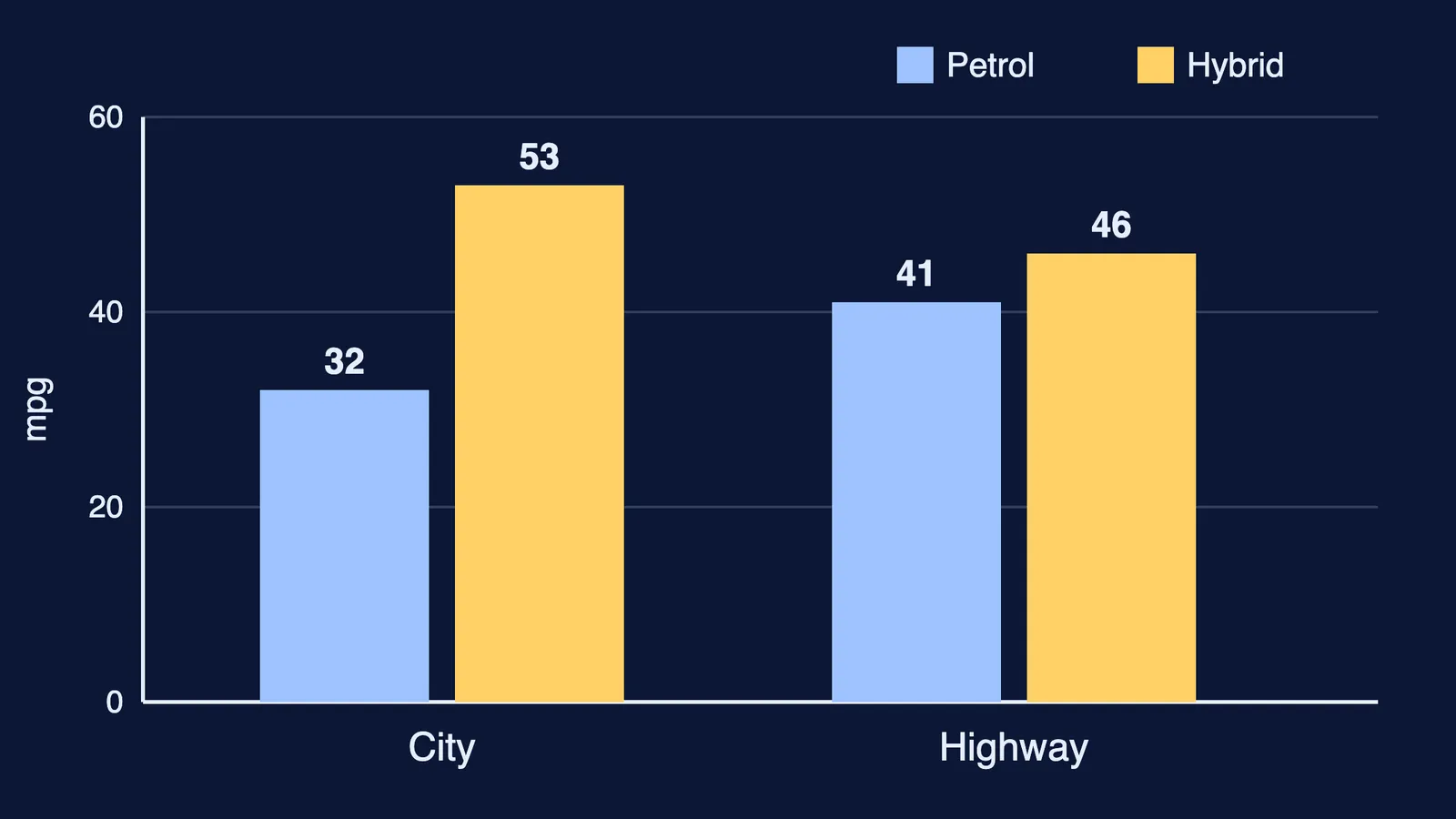
The official ratings show the pattern. On fueleconomy.gov, the 2024 Toyota Corolla with a 2.0-litre petrol engine is rated 32 mpg in the city and 41 mpg on the highway. The 2024 Corolla Hybrid is rated 53 mpg in the city and 46 mpg on the highway. That is about 66% better in the city but only about 12% better on the highway. These are US test figures in miles per US gallon; mileage in Indian traffic will differ.
How much energy does one stop throw away?
Here is a worked example with Class 11 physics. Take a small sedan of mass 1,300 kg (a round number we chose) moving at 50 km/h.
Convert the speed: 50 km/h = 50 × 1000 ÷ 3600 ≈ 13.9 m/s.
Find the kinetic energy: KE = ½mv² = ½ × 1300 × 13.9² ≈ 125,000 J, about 125 kJ.
When an ordinary car brakes to a stop, its brakes turn most of that energy into heat.
Over 20 stops on a commute, that is up to about 2.5 MJ of motion lost.
A hybrid recovers part of that 125 kJ at each stop and can spend it pulling away from the next signal, at the low speeds where petrol engines are least efficient. At a steady highway speed you rarely brake, so there is little to recover. That idea goes a long way to explaining the mileage numbers above.
Electric trains use the same trick; see how Vande Bharat runs without a separate engine.
How can you use this in physics problems?
When a car, train or lift question mentions braking, motors or efficiency, run this checklist:
List every energy source: fuel, battery, height.
List every place energy goes: kinetic energy, brake heat, idling, friction.
Ask whether the motion stops and starts. If it does, recovered braking energy matters; if it is steady, it barely does.
Keep power and energy apart: a motor's power decides how fast the car accelerates, while energy decides how far it goes.
The last point trips up many students; try average and instantaneous power for an accelerating car next.
If energy-flow problems still feel abstract, Fermi's AI tutor can work out what you already know, build a plan for the session and draw the figure as it teaches. The Fermi Simulation Lab has interactive simulations for the ideas that are easier to see than to read.


