On this page
Stand on a platform when a Vande Bharat pulls in and you will notice something missing: there is no locomotive at the front. The train pushes itself from many points along its length, using the same force and friction you meet in Class 11.
How does Vande Bharat run without a separate engine?
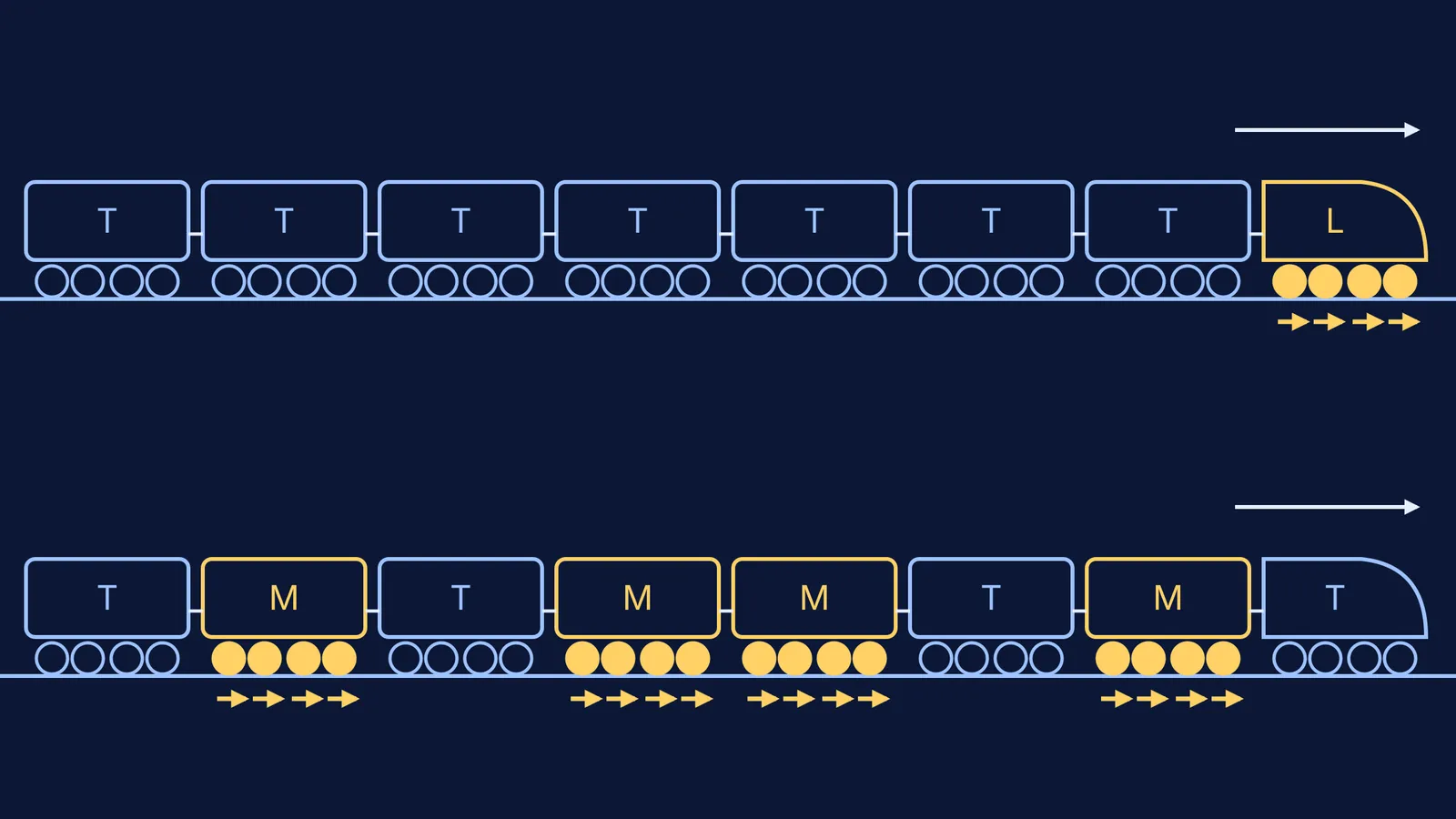
Vande Bharat is what railway engineers call a train set with distributed traction. According to The Week's report from Integral Coach Factory (ICF), Chennai, the trains have motors fitted in every second coach, and they need no locomotive because each powered unit acts as a locomotive.
The train collects electricity from the overhead wire through a pantograph on the roof, as the Vande Bharat trainset entry on Wikipedia) describes, and feeds traction motors mounted under the floor.
Putting the machinery below the floor also frees space. The Press Information Bureau factsheet on Vande Bharat says the 16-coach train seats 1,128 passengers, more than a conventional Shatabdi rake of the same length, because all electric equipment was shifted below the coaches.
Why do motors in many coaches give faster pick-up?
Each motor turns a wheel, the wheel pushes backwards on the rail, and the rail pushes the wheel forwards with an equal and opposite force. That forward push is static friction, and the two pushes form a Newton's third law pair, which you can revise in our post on action-reaction pairs and how to spot them.
Friction has a ceiling. The most grip a wheel can get is roughly the coefficient of friction times the normal force pressing that wheel onto the rail. Only driven wheels can push, so what matters is how much of the train's weight sits on them.
In a locomotive-hauled train, only the locomotive's wheels push; the coaches are dragged along.
In Vande Bharat, about half the vehicles have driven wheels, so far more of the train's weight helps them grip.
More grip means more forward force before the wheels slip, and by F = ma, more force on the same mass means more acceleration.
Worked example: how hard does Vande Bharat accelerate?
The government magazine New India Samachar reports that the upgraded Vande Bharat reaches 100 km/h in less than 52 seconds and weighs 392 tonnes. Let us turn that into physics.
Convert speed: 100 km/h = 100 x 1000 / 3600 = 27.8 m/s.
Average acceleration: a = 27.8 / 52 = 0.53 m/s squared.
Net force needed for the empty train: F = ma = 392,000 x 0.53, about 210,000 N, or 210 kN.
Compare with weight: 392,000 x 9.8 is about 3.84 million N. If roughly half of that sits on driven wheels, each newton of load must supply about 0.11 N of forward friction.
Now imagine only one vehicle in eight were driven. The same 210 kN would need about 0.44 N of friction per newton of load, four times as much, and the wheels would be far more likely to slip.
The PIB factsheet gives a second data point: the newer train takes 140 seconds to reach 160 km/h, compared with 145 seconds earlier. That averages about 0.32 m/s squared, lower than 0.53. Why? Motor power is P = Fv, so at high speed the same power gives less force, and air resistance grows as speed rises.
Why does Vande Bharat also stop faster?
The motors work in reverse when the train brakes. The Week's ICF report says the train uses a mix of electric and pneumatic braking, and during braking it turns the train's kinetic energy into electricity and feeds it back into the supply. Because many axles have motors, that electric braking force is also spread along the train. The PIB factsheet says its intelligent braking system enables better deceleration, and that regenerative braking can save up to 30% of electrical energy.
A motor run backwards is a generator; see how regenerative braking works. For why heavy trains still need long distances, read why trains take so long to stop.
How can you use this in your physics revision?
Use this three-question check on any vehicle problem:
Which surface pushes the vehicle forward, and in which direction does friction act on the driven wheels?
What normal force sits on the driven wheels, and what is the maximum friction there?
Is the limit grip (friction) or power (P = Fv) at this speed?
If forces like these are hard to picture, the Fermi Simulation Lab has interactive simulations for ideas that are easier to see than to read. If F = ma or friction itself feels shaky, the Fermi Concept Library has a lesson on each concept and where it fits.
So Vande Bharat does have engines: many of them, under half the coaches, all pushing on the rails together.