

On this page
Have you ever wondered why a train engineer cannot simply hit the brakes when they spot a car or person on the tracks? By the time an obstacle is visible, it is almost always too late.
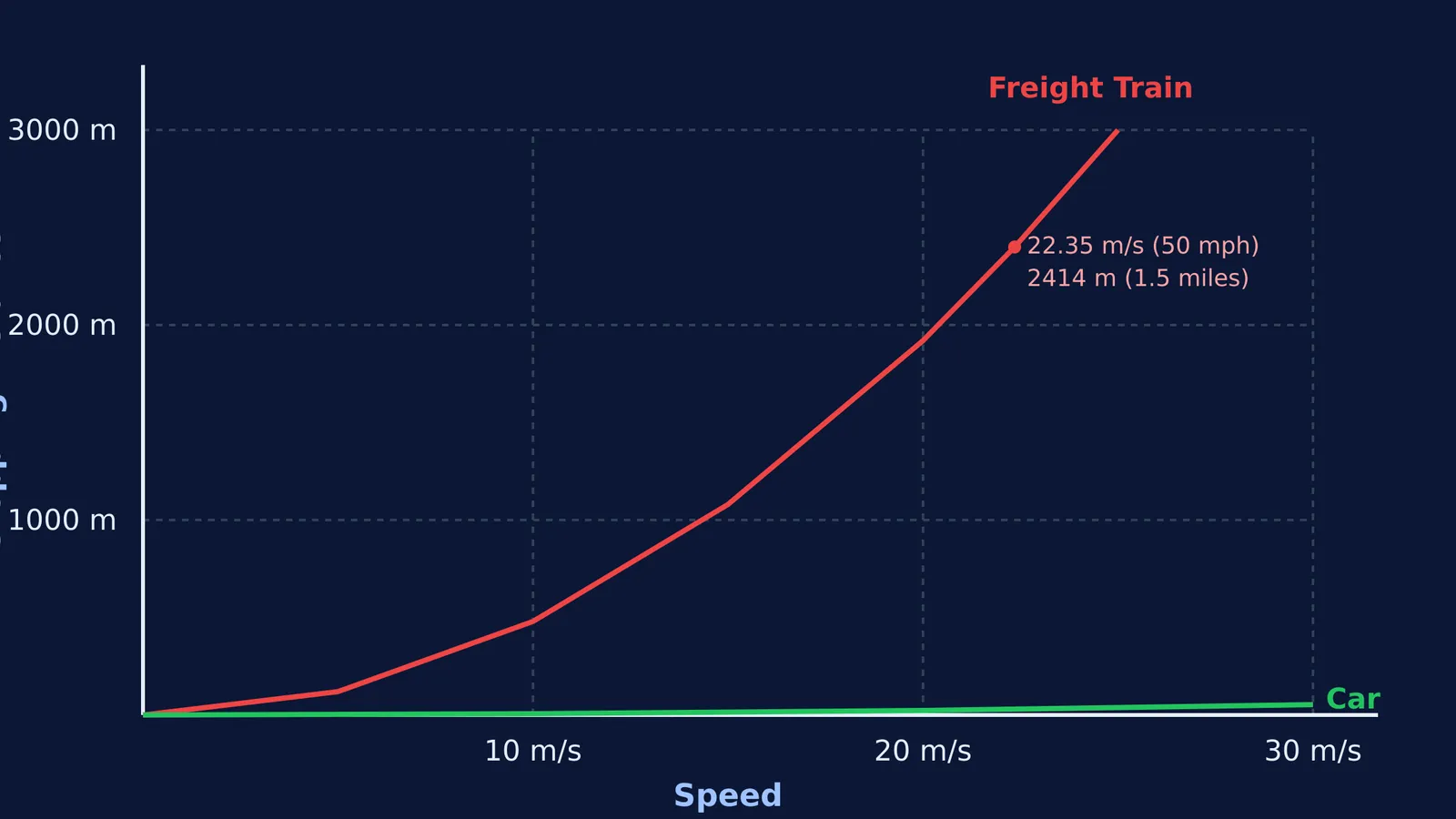
According to the Minnesota Department of Transportation, a fully loaded freight train travelling at 50 mph requires approximately 1.5 miles to come to a complete stop. The physics of momentum, kinetic energy and friction explain why stopping something this massive takes so much track.
Why do trains take so long to stop?
Stopping any moving object means getting rid of its kinetic energy (E = mv²/2) and fighting its momentum (p = mv). Because velocity is squared in the energy equation, doubling your speed quadruples the stopping distance.
But mass (m) is the bigger problem. A fully loaded freight train has far more mass than a family car. According to Newton's second law (F = ma), massive objects require immense force to decelerate. That kinetic energy must be dissipated as heat through friction.
To bring that mass to a halt, the brakes push brake shoes against the wheels, and the wheels push against the rails. The maximum possible deceleration before the wheels start sliding is governed by the coefficient of static friction (μ).
According to Engineering ToolBox data, the coefficient of static friction for a rubber tyre on dry asphalt is around 0.9. A train, however, relies on steel wheels and steel rails, where the dry static friction is between 0.5 and 0.8. If the rails are even slightly greasy, the static coefficient drops to 0.16, giving a train significantly less "grip" than a car.
To see why this matters, consider the kinematics equation d = v² / (2μg). If a car with a high friction coefficient takes a given distance to stop, a train with a much lower coefficient will require several times that distance from the same speed.
How does the contact patch limit braking?
Despite a locomotive's immense size, the actual area where each wheel touches the rail is tiny. Because hardened steel does not flatten out like a rubber tyre, the contact patch between a train wheel and the track is roughly the size of a single coin.
All of the train's braking force must be transmitted through these tiny patches of steel. If the brakes apply a force greater than this friction limit, the wheels will lock up and slide. Sliding destroys the wheels by grinding flat spots into the steel, which can lead to a derailment. As a result, engineers must apply the brakes gently, keeping the actual deceleration rate to a fraction of what the friction coefficient technically allows.
When that much kinetic energy is converted into heat, temperatures rise drastically. If a train engineer applies the brakes too heavily for too long, the brake shoes and wheels can overheat. The intense heat can cause the steel to expand and even melt or fail. This thermal limit is another reason why braking must be spread out over long distances.
What is brake propagation delay?
When you press the brake pedal in a car, hydraulic fluid clamps the brake pads almost instantly. Trains, however, use air brakes. When the engineer initiates a stop, a drop in air pressure must travel backward through a pipe running the entire length of the train.
Air pressure changes cannot travel faster than the speed of sound. On a long train, it takes time for the signal to reach the rear cars. During those crucial seconds, the unbraked cars at the back continue to push the front of the train forward, significantly adding to the total distance.
What do engineers do to improve grip?
To compensate for low friction, especially in emergency situations or when climbing steep grades, locomotives carry a built-in workaround: sand. Locomotives are equipped with sanders that drop abrasive sand directly onto the rails just in front of the wheels. This artificially increases the coefficient of friction, giving the wheels more grip to either accelerate a heavy load or help the train decelerate faster.
Visualising how these variables change a stopping distance curve can be tricky, which is why the Fermi Simulation Lab offers interactive simulations for the ideas that are easier to see than to read.
If you are working through kinematics and forces in class, these principles appear constantly. You can explore how they apply in different scenarios in our guides to calculating stopping distance and reaction time and solving static and kinetic friction problems.


