

On this page
When you step on the brake pedal in a conventional car, the brake pads clamp down on the rotors. Friction slows the car, turning its kinetic energy into wasted heat that dissipates into the surrounding air. Electric vehicles (EVs) have a smarter and far more efficient way to stop: regenerative braking. By running the electric motor in reverse, the car captures its own forward momentum and turns it back into electricity, storing it in the battery for later use.
How does regenerative braking charge an electric vehicle?
To understand regenerative braking, we must look at Faraday's law of electromagnetic induction. An electric motor and an electric generator are essentially the exact same device, simply operating in reverse of one another. When you press the accelerator pedal, electricity from the battery flows through the motor's coils within a strong magnetic field. This flow of charge creates an electromagnetic force that spins the wheels and propels the car forward.
When you lift your foot off the pedal to slow down, the forward momentum of the heavy car keeps the wheels turning, which in turn spins the motor. Because the coils are now rotating through the magnetic field without drawing power from the battery, they act as a generator. If you are studying transformers and AC generators: turns ratio, efficiency and losses, the physics is exactly the same: motion through a magnetic field induces an electric current that flows back into the battery. The resistance you feel—the counter-electromotive force governed by Faraday's and Lenz's laws: finding the induced current direction—is what provides the braking effect, slowing the vehicle down smoothly.
How does regenerative braking extend driving range?
While no system captures all the available kinetic energy due to inevitable losses from heat and internal resistance, modern EVs are highly effective at recycling momentum. The U.S. Department of Energy notes that electric vehicles convert over 77% of electrical energy from the grid to power at the wheels. By contrast, conventional gasoline vehicles only convert 12% to 30% of the energy stored in gasoline to power at the wheels. This dramatic difference in efficiency makes it highly rewarding to save every possible bit of charge.
This recovered charge directly boosts how far you can drive before needing to plug in. It is particularly noticeable in stop-and-go city traffic or when descending long, steep hills, where frequent deceleration offers many continuous chances to harvest energy that would otherwise be thrown away.
For students preparing for physics exams, connecting these everyday technologies to textbook concepts makes the maths much easier to grasp. If you want to test these principles yourself, the Simulation Lab has interactive simulations for the ideas that are easier to see than to read.
Why do EVs still have normal brakes?
Even with the advantages of regenerative braking, every EV is equipped with standard friction brakes. The electric motor can only provide a limited amount of resistive torque, which is fine for gradual stops but insufficient for emergencies. If you need to stop suddenly to avoid an obstacle, or if the battery is completely full and cannot safely accept a rapid surge of charge, the car will automatically engage the traditional brake pads. However, because the motor handles most of the routine slowing down, an EV's mechanical brakes wear out much slower than those in a standard car, often lasting for the entire life of the vehicle.
A quick energy recovery calculation
To see exactly how much energy this system saves in practice, let's look at the maths for a hypothetical braking event based on standard kinetic energy equations. By replacing percentages with simple fractions, we can build a clear, step-by-step worked example.
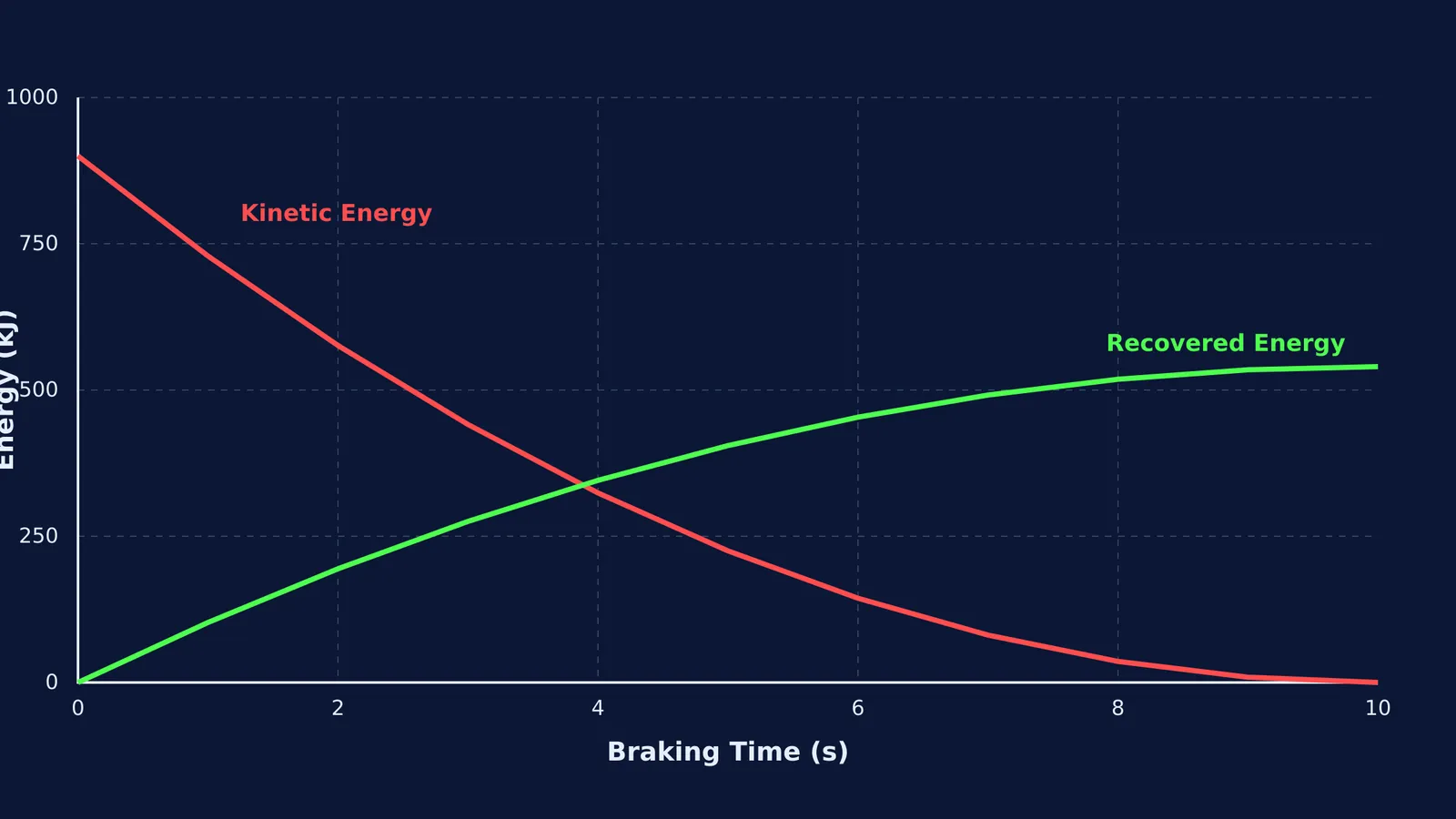
Find the kinetic energy: A 2000 kg EV travelling at 30 m/s (about 108 km/h) has a kinetic energy of ½mv², which is ½ × 2000 × 30² = 900,000 Joules, or 900 kJ.
Calculate the recovered energy: If the regenerative braking system captures a fraction of this energy, such as three-fifths, it returns 540 kJ directly to the battery pack.
Compare to friction brakes: In a standard petrol car, all 900 kJ of that kinetic energy would be permanently lost to the air as heat, providing absolutely no benefit to the driver.


