

On this page
A car pulls away from a signal with a steady push from its tyres. Is the engine working at the same rate the whole time? No. If the force stays constant, the power keeps rising, and that one fact settles a classic physics exam question: how do average power and instantaneous power compare over the run?
From rest, the average is half the final value. Here is why, with real numbers, and where the rule breaks.
What is the difference between average and instantaneous power?
Average power is the work done during a time interval divided by that interval, P_avg = ΔW/Δt, as defined in OpenStax University Physics, section 7.4 on power.
Instantaneous power is the limit of that average as the time interval shrinks to zero, P = dW/dt, according to the same OpenStax section.
The same section shows that P = F·v, measured in watts (1 W = 1 J/s). For a car speeding up on a straight road, force and velocity are parallel, so this is simply F times v.
Why does power grow linearly with time at constant force?
Follow the chain one step at a time:
A constant force F on a car of mass m gives a constant acceleration, a = F/m.
Starting from rest, the speed after time t is v = at.
The instantaneous power is P = Fv = Fat = (F²/m)t.
F and m do not change, so P is a constant multiplied by t: a straight line through the origin on a power-time graph.
Why is average power half the final power?
There are three ways to see it, and they agree.
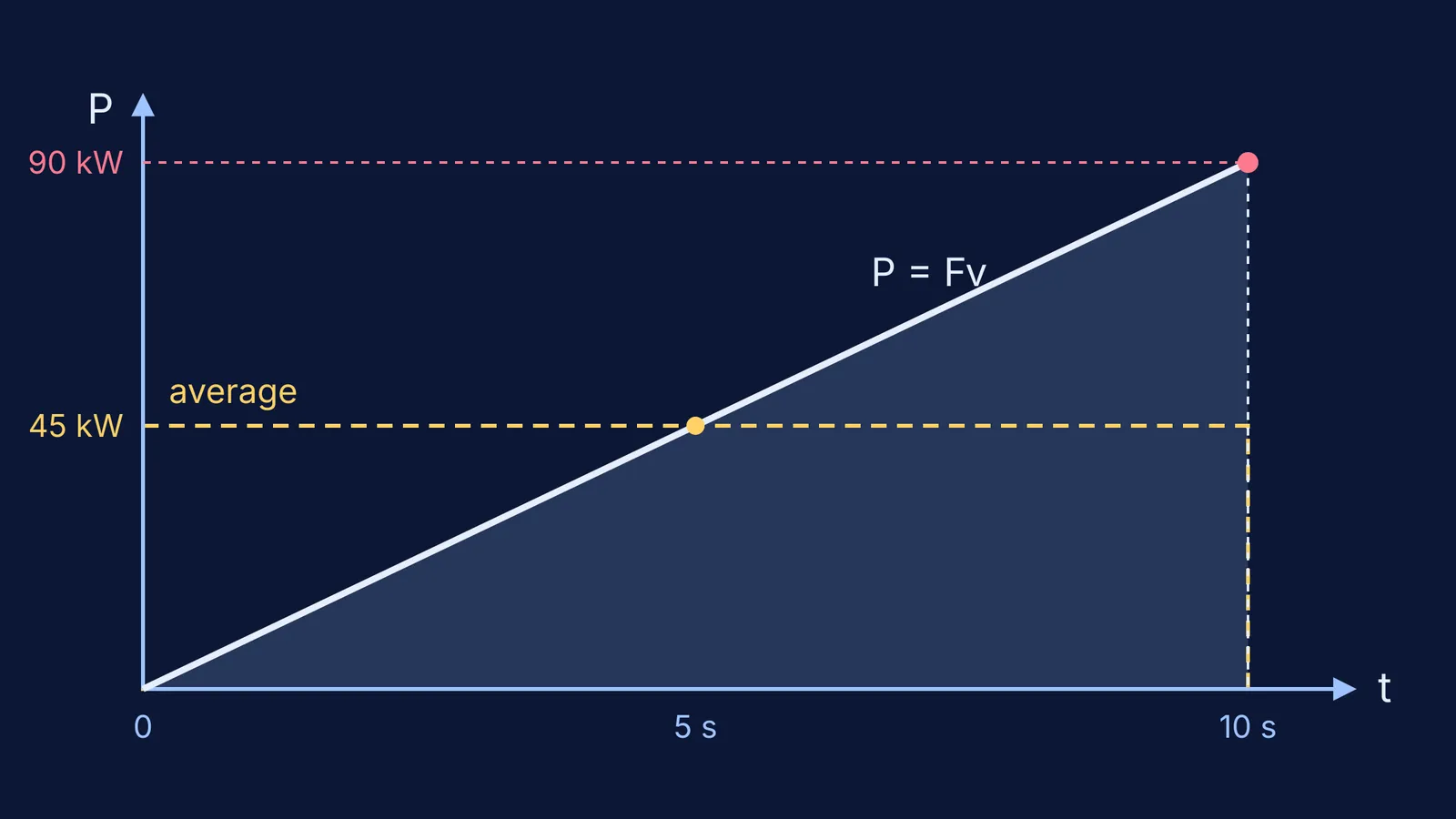
The graph. Work is the area under the power-time graph. Under a straight line from zero to P_final, that area is a triangle, ½ × t × P_final. Divide by t and you get P_final/2.
Work-energy. The work done equals the kinetic energy gained, ½mv². Divide by t, and use mv/t = ma = F: average power = ½Fv.
Average velocity. With constant acceleration, average velocity is (u + v)/2, which is v/2 from rest. Average power is F times average velocity, so it is F × v/2. Our post on when average velocity equals u plus v by 2 explains why that formula needs constant acceleration.
Worked example: a 1000 kg car pushed by 3000 N
Take a 1000 kg car on a level road, starting from rest, with a constant net force of 3000 N for 10 s. Ignore friction for now.
Acceleration: a = 3000/1000 = 3 m/s².
Final speed: v = 3 × 10 = 30 m/s, which is 108 km/h.
Final instantaneous power: P = Fv = 3000 × 30 = 90,000 W = 90 kW.
Work done: W = ½mv² = ½ × 1000 × 30² = 450,000 J. As a check, the distance is ½at² = 150 m, and F × s = 3000 × 150 = 450,000 J.
Average power: 450,000 J ÷ 10 s = 45 kW, exactly half of 90 kW.
At t = 5 s the power is also 45 kW: here the average equals the power at the midpoint in time.
Using the OpenStax conversion of 1 hp = 746 W, 90 kW is about 121 hp and 45 kW is about 60 hp. If unit conversions slow you down, our horsepower-to-watts walkthrough has more practice.
When does the half rule fail?
The car is already moving. If it starts at speed u, average power is F(u + v)/2, which is more than half of Fv.
The power is constant, not the force. Many problems say an engine "delivers constant power P". Then the force falls as speed rises, the average power is just P, and Pt = ½mv² gives v proportional to √t. Read the question for which quantity is held fixed.
Force and velocity are not parallel. Then you need the full dot product F·v, not F times v. Our post on instantaneous power from force and velocity vectors works through that case.
Constant friction does not break the rule. The engine force (ma plus friction) is still constant, so engine power still rises linearly from zero.
How should you practise this for exams?
When you meet a power question, write down what is constant before you write any formula: force, acceleration, or power. Then sketch P against t. A straight line through the origin means halve. A flat line means the power is the average. Anything else means integrate P = Fv over time.
To practise picking the right case, the Fermi Problem Library has worked problems with a step-by-step solver that explains the reasoning rather than printing an answer. If the gap is in the idea of power itself, or in the work-energy theorem underneath it, each concept in the Fermi Concept Library has its own lesson.
Next time a power question gives you a constant force, sketch the straight line first. The triangle gives you the average.


