

On this page
In physics kinematics, students often rely on algebraic shortcuts to solve exam problems quickly. One of the most common shortcuts is taking the arithmetic mean of the initial and final velocities to find the average velocity. However, this formula only works under a very specific condition, and using it incorrectly is a frequent trap set by examiners in competitive tests like JEE Main, JEE Advanced and NEET-UG.
When is average velocity equal to u plus v by 2?
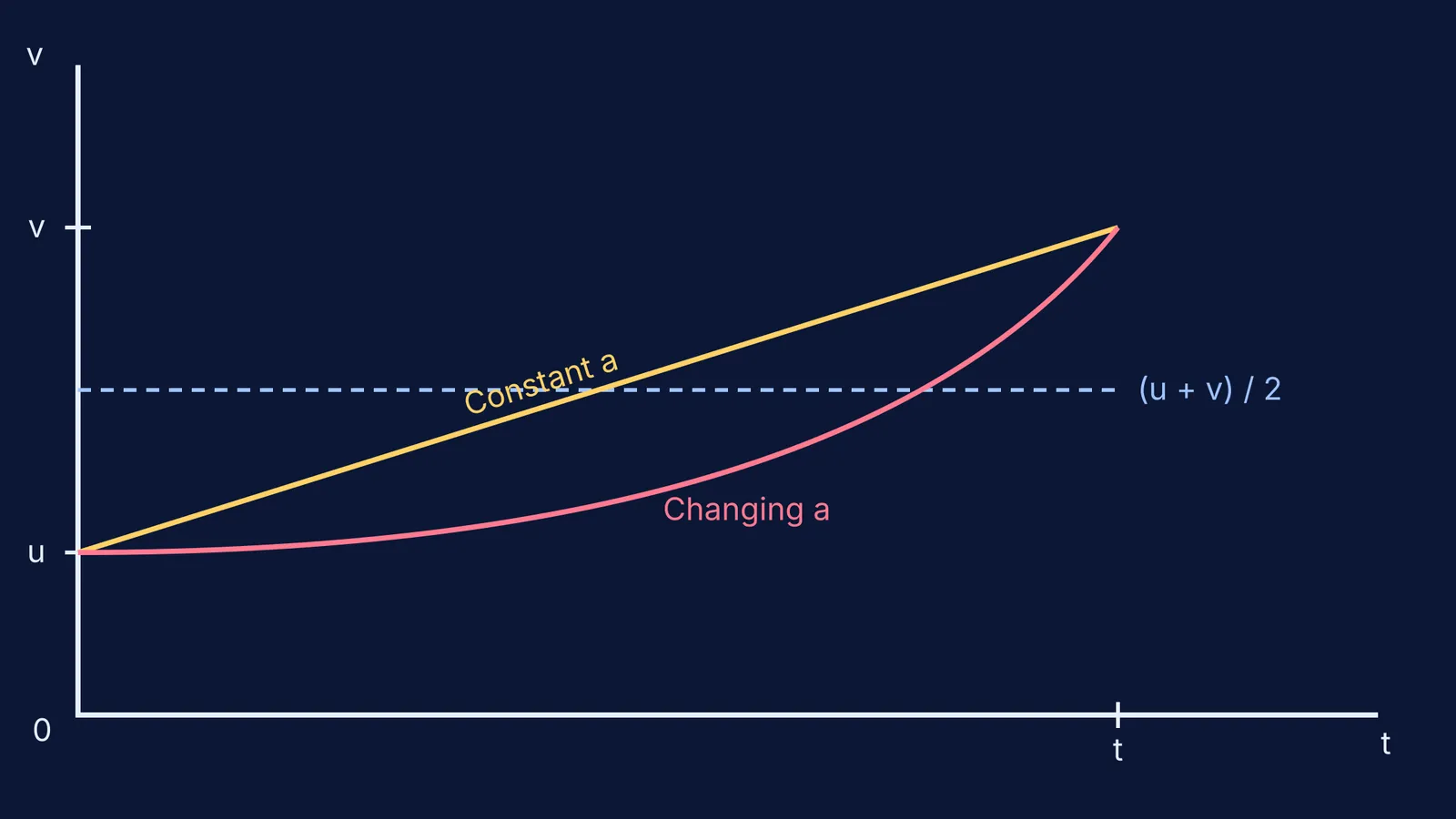
The formula stating that average velocity is (u + v)/2 is valid only when an object moves with a constant, uniform acceleration. According to OpenStax University Physics, when acceleration is constant, the object's velocity increases or decreases at a perfectly steady rate.
If you plot a velocity-time graph for this motion, it forms a perfectly straight diagonal line. Because the relationship between velocity and time is strictly linear, the exact mathematical midpoint of the initial velocity (u) and the final velocity (v) yields the true average velocity over that specific time interval. The instantaneous acceleration equals the average acceleration at every moment.
You can then multiply this average velocity by the total time (t) to find the total displacement. Graphically, this corresponds to calculating the area of the trapezoid formed under the straight line. The area of this trapezoid can be broken down into a rectangle and a triangle, which simplifies algebraically to the same exact result. This logic forms the mathematical foundation for deriving the standard equations of motion.
If you find yourself stuck trying to remember the conditions for these formulas during your revision, the Fermi Concept Library can help you trace the derivations step by step and understand exactly when each one applies.
Why does the shortcut fail for changing acceleration?
When an object's acceleration changes over time, its velocity-time graph is no longer a straight line; instead, it curves. If the graph curves, the area underneath it—which represents the total displacement—is no longer a simple geometric trapezoid. Consequently, the true average velocity shifts away from the exact mathematical middle of u and v.
Consider a hypothetical mathematical example to see why the shortcut breaks down. Imagine a car that needs to travel for 4 seconds, starting at an initial velocity of 10 m/s and ending at 30 m/s.
If the car accelerates at a constant rate, its speed steadily creeps up from 10 to 30. Its average velocity is exactly (10 + 30)/2 = 20 m/s. In 4 seconds, it covers 20 × 4 = 80 metres.
Now, imagine the car drives at a steady 10 m/s for the first 3 seconds, covering 30 metres. Then, in the final 1 second, it suddenly slams on the accelerator, uniformly increasing its speed to 30 m/s. In that final second, its average speed is 20 m/s, so it covers 20 metres.
Its total displacement over the entire journey is 30 + 20 = 50 metres. Its true average velocity over the 4 seconds is 50 m / 4 s = 12.5 m/s.
The algebraic formula (u + v)/2 still spits out 20 m/s, which is completely wrong in this scenario. Because the car spent the vast majority of its time travelling slowly and only sped up at the very end, the true average is heavily weighted towards the slower speed. This is a classic trap in problems testing the difference between average speed vs average velocity.
How do you find average velocity when acceleration varies?
If the acceleration is changing, you cannot use the arithmetic mean shortcut. Instead, you must return to the fundamental, universal definition of average velocity: total displacement divided by total time. This definition applies to all types of motion without exception.
When acceleration is given as a function of time or velocity, you must use calculus to find the answer. You integrate the velocity function over the given time interval from the start time to the end time to find the exact total displacement. Then, you divide that result by the total time elapsed.
This integration mathematically computes the exact area under the curved velocity-time graph. It ensures you account for every single moment of the journey, whether the object was accelerating rapidly, slowing down, or coasting at a steady speed.
Relying on first principles rather than algebraic shortcuts is the only way to guarantee a correct answer in advanced kinematics problems. By mastering the core definitions and conditions for each equation, you will avoid common pitfalls and tackle complex physics scenarios with confidence.
To summarise, always follow these rules when calculating average velocity:
Check for constant acceleration: If acceleration is uniform, you can safely use the (u + v)/2 shortcut.
Identify changing acceleration: If acceleration varies with time or position, the arithmetic mean is incorrect.
Use first principles: When in doubt, divide the total displacement by the total time.


