On this page
Every Class 12 student learns Henry's law as p = K_H x. William Henry, a Manchester chemist, never wrote it that way. His paper, "Experiments on the quantity of gases absorbed by water, at different temperatures, and under different pressures", was read to the Royal Society on 23 December 1802 and printed in Philosophical Transactions in 1803 (DOI 10.1098/rstl.1803.0004). A scan of the paper and its short appendix is free to read on the Internet Archive. Reading it clears up two things that trip students: Henry stated his law in volumes, and the gas-mixture part came from a suggestion by his friend John Dalton.
What did William Henry actually write in 1803?
Henry opens by crediting earlier work: the use of pressure to charge water with gas was "first, I believe, suggested by Dr. Priestley" (see how Joseph Priestley invented soda water).
He shook a measured volume of gas with boiled water over mercury and read how far the mercury rose as the gas dissolved. To add pressure, he poured mercury into a long tube: a column 28 inches higher for one extra atmosphere and 56 inches for two, so up to three atmospheres in all.
After "a series of at least fifty experiments, on carbonic acid, sulphuretted hydrogen gas, nitrous oxide, oxygenous and azotic gases" (CO₂, H₂S, N₂O, O₂ and N₂), he stated what he called a general law:
"under equal circumstances of temperature, water takes up, in all cases, the same volume of condensed gas as of gas under ordinary pressure."
He then drew the consequence. Because a gas's volume is inversely proportional to the pressure on it, water under one, two or more extra atmospheres takes up an amount which, "ordinarily compressed, would be equal to twice, thrice, &c. the volume absorbed under the common pressure of the atmosphere".
What do Henry's own numbers show?
His temperatures are in °F. For carbonic acid, 100 measures of water took up 108 measures of gas at 55 °F (12.8 °C) and 84 at 85 °F (29.4 °C) in matching experiments, and only 45 to 60 at 110 °F (43.3 °C). Warm water held less gas, the same trend NCERT describes when K_H rises with temperature. In the appendix he gives 106 to 108 measures of H₂S per 100 of water at 60 °F (15.6 °C).
His oxygen, nitrogen and hydrogen figures (one to four measures per 100 of water) came from impure gases, and he corrected them in the appendix, so do not use them to check modern K_H values.
Why is "the same volume" a trap in JEE?
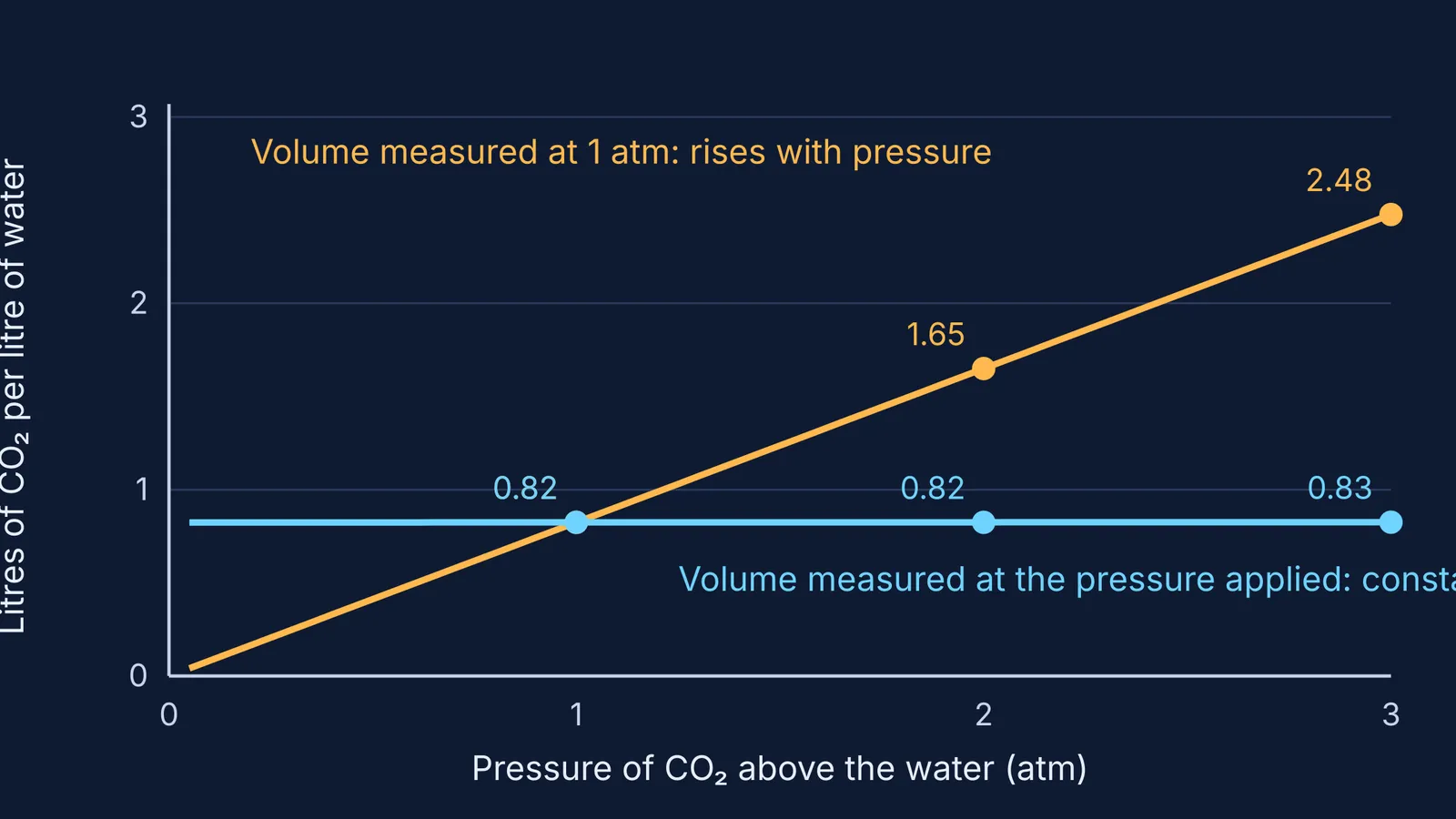
The amount of gas that dissolves (moles or grams) is proportional to pressure. That is the law you use in numericals. But if you measure the dissolved gas as a volume at the pressure you applied, it comes out the same at every pressure, because doubling the pressure doubles the amount and halves the volume each mole takes up. Both statements are true. "The volume dissolved, measured at the pressure used, is independent of pressure" is Henry's original form, not a contradiction of NCERT.
Worked example: Henry's law in his own units
How much CO₂ dissolves in 1 L of water at 298 K under 1 atm and under 3 atm? Use K_H = 1.67 kbar from NCERT's Solutions chapter, Table 1.2.
Convert units. K_H = 1670 bar, and 1 atm = 1.01325 bar.
Mole fraction at 1 atm: x = p / K_H = 1.01325 / 1670 = 6.07 × 10⁻⁴.
Moles of water in 1 L (about 1000 g): 1000 / 18.015 = 55.51 mol. So n(CO₂) = x × 55.51 / (1 − x) = 0.0337 mol, which is 1.48 g.
Volume of that gas at 1 atm and 298 K: V = nRT/P = 0.0337 × 0.08206 × 298 / 1 = 0.82 L.
At 3 atm: x = 3.04 / 1670 = 1.82 × 10⁻³, n = 0.101 mol, mass = 4.46 g. That is three times as much, as Henry said.
Volume of this gas measured at 1 atm: 2.48 L. Measured at 3 atm: 2.48 / 3 = 0.82 L, about the same as in step 4. That is Henry's "same volume of condensed gas".
About 0.82 L per litre at 25 °C sits sensibly beside Henry's 1.08 at 12.8 °C, since colder water holds more CO₂.
Where does Dalton come in?
Henry's first CO₂ results "differed considerably from each other" at the same temperature. He writes: "Of the cause of these variations I was not aware, till my friend Mr. Dalton suggested, that they probably depended on the variable amount of the residues." The undissolved gas always held a little air, and the more air it held, the less CO₂ went in. When he shook 20 measures of CO₂ with 10 of water, at least 10 dissolved. With 20 of CO₂ plus 10 of common air, the same water took only 6.
In the appendix he states the idea in full: "the theory which Mr. Dalton has suggested to me on this subject... is, that the absorption of gases by water is purely a mechanical effect, and that its amount is exactly proportional to the density of the gas, considered abstractedly from any other gas with which it may accidentally be mixed." In modern words, only a gas's own partial pressure counts.
You can test this on his mixture. Let a measures of CO₂ dissolve. The leftover gas is (20 − a) of CO₂ and 10 of air at 1 atm, so the CO₂ fraction is (20 − a)/(30 − a). If 10 measures of water hold 10 to 10.8 measures of pure CO₂, then a = 10 × (20 − a)/(30 − a) gives a = 5.9, and the 10.8 version gives 6.3. Henry measured 6. The same idea explains why air dissolved in water is richer in oxygen.
NCERT's short history says that Dalton, "a contemporary of Henry, also concluded independently" that solubility depends on partial pressure. Henry's own paper tells it a little differently: he credits Dalton with suggesting the idea to him. We have not read Dalton's own papers here, so the fair summary is that the partial-pressure part reached Henry's paper through Dalton.
How is Henry's law tested in exams?
It sits in Class 12 Solutions and in the JEE Main, JEE Advanced and NEET-UG syllabi. Common question types:
moles or mass dissolved against pressure, a straight line through the origin;
the statement that the volume dissolved, measured at the pressure used, does not change;
gas mixtures, where you must use the partial pressure (for O₂ in air, about 0.21 of the total);
a larger K_H meaning lower solubility, and K_H rising with temperature.
For more numericals in NCERT's form, see Henry's law and the solubility of gases, with worked problems.
To see how mole fraction, partial pressure and solubility link up, the Concept Library covers every concept in physics, chemistry, biology, mathematics and computing. For timed practice on questions like these, Fermi Test Prep is built for JEE Main and Advanced preparation, with an AI tutor.
Quick checklist
Henry's 1803 law: the same volume of compressed gas dissolves at every pressure.
So the amount dissolved is twice at 2 atm and three times at 3 atm.
Dalton suggested the partial-pressure idea, which Henry credits in his appendix.
Use partial pressure, not total pressure, for a gas in a mixture.