On this page
You are driving on a busy highway, the traffic ahead suddenly stops, you crawl for a few minutes, and then everything clears. No accident, no broken-down truck, nothing. What you met was the leftover of a stop that happened kilometres ahead and minutes earlier. A jam is not a fixed thing sitting on the road. It is a wave that travels backwards, against the traffic, and it can keep going long after its cause has gone. You can work out its speed with one line of Class 11 reasoning: cars are conserved.
Why does a traffic jam move backwards?
Think about the back edge of a queue. Cars keep arriving at it from behind and stopping. Each new car that stops joins the queue at its back, so the back edge moves towards the oncoming traffic, even though no car ever drives backwards.
Now count cars. Suppose the free traffic behind has flow q₁ (cars per hour passing a point) and density ρ₁ (cars per kilometre), and the queue has flow q₂ and density ρ₂. Let the boundary between them move at speed w. In the frame moving with the boundary, every car that crosses it on one side must come out on the other, because cars are not created or destroyed. The rate at which cars cross, seen from the moving boundary, is q − ρw on each side. Setting the two equal gives
w = (q₂ − q₁)/(ρ₂ − ρ₁)
This is the shock-wave speed of the Lighthill–Whitham–Richards theory of traffic, set out by Lighthill and Whitham in 1955 (Proceedings of the Royal Society A). The relative velocity step is the same idea as in one train overtaking another: what matters is speed relative to the moving thing you are counting across.
For a stopped queue, q₂ = 0 and ρ₂ > ρ₁, so w is negative. The tail runs back up the road.
How fast does the tail of a jam run back?
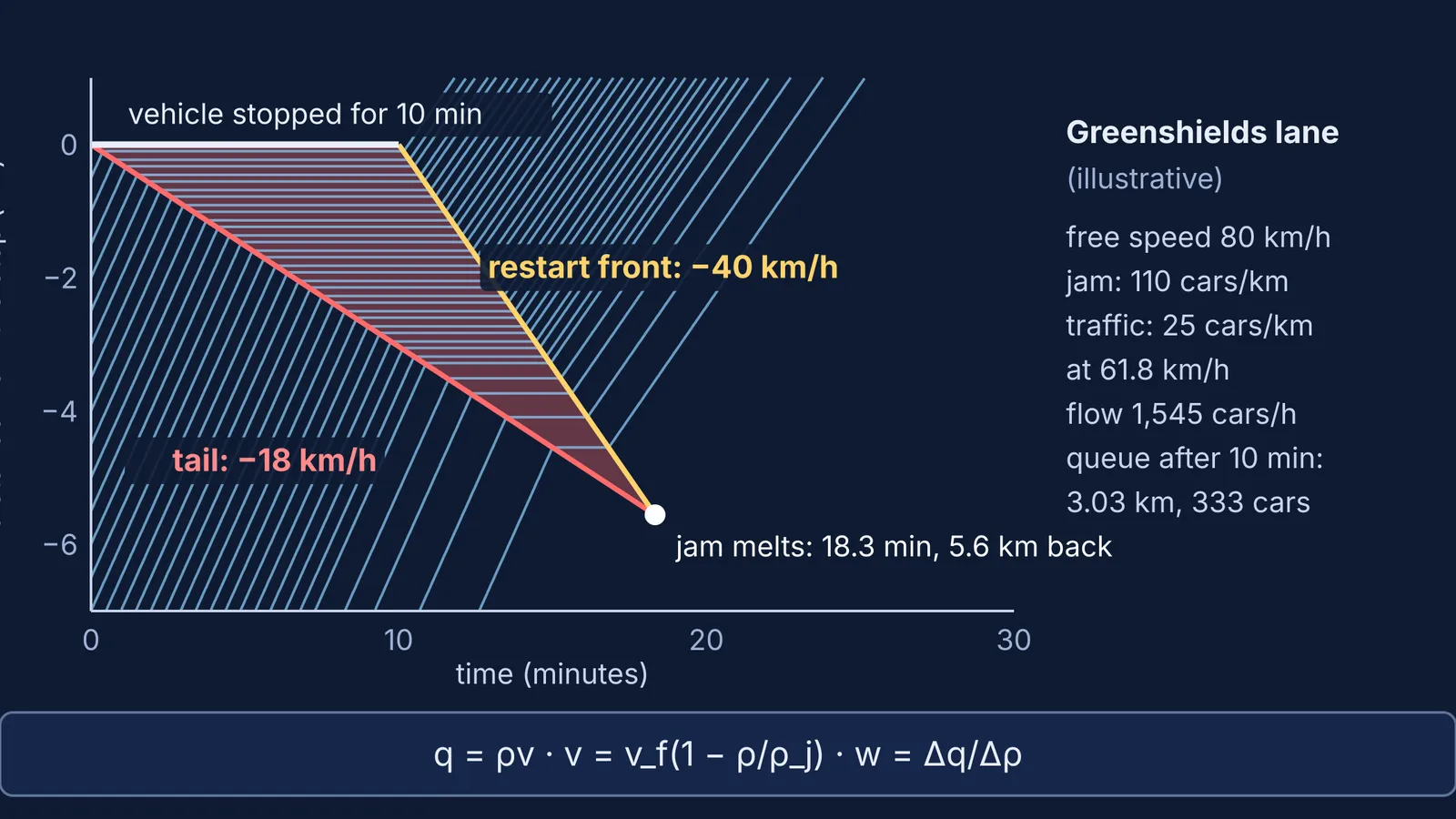
You need a rule linking speed and density for one lane. The simplest is a straight line, first proposed by Bruce Greenshields in the 1930s: v = v_f(1 − ρ/ρ_j), where v_f is the speed on an empty road and ρ_j is the jam density, when cars are bumper to bumper. Real traffic does not follow a straight line exactly, so the values below are illustrative: v_f = 80 km/h and ρ_j = 110 cars/km, about 9 m of road per stopped car.
Flow is q = ρv. It is zero for an empty road and zero for a stopped queue, and largest in between, at ρ = 55 cars/km and v = 40 km/h, where q = 2,200 cars an hour.
Worked example: a 10-minute stop on a busy lane
Traffic is flowing at 25 cars/km when a vehicle stops dead across the lane for 10 minutes.
Upstream traffic. v₁ = 80 × (1 − 25/110) = 61.8 km/h. Flow q₁ = 25 × 61.8 = 1,545 cars an hour, one car every 2.3 s.
The queue. It is stopped, so ρ₂ = 110 cars/km and q₂ = 0.
Speed of the tail. w = (0 − 1,545)/(110 − 25) = −18.2 km/h. The minus sign means it moves back, against the traffic.
Closing speed. A driver at 61.8 km/h approaches the tail at 61.8 + 18.2 = 80 km/h. That is why the tail seems to come at you so fast.
After 10 minutes. The tail is 18.2 × (10/60) = 3.03 km back. The queue holds 110 × 3.03 = 333 cars.
The obstacle clears. Cars at the front pull away. They leave at the capacity state, 55 cars/km at 40 km/h (2,200 cars an hour). The boundary between the queue and the departing cars moves at w = (2,200 − 0)/(55 − 110) = −40 km/h. The restart also travels backwards, and faster than the tail.
The jam melts. The restart front gains on the tail at 40 − 18.2 = 21.8 km/h. It starts at the obstacle while the tail is 3.03 km back, so it catches up after a further 3.03/21.8 h, about 8.3 minutes. That is 18.3 minutes after the stop began, at 18.2 × 18.3/60 = 5.6 km behind the obstacle.
Check the units: (cars/h)/(cars/km) = km/h.
So drivers up to 5.6 km behind the spot still have to stop, for up to 8 minutes after the road ahead was clear again. Counting cars crossing the moving tail, at 1,545 + 25 × 18.2 = 2,000 cars an hour for 18.3 minutes, about 611 cars have to stop in total.
Can a jam form with no obstacle at all?
Yes, and this is the "phantom" jam. In 2008 a team in Japan put 22 cars on a circular track 230 m round and asked the drivers to cruise at about 30 km/h with even spacing. Small fluctuations grew, a jam formed with no bottleneck, and the jam cluster travelled backward at roughly 20 km/h, which the authors note is the common value measured for jams on real highways (Sugiyama and others, New Journal of Physics, 2008).
The straight-line model above cannot produce that jam. It assumes every driver matches speed to spacing instantly. Real drivers react late: someone brakes a little, the driver behind brakes a little harder after a reaction delay, and the next one harder still. The reaction time you met in stopping distance and reaction time is what turns a tiny dab of brakes into a full stop several cars back. Once a jam exists, though, its back and front move by the same counting rule, which is why the measured speed is so similar from place to place.
If relative velocity in moving frames still feels shaky, the Concept Library has a lesson for it, and the jam is a good test of whether the idea has stuck.
How is this different from waves at traffic signals?
A signal is a stop that repeats every cycle, so the same backward tail and backward restart happen at every red light. How traffic lights are timed and how green waves work covers the cycle, split and offset that engineers choose. The jam wave is what happens behind each red: the queue's tail grows back during red, and the restart runs back to meet it during green.
From the physics, the one piece of practical sense is simple: keep a gap. A longer gap gives you time to ease off instead of braking hard, so the disturbance you pass back is smaller.
Quick checklist
Cars are conserved, so a boundary between two traffic states moves at w = (q₂ − q₁)/(ρ₂ − ρ₁).
A stopped queue has q = 0, so its tail moves back: −18.2 km/h in the example.
Drivers close on the tail at 61.8 + 18.2 = 80 km/h.
When the stop clears, the restart front also moves back, at −40 km/h, and catches the tail.
A 10-minute stop leaves a jam that melts 18.3 minutes later, 5.6 km back.
Real jams move back at roughly 20 km/h, and can form with no obstacle because drivers react late.