On this page
Table 6.5 in NCERT Class 11 Chemistry, Unit 6 (Equilibrium), lists lime water at pH 10.5, just above milk of magnesia at 10. You can check that number without a pH meter. You need two things from the same chapter: the solubility product of calcium hydroxide and the definition of pH. Worked that way, the answer comes out near 12.3, and careful measurement gives 12.45. The same check works for any value in a pH table.
What does NCERT's pH table say about lime water?
Table 6.5, "The pH of Some Common Substances", is on page 195 of the Reprint 2026-27 of NCERT Class 11 Chemistry, Unit 6. Its basic end reads:
Saturated solution of NaOH: ~15
0.1 M NaOH solution: 13
Lime water: 10.5
Milk of magnesia: 10
The order is right: lime water is more basic than milk of magnesia. The question is the size of the number. Table 6.9 (page 205) lists the Ksp of calcium hydroxide, Ca(OH)₂, as 5.5 × 10⁻⁶ at 298 K.
What is the pH of saturated lime water?
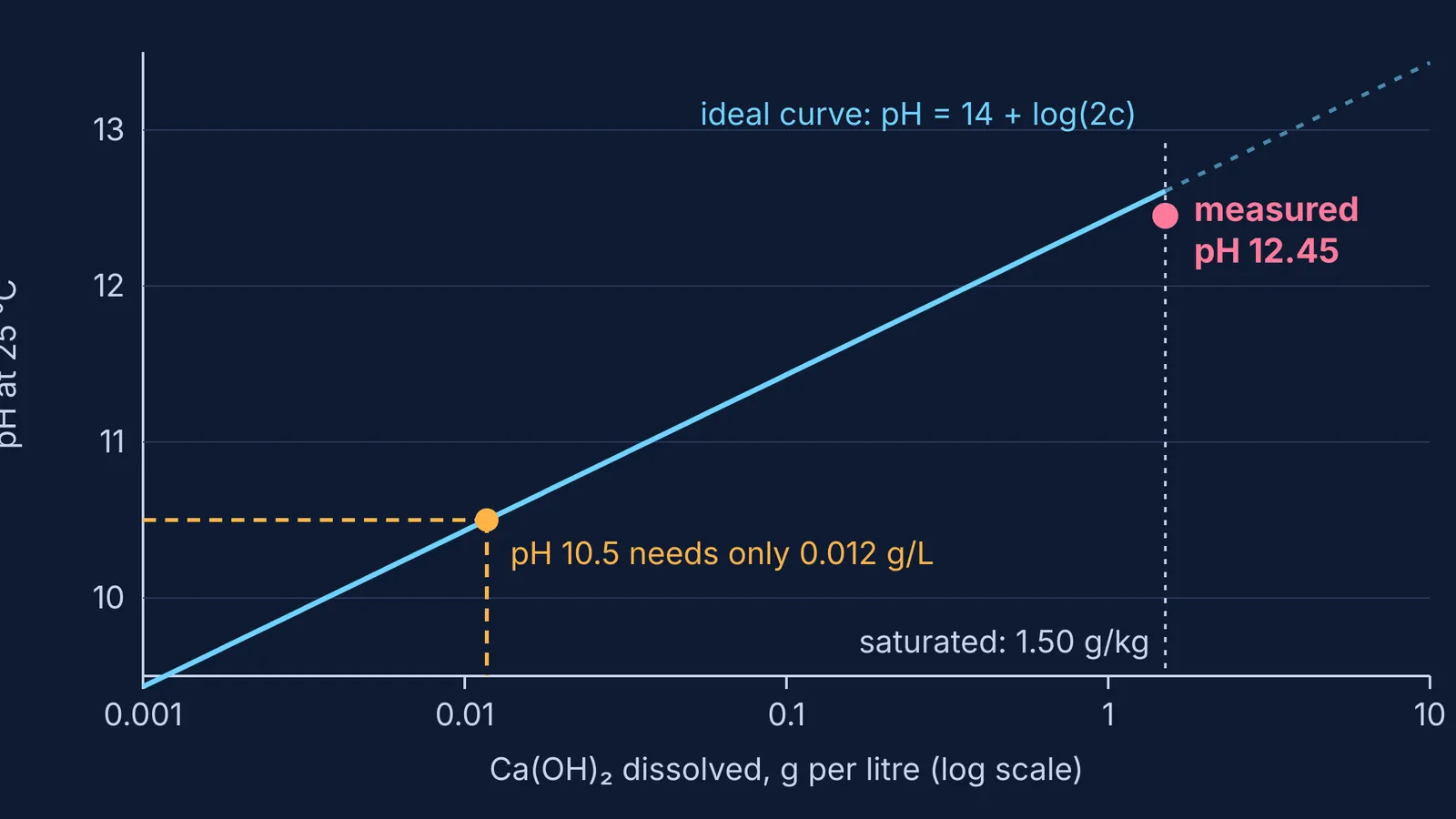
A careful measurement comes from a 1956 paper by Roger Bates, Vincent Bower and Edgar Smith of the US National Bureau of Standards, "Calcium hydroxide as a highly alkaline pH standard", in the Journal of Research of the NBS. They recommended a calcium hydroxide solution saturated at 25 °C as the sixth NBS pH standard. Their abstract states that "the saturated solution is about 0.0203 M and has a pH of 12.45 at 25 °C".
A few details from the same paper are useful:
The solubility they measured was 0.0203 mol per kg of water at 25 °C. With a molar mass of 74.09 g/mol, that is about 1.50 g of Ca(OH)₂ per kg of water.
The pH depends on temperature. It falls by about 0.033 unit per °C. A solution saturated at 25 °C reads 12.63 at 20 °C and 12.30 at 30 °C.
So "about 12.4" is a safe figure for fresh, saturated lime water at room temperature.
How do you check lime water's pH from NCERT's own Ksp?
Use NCERT's Ksp of 5.5 × 10⁻⁶ and assume the dissolved calcium hydroxide is fully split into ions.
Write the equilibrium. Ca(OH)₂(s) ⇌ Ca²⁺(aq) + 2OH⁻(aq). The equation balances: one Ca, two O and two H on each side, and the charges add up to zero.
Set up Ksp. If s mol/L dissolves, [Ca²⁺] = s and [OH⁻] = 2s. So Ksp = s × (2s)² = 4s³.
Solve for s. s³ = 5.5 × 10⁻⁶ ÷ 4 = 1.375 × 10⁻⁶, so s = 0.0111 mol/L. That is about 0.82 g per litre.
Find [OH⁻]. [OH⁻] = 2s = 0.0222 mol/L.
Find pOH. pOH = −log(0.0222) = 1.65.
Find pH. pH = 14 − 1.65 = 12.35.
The textbook's own Ksp predicts a pH of about 12.3, close to the measured 12.45. The table's 10.5 is 1.85 units lower. Since each pH unit is a factor of 10, that is about 70 times less hydroxide than the Ksp predicts.
If you want the reverse calculation, getting Ksp from a measured pH, it is worked step by step in finding Ksp of a metal hydroxide from the pH of its saturated solution.
What would a pH of 10.5 actually mean?
Turn the tabulated pH into a concentration. This check needs no Ksp.
pOH = 14 − 10.5 = 3.5.
[OH⁻] = 10⁻³·⁵ = 3.2 × 10⁻⁴ mol/L.
Each Ca(OH)₂ gives two OH⁻, so [Ca(OH)₂] = 1.6 × 10⁻⁴ mol/L.
Mass dissolved = 1.6 × 10⁻⁴ × 74.09 = 0.012 g per litre.
A pH of 10.5 would mean only 0.012 g of calcium hydroxide in a litre. Bates and his colleagues found about 1.50 g per kg of water dissolves at 25 °C, roughly 130 times more. The Ksp that pH 10.5 would need is 4 × (1.6 × 10⁻⁴)³ = 1.6 × 10⁻¹¹. That is the size of the Mg(OH)₂ value in the same Table 6.9 (1.8 × 10⁻¹¹), not the Ca(OH)₂ value. In other words, pH 10.5 describes a far less soluble hydroxide, such as magnesium hydroxide. NCERT's Mg(OH)₂ Ksp gives a saturated pH of 10.52.
We don't know how 10.5 came to be printed, and the check doesn't need to know.
Why do the calculated and measured values differ slightly?
You now have three numbers for the same solution:
12.35 from NCERT's Ksp.
12.45 measured by Bates, Bower and Smith.
12.61 if you take their 0.0203 M, assume every Ca(OH)₂ gives two free OH⁻, and use pH = 14 + log[OH⁻].
The spread has two causes, both discussed in the paper. First, at this ionic strength (about 0.06) ions do not behave as if they were alone, so their effective concentration (activity) is lower than the molar concentration. Second, the paper treats the second step, CaOH⁺ ⇌ Ca²⁺ + OH⁻, as incomplete, so some hydroxide stays paired with calcium. Ksp values also differ between data tables. None of these effects moves the answer by more than about 0.2 unit, so "about 12.4" covers them. None of them gets anywhere near 10.5.
One trap: don't put 0.0203 M into 4s³ to get a Ksp. That gives 3.3 × 10⁻⁵, which is too large, because 0.0203 M is a concentration, not an activity.
Why might lime water in your lab read below 12.4?
A classroom reading can come out lower, and that doesn't mean the table was right. Lime water left open absorbs carbon dioxide from the air: Ca(OH)₂(aq) + CO₂(g) → CaCO₃(s) + H₂O(l). Each CO₂ removes two OH⁻, so the pH drifts down, and a white film of calcium carbonate appears. This is the same reaction behind why limewater turns milky, then clear, with excess CO₂. Partial saturation or a warm lab also lowers it. Fresh, filtered, saturated lime water at 25 °C is about 12.4.
How can you use this check on other table values?
The method is short enough to run in your head:
Turn the tabulated pH into [H⁺] or [OH⁻].
Turn that into a concentration of the solute.
Ask whether that much can dissolve, using a Ksp or a solubility from the same book.
The same habit catches a mismatch in NCERT's HOCl pH problem, whose Ka disagrees with the chapter's own table. If you are preparing for JEE and want numericals that come with the chemistry behind them, Fermi Test Prep covers JEE Main and Advanced preparation, and Fermi's AI tutor for JEE prep checks your understanding as it goes.
Quick checklist
NCERT Table 6.5 lists lime water at pH 10.5. Measured saturated lime water at 25 °C is 12.45 (Bates, Bower and Smith, 1956).
NCERT's own Ksp, 5.5 × 10⁻⁶, gives s = 0.0111 M and pH ≈ 12.35.
pH 10.5 would mean only 0.012 g/L of dissolved Ca(OH)₂, about 130 times too little.
The pH falls about 0.033 unit per °C, and CO₂ from air lowers it further.
In exams, keep NCERT's order and use the value the question gives.