On this page
Sports teams and school fitness tests measure a vertical jump in two common ways. A jump mat (or a phone app that films your feet) only times how long you are off the ground. A force plate never looks at the flight at all: it records how hard you push on the floor. Both give a height in centimetres, and both rest on Class 11 physics. One uses projectile motion, the other the impulse–momentum theorem. Both methods are set out in Linthorne's paper in the American Journal of Physics, which also adds a third, the work–energy theorem.
Why you can jump higher on the Moon, and how push-off distance sets the height, is covered in how high could you jump on the Moon. Here the question is the measurement.
How does a jump mat turn flight time into height?
Once your feet leave the mat, only gravity acts on you (air drag is tiny at these speeds). Your centre of mass is a projectile thrown straight up. If you land in the same body position as you took off, the rise and the fall take equal times, each half of the flight time t.
Time to the top: t/2.
Falling from rest for t/2 drops you h = ½ g (t/2)².
So h = g t² / 8.
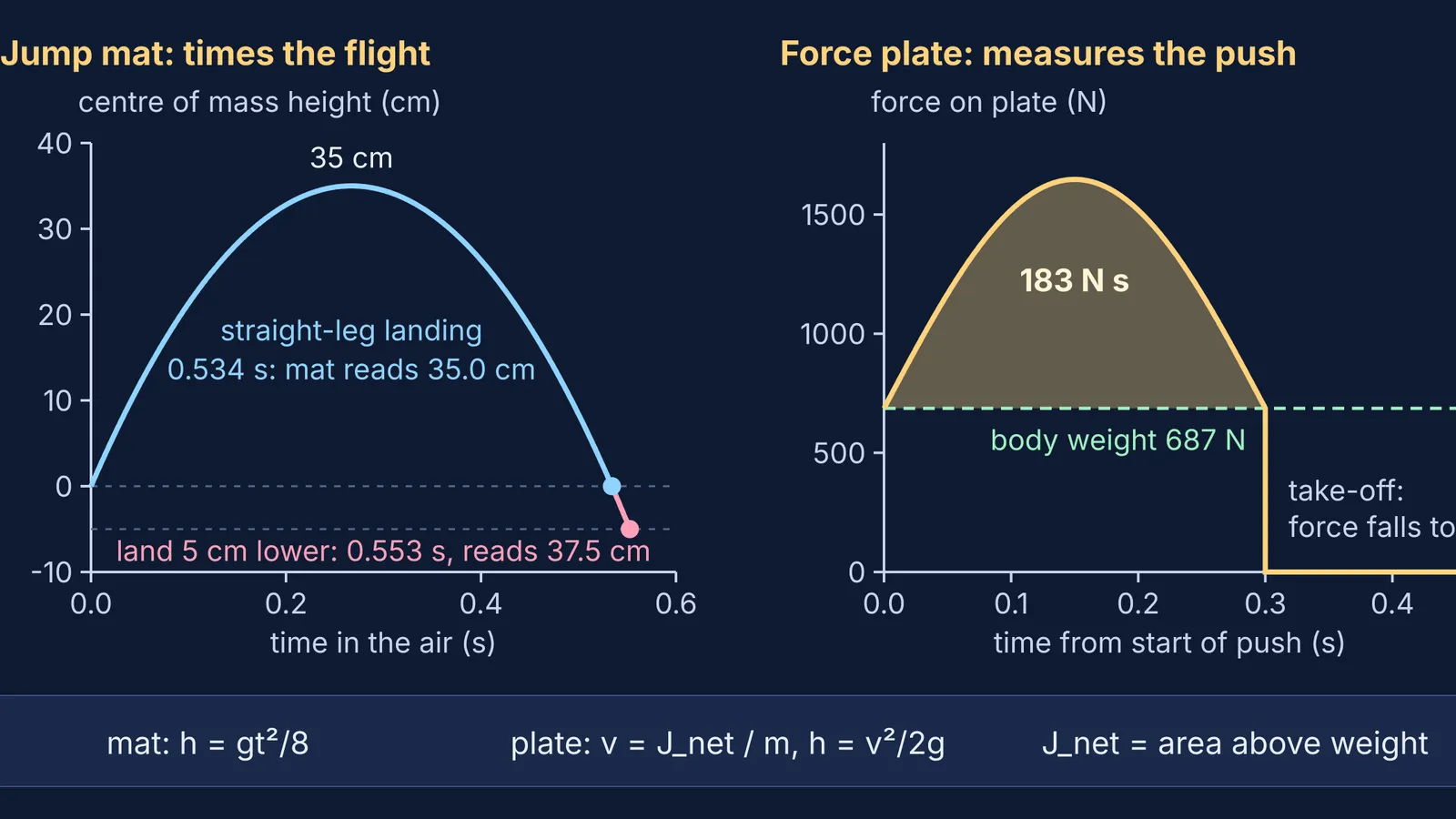
That is all a jump mat does. It starts a clock when the circuit under your feet opens and stops it when you land. Take a flight of 0.534 s and g = 9.81 m/s²:
h = 9.81 × 0.534² / 8 = 9.81 × 0.2852 / 8 = 0.350 m, or 35.0 cm.
Units check: (m/s²)(s²) = m. The take-off speed follows too: v = g t / 2 = 9.81 × 0.267 = 2.62 m/s.
Notice what h means here. It is the rise of your centre of mass after take-off, not the gap between your toes and the floor.
Why does landing with bent legs give a bigger reading?
The formula assumes you land with your centre of mass at the take-off height. A recent systematic review of jump-height methods states this assumption, and notes that people usually land lower because they bend their hips, knees and ankles as they come down (Xu and colleagues, Sports Medicine, 2023). Landing lower means a longer fall, so a longer flight, so a bigger number.
Work it out for the same 35 cm jump (take-off speed 2.62 m/s):
Rise. v/g = 2.62 / 9.81 = 0.267 s, whatever happens later.
Land 2 cm lower. The fall is 0.37 m, taking √(2 × 0.37 / 9.81) = 0.275 s. Flight = 0.542 s. The mat reads 9.81 × 0.542² / 8 = 36.0 cm, 2.8% too high.
Land 5 cm lower. The fall is 0.40 m, taking 0.286 s. Flight = 0.553 s. The mat reads 37.5 cm, 7.0% too high.
The jump did not change; only the landing did. The same review reports a force-plate study where flight time gave heights about 2.4 cm larger than the impulse method. Tucking your feet up before landing has the same effect, which is why testers ask you to land on straight legs.
How does a force plate find your take-off speed?
A force plate is a very fast, very accurate weighing scale. Like a weighing machine in an accelerating lift, it reads more than your weight whenever you accelerate upward. The extra force is what changes your momentum.
Take upward as positive. During the push, Newton's second law gives F − mg = ma. Add this up over time and you get the impulse–momentum theorem:
∫(F − mg) dt = m v − 0
So the net impulse J_net, the area between the force curve and the body-weight line, equals your momentum at take-off. Then v = J_net / m and h = v² / 2g. Reading areas from force–time graphs is explained in impulse and force–time graphs.
The landing never enters this calculation, so bent knees on landing cannot spoil it. The review above found the impulse method more accurate and reliable than flight time when both come from the same force plate.
Worked example: one jump, two methods
A 70 kg athlete jumps from a still crouch. The plate records an average force of 1,298 N over a 0.30 s push. Take g = 9.81 m/s².
Weight. mg = 70 × 9.81 = 687 N.
Average net force. 1,298 − 687 = 611 N, which is 1.89 times body weight in total force.
Net impulse. J_net = 611 × 0.30 = 183 N s.
Take-off speed. v = 183 / 70 = 2.62 m/s.
Height. h = 2.62² / (2 × 9.81) = 6.87 / 19.62 = 0.350 m.
Predicted flight time. t = 2v / g = 0.534 s, so a mat under the plate would also read 35.0 cm if the athlete lands on straight legs.
Check the push. Average acceleration 611 / 70 = 8.73 m/s², so the centre of mass rises ½ × 8.73 × 0.30² = 0.39 m during the push, a sensible crouch depth.
Now let the athlete land 5 cm lower. The plate still says 35.0 cm. The mat says 37.5 cm.
Why must the force plate know your weight exactly?
Every second of the integration subtracts mg. If the weight is set 1% too high (about 7 N for this athlete), the computed net impulse falls by 7 × 0.30 = 2.1 N s over the push. Take-off speed drops by 0.03 m/s and the height reads 34.2 cm, about 2% low. Integrate over a longer stretch, as you must for a countermovement jump, and the error grows in proportion to the time. That is why the athlete stands still on the plate first: the plate weighs them before the jump.
What changes in a countermovement jump?
In a countermovement jump you start standing, dip down, then drive up. During the dip the force drops below your weight, so that part of the area is negative: you gain downward momentum. The drive phase must first cancel it and then give 183 N s of upward momentum. Integrate from standing still to take-off and the total net area is still m v, so the same h = v² / 2g applies. The flight-time method does not care about any of this; it only sees the time in the air, and so it still depends on the landing.
Jump tests like this one are standard JEE-style ground: a force–time graph to read, an impulse to find and a projectile to finish. If you are preparing for JEE Main and Advanced, Fermi Test Prep offers personalised preparation with an AI tutor, live classes, adaptive mocks, mentorship and a study plan that updates based on mastery.
Quick checklist
Jump height means the rise of the centre of mass after take-off.
Jump mat: h = g t² / 8, valid only if take-off and landing positions match.
Landing 2 cm lower adds about 3%; 5 cm lower adds 7% to a 35 cm jump.
Force plate: J_net = area above body weight = m v; then h = v² / 2g.
Always subtract the weight before taking the area.
A small error in body weight grows with the integration time.