On this page
A magnifying glass held in sunlight can char paper in seconds. So what about the full Moon? It is the brightest thing in the night sky, and the lens works the same way. Yet no lens, however large, can light paper with moonlight. The reason is not that the lens is too small. It is a rule of optics: a lens cannot make the spot brighter than the surface of the thing it is imaging, and the Moon's surface is simply not bright enough.
How much light does the full Moon send us?
Astronomers measure brightness in magnitudes. Five magnitudes is a factor of exactly 100, so a difference Δm means a brightness ratio of 10^(0.4Δm). NASA's fact sheets give the Sun an apparent visual magnitude of −26.74 and the full Moon, at mean opposition, −12.74. The Moon fact sheet also lists solar irradiance at Earth's distance as 1,361 W/m².
Difference: 14.00 magnitudes.
Ratio: 10^(−0.4 × 14.00) = 2.51 × 10⁻⁶.
Moonlight above the air: 1,361 × 2.51 × 10⁻⁶ = 3.42 × 10⁻³ W/m², or 3.4 mW/m².
So full moonlight is about 400,000 times weaker than sunlight. This uses the visual-band ratio for all wavelengths, which is a fair approximation because moonlight is reflected sunlight. A half Moon is roughly ten times fainter still, for the reasons in why the full moon is so much brighter than the half moon.
How big is the image of the Moon formed by a lens?
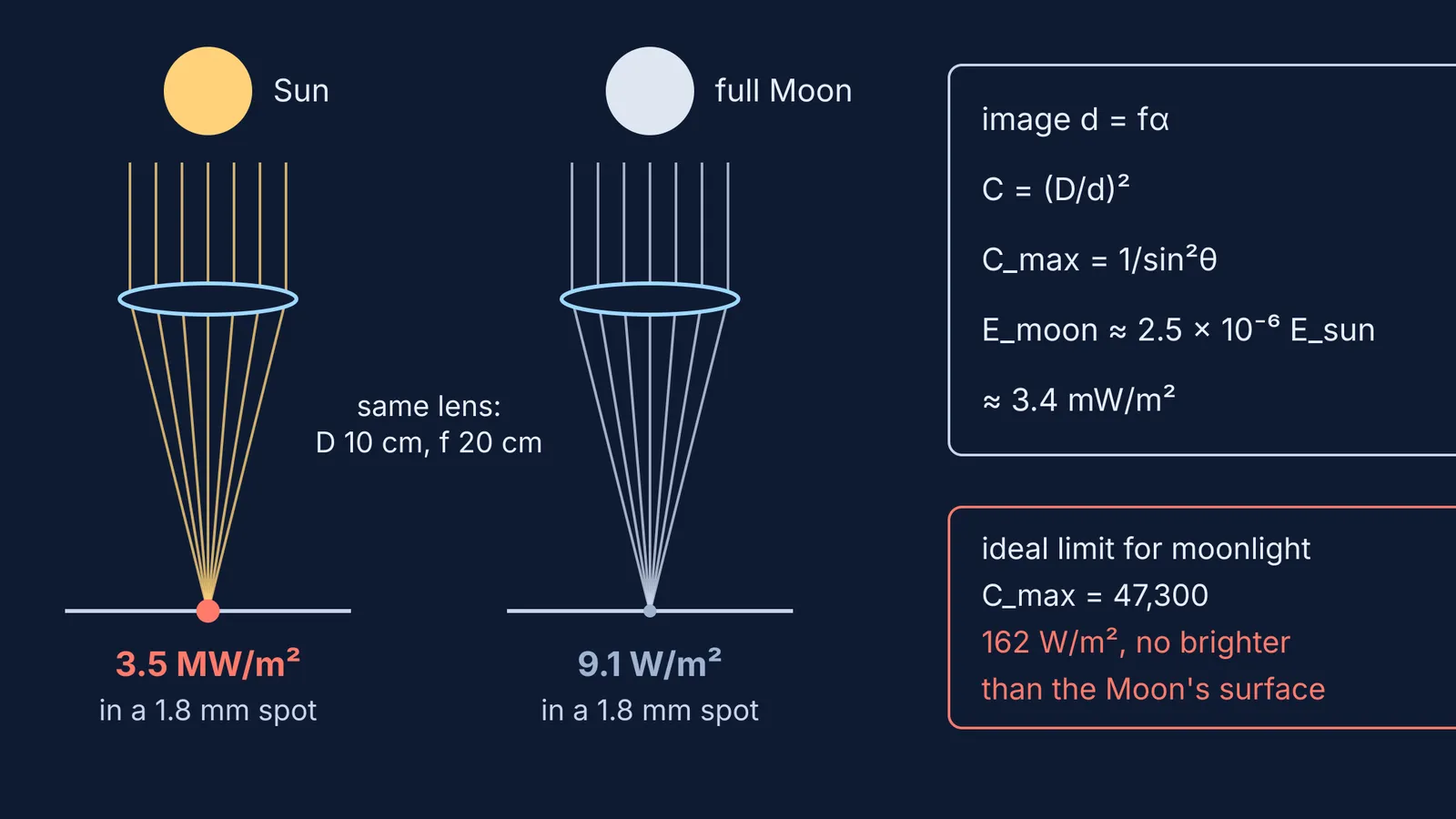
The Moon is effectively at infinity, so a converging lens forms its image in the focal plane. An object of angular diameter α makes an image of diameter d = fα, with α in radians. The same NASA sheet gives the Moon's apparent diameter at mean opposition as 1,896 arcseconds, which is 0.527°, or an angular radius of 0.263°.
The lens collects all the light falling on its area and puts it into that small image. If the lens has diameter D, the concentration is C = (D/d)², the ratio of the two areas.
Worked example: a 10 cm lens under the full Moon
Take a lens of diameter D = 10 cm and focal length f = 20 cm, and assume it transmits 90% of the light.
Moon's angle in radians. α = 0.527° × π/180 = 9.19 × 10⁻³ rad.
Image size. d = fα = 0.20 m × 9.19 × 10⁻³ = 1.84 × 10⁻³ m, so 1.84 mm.
Concentration. C = (100 mm/1.84 mm)² = 2,960.
Irradiance in the spot. 3.42 × 10⁻³ W/m² × 2,960 × 0.9 = 9.1 W/m².
Power through the lens. 3.42 × 10⁻³ × π × (0.05)² × 0.9 = 2.4 × 10⁻⁵ W, about 24 µW.
Units check: (W/m²) × (dimensionless C) = W/m². The spot gets about 9 W/m², under 1% of the 1,361 W/m² of sunlight above the air. Nothing burns.
Now point the same lens at the Sun. The Sun's apparent diameter at 1 AU is 1,919 arcseconds, so its image is 1.86 mm across and C = 2,890. Above the air the spot would get 1,361 × 2,890 × 0.9 = 3.5 MW/m². That is the difference between charred paper and nothing. The ignition side of the sunlit case is covered in why a convex lens burns paper in sunlight.
Why can't a bigger lens fix it?
Here is the step that a burning-glass picture misses. Imagine standing in the bright spot and looking back at the lens. The lens looks filled with Moon: every direction through it that leads back to the Moon shows you the Moon's surface. The bigger and faster the lens, the larger the patch of sky it fills, but each patch can be no brighter than the lunar surface itself.
This is the brightness theorem, a consequence of the conservation of étendue: no passive optical system can raise the radiance of light above that of the source surface. The cleanest form of the limit, from Winston, J. Opt. Soc. Am. 60, 245 (1970) and nonimaging optics after it, is that the largest concentration in air from a source of angular radius θ is
C_max = 1/sin²θ.
The same formula appears for the Sun in why 500 suns add only 0.16 V in concentrator solar cells. For the Moon, with θ = 0.263°:
C_max = 1/sin²(0.263°) = 47,300.
Highest possible irradiance: 3.42 × 10⁻³ × 47,300 = 162 W/m².
Even a perfect concentrator that surrounds the paper with Moon in every direction gives 162 W/m², about 12% of sunlight above the air. Paper lying in ordinary sunshine does not catch fire, so paper under an ideal moonlight concentrator will not either.
Our 10 cm lens reaches about 6% of the ideal limit. That fits the étendue picture: seen from the spot, the lens fills a cone of half-angle u where tan u = 5/20, and sin²u = 0.059.
What about the Moon's own heat?
The Moon's day side is hot and glows in the far infrared. Two things stop that from helping. Ordinary glass absorbs most far-infrared light, so a glass lens barely passes it. And even a mirror that did reflect it would face the same rule: the focused infrared can be no brighter than the lunar surface emitting it. A spot cannot be made hotter than the source by mirrors and lenses alone, which is the second law of thermodynamics in optical form.
If you want to practise image-size and concentration problems like the ones above, the Fermi Problem Library has a step-by-step solver that explains the reasoning. To see how a lens forms an image of an extended source, try the Simulation Lab.
Quick checklist
Full moonlight is about 2.5 × 10⁻⁶ of sunlight, about 3.4 mW/m².
A lens of focal length f makes an image of diameter fα of a distant object of angular size α.
Concentration C = (D/d)²; a 10 cm, f = 20 cm lens gives about 2,960 and only about 9 W/m² from the Moon.
No passive optics can beat C_max = 1/sin²θ, which for the Moon caps the spot at about 162 W/m².
A lens cannot make the spot brighter than the Moon's own surface.