On this page
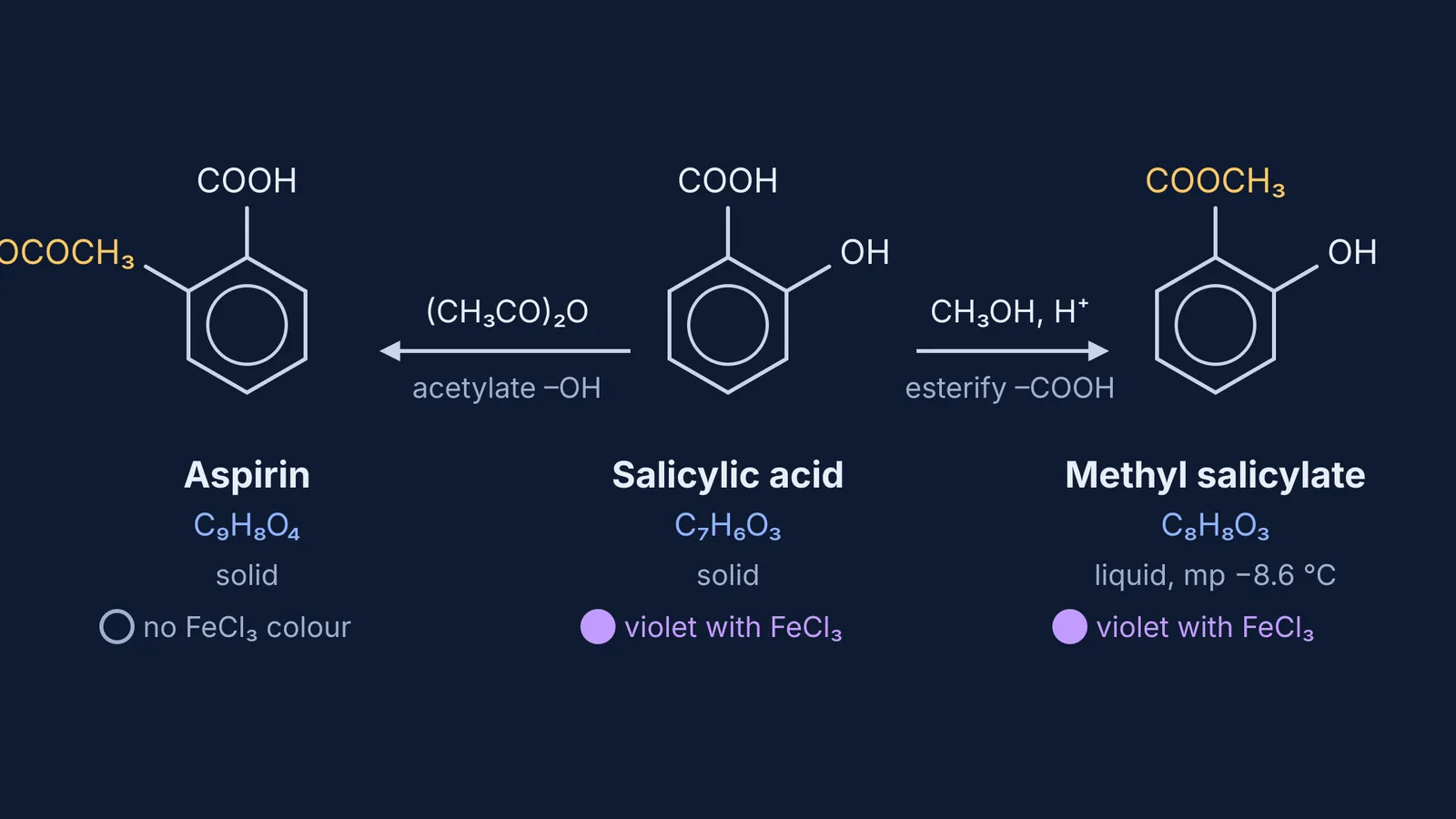
Many pain-relief balms list methyl salicylate, also called oil of wintergreen, on the label. Aspirin tablets and these balms share a parent: salicylic acid (2-hydroxybenzoic acid), which has two groups that can become an ester, the phenol –OH and the –COOH. Turn the –OH into an ester and you get aspirin, a white solid. Turn the –COOH into an ester and you get methyl salicylate, a fragrant liquid. This pair revises three exam ideas at once: which reagent attacks which group, the neutral FeCl₃ test, and intramolecular hydrogen bonding.
What is oil of wintergreen chemically?
Oil of wintergreen is methyl salicylate, methyl 2-hydroxybenzoate, C₈H₈O₃, molar mass 152.15 g/mol. PubChem's record for methyl salicylate describes it as an ester made naturally by many plants, especially wintergreens, and notes that it can also be made synthetically. The same record says the natural oil is steam-distilled from leaves, yielding about 0.7% oil, and that natural and synthetic grades are used interchangeably. So a balm need not contain plant oil at all; the molecule is identical either way.
Aspirin is acetylsalicylic acid, C₉H₈O₄, 180.16 g/mol (PubChem). Its –COOH is free and its phenol –OH is an acetate ester. Methyl salicylate is the reverse.
Which reagent turns salicylic acid into aspirin, and which into methyl salicylate?
JEE and NEET ask this as "which reagent converts salicylic acid to X". The two equations:
Aspirin (O-acetylation of the phenol): C₇H₆O₃ + (CH₃CO)₂O → C₉H₈O₄ + CH₃COOH. The reagent is acetic anhydride, usually with a little acid catalyst. The full mechanism and purification are in our post on the preparation of aspirin from salicylic acid.
Methyl salicylate (Fischer esterification of the –COOH): C₇H₆O₃ + CH₃OH ⇌ C₈H₈O₃ + H₂O, with concentrated H₂SO₄ as catalyst and heat. It is an equilibrium, like every Fischer esterification. Why excess alcohol and water removal push it forward is covered in Fischer esterification: mechanism and how to push the equilibrium.
Check the atoms: C 7 + 4 = 9 + 2 and O 3 + 3 = 4 + 2 for aspirin; C 7 + 1 = 8 and H 6 + 4 = 8 + 2 for methyl salicylate.
Why does each reagent pick a different group?
With acetic anhydride, the anhydride is the electrophile. Salicylic acid must supply the nucleophile, and its phenol oxygen does that job, attacking a carbonyl carbon of the anhydride. The phenol –OH ends up as –OCOCH₃. The –COOH is left unchanged.
With methanol and H⁺, the roles swap. The acid protonates the C=O of salicylic acid's –COOH, which makes that carbon the electrophile. Methanol, present in large excess, is the nucleophile that attacks it. The phenol –OH is not part of this reaction, so it stays free.
Acetic acid itself is a poor acetylating agent for a phenol, which is why aspirin uses the far more reactive acetic anhydride. "Acetic acid + salicylic acid gives aspirin" is not the answer examiners want.
Which one gives a violet colour with neutral FeCl₃?
The neutral FeCl₃ test detects a free phenolic –OH, which forms a coloured complex with Fe³⁺. How the reagent is made and why it must be neutral are explained in our post on the neutral ferric chloride test for phenols. Apply it here:
Salicylic acid: free phenol, so it gives a violet colour.
Methyl salicylate: the phenol –OH is still free, so it also gives a violet colour.
Pure aspirin: the phenol –OH has been acetylated, so there is no free phenol and no violet colour.
So FeCl₃ checks aspirin purity: violet means leftover salicylic acid, or aspirin partly hydrolysed in damp storage. It cannot tell salicylic acid from methyl salicylate, since both have a free phenol. For that, use the –COOH: salicylic acid fizzes (CO₂) with NaHCO₃; methyl salicylate does not.
Why is methyl salicylate a liquid when its para isomer is a solid?
Methyl salicylate has an isomer with exactly the same formula, C₈H₈O₃: methyl 4-hydroxybenzoate, better known as methylparaben. PubChem's methylparaben record describes it as a widely used antimicrobial preservative in cosmetics, so it is the "paraben" you may see on labels. PubChem data:
Methyl salicylate (ortho): melting point −8.6 °C, boiling point about 220–224 °C. A liquid at room temperature.
Methylparaben (para): melting point about 125–131 °C (PubChem lists both 125.2 °C and 131 °C), boiling point about 270 °C with decomposition. A solid.
Same formula, yet more than 130 °C apart in melting point. In methyl salicylate the phenol –OH sits next to the ester, so its hydrogen bonds to the ester C=O oxygen in the same molecule, closing a six-membered ring. That O–H is busy, so molecules hold each other weakly. In methylparaben the groups are on opposite sides of the ring, so each O–H bonds to a neighbouring molecule, building a network that needs more energy to break.
The weak pull between molecules also fits the fact that the natural oil is steam-distilled from leaves, like steam-volatile o-nitrophenol. Our post on intramolecular hydrogen bonding works the nitrophenol and hydroxybenzoic acid pairs; the ester pair here follows the same rule.
Worked example: how much salicylate is in a teaspoon of wintergreen oil?
Mass: take 5 mL and PubChem's density of 1.174 g/mL. Mass = 5 × 1.174 = 5.87 g.
Moles: 5.87 ÷ 152.15 = 0.0386 mol of methyl salicylate.
Salicylate released: each molecule hydrolyses to one salicylate, so 0.0386 mol of salicylate.
Aspirin with the same number of moles: 0.0386 × 180.16 = 6.95 g of aspirin.
So one teaspoon carries as many moles of salicylate as nearly 7 g of aspirin. This is a mole comparison only, not a statement that the two are equally toxic gram for gram, since a liquid is absorbed differently from a tablet.
The real point is safety. PubChem's toxicity notes state that "as little as 4 mL (4.7 g) of methyl salicylate may be fatal in children", and that the oil is a common paediatric poison. MedlinePlus lists deep-heating muscle creams and oil of wintergreen among the products involved in methyl salicylate overdose. Keep wintergreen oil and balms out of children's reach, never swallow them, and if anyone does swallow some, get medical help at once from a hospital or poison control centre.
If the reactions of phenols and carboxylic acids still blur together, the Fermi Concept Library, part of Fermi Test Prep for JEE Main and Advanced, gives every chemistry concept its own lesson and shows where it sits in the map.
What should you write in the exam?
Reagent for aspirin: acetic anhydride (or acetyl chloride) acetylates the phenol –OH. Name the by-product, acetic acid.
Reagent for methyl salicylate: methanol with concentrated H₂SO₄ and heat, by Fischer esterification of the –COOH. Write ⇌, since it is an equilibrium.
FeCl₃ test: salicylic acid and methyl salicylate give violet; pure aspirin does not.
H-bonding: methyl salicylate (ortho) has intramolecular H-bonding, so it melts and boils lower than methylparaben (para), which has intermolecular H-bonding.
Quick checklist
Acetylate the –OH: aspirin, a solid with no free phenol.
Esterify the –COOH: methyl salicylate, a liquid with a free phenol.
NaHCO₃ spots a free –COOH; neutral FeCl₃ spots a free phenol.
Wintergreen oil is poisonous if swallowed; keep it away from children.