On this page
Kuttanad in Kerala grows rice on land below sea level, and some of its paddy soils have a pH below 4. The cause is pyrite, FeS₂, hidden in the waterlogged mud. Drain the fields and air turns it into sulphuric acid. The same mineral is behind a favourite JEE redox question: the n-factor of FeS₂. It is 15 when FeS₂ is oxidised to Fe³⁺ and sulphate, and 11 when it is roasted to Fe₂O₃ and SO₂. Here is why, starting with the oxidation-state trap.
Why are Kuttanad's soils so acidic?
A 2017 study by M. M. Aneesa Beegum and V. I. Beena in the Journal of the Indian Society of Coastal Agricultural Research describes the region. Kuttanad lies 0.6–2.2 m below mean sea level and is known as the "rice bowl" of Kerala. About 50,000 ha are under rice, and acid sulphate soils (Typic Sulfaquents) cover 14,227 ha of this. The six acid sulphate soil series they sampled had pH values from 2.88 to 3.89; Purakkad and Thuravur read 2.9, and Ambalapuzha and Thottapally 3.9.
The paper's explanation: "oxidation of reduced sulphur compounds in pyritic mud releases sulphuric acid", and "if these soils are drained they come into contact with oxygen". Waterlogged, the pyrite is stable; drained, it oxidises.
How did pyrite get there? Under waterlogged, oxygen-free conditions, bacteria reduce sulphate from sea water to hydrogen sulphide, which reacts with iron to form fine crystals of pyrite, as the Wikipedia article on acid sulfate soils explains.
What is the oxidation state of sulphur in FeS₂?
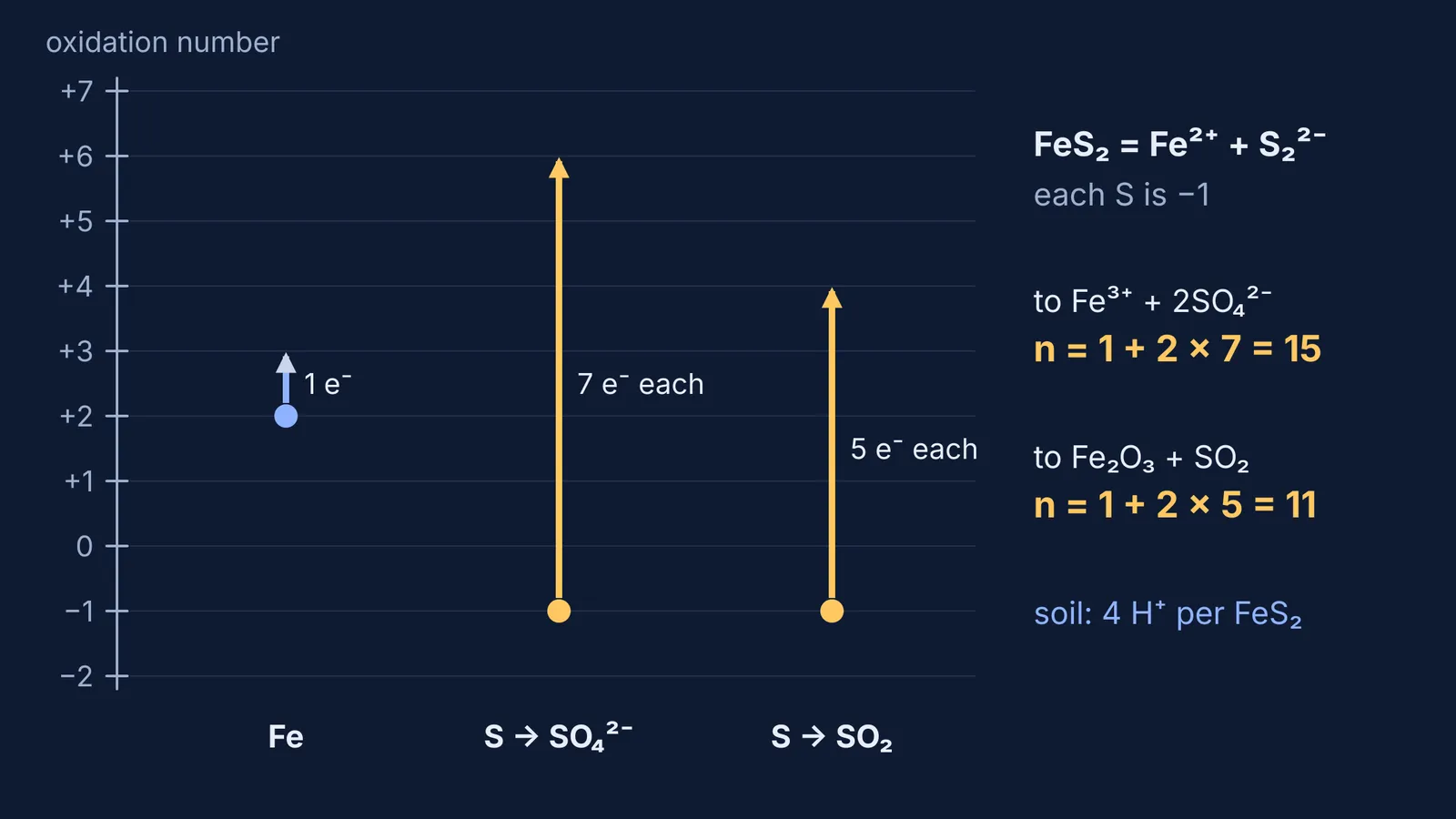
FeS₂ is not iron(IV) sulphide. PubChem's record for pyrite writes it as Fe²⁺(S₂)²⁻. The two sulphur atoms are bonded to each other as a disulphide ion, S₂²⁻, just like the O–O pair in a peroxide.
Iron: +2.
The S₂²⁻ ion carries −2 in total, so each sulphur is −1.
Check: +2 + 2 × (−1) = 0. The formula is neutral.
Writing S = −2 out of habit while keeping Fe = +2 gives a total of −2, impossible for a neutral compound, and leads to a wrong n-factor of 17.
How do you get an n-factor of 15 for FeS₂?
When FeS₂ is fully oxidised, as in the soil, iron ends as Fe³⁺ and sulphur ends as sulphate, SO₄²⁻, where sulphur is +6. Both parts of the formula lose electrons, which is the same idea as in why the n-factor of ferrous oxalate is 3.
Iron: +2 → +3, a loss of 1 electron.
Each sulphur: −1 → +6, a loss of 7 electrons.
Two sulphurs: 2 × 7 = 14 electrons.
Total: 1 + 14 = 15 electrons per FeS₂. So n = 15.
Equivalent mass: molar mass ÷ n = 119.98 ÷ 15 = 8.00 g per equivalent.
A faster check: the oxidation numbers in FeS₂ add to zero, and in the products one Fe at +3 and two S at +6 add to 15. The total change is 15 − 0 = 15, however you split the charge inside FeS₂. Even Fe = +4 with S = −2 gives 15, because that split also adds to zero. Only a split that does not add to zero goes wrong.
For the general method, see n-factor and the equivalent concept in redox titrations.
What balanced equation turns pyrite into sulphuric acid?
Each O₂ takes 4 electrons, so 15 electrons need 15 ÷ 4 = 3.75 O₂. A net equation for the soil, with iron ending as Fe(OH)₃, is:
FeS₂ + 15/4 O₂ + 7/2 H₂O → Fe(OH)₃ + 2H₂SO₄
Multiply by 4 to clear the fractions:
4FeS₂ + 15O₂ + 14H₂O → 4Fe(OH)₃ + 8H₂SO₄
Check: Fe 4 = 4. S 8 = 8. O 30 + 14 = 44 on the left, 12 + 32 = 44 on the right. H 28 = 12 + 16. It balances. Each FeS₂ gives 2 H₂SO₄, which is 4 H⁺.
This is a net balance, not a mechanism. In real soil it runs in steps. A common first step is FeS₂ + 7/2 O₂ + H₂O → Fe²⁺ + 2SO₄²⁻ + 2H⁺ (check the charge: 0 on the left, +2 − 4 + 2 = 0 on the right). The Fe²⁺ is then oxidised to Fe³⁺, which can itself attack more pyrite, and bacteria speed up parts of the chain. Some iron and sulphate end up in minerals such as jarosite, which Beegum and Beena also mention, rather than as Fe(OH)₃.
Why is the n-factor 11 when FeS₂ is roasted?
Roasting pyrite in air gives Fe₂O₃ and SO₂. Now sulphur stops at +4, not +6.
Iron: +2 → +3, 1 electron.
Each sulphur: −1 → +4, 5 electrons; two sulphurs give 10.
Total: 1 + 10 = 11, so n = 11.
Equivalent mass: 119.98 ÷ 11 = 10.9 g.
The balanced equation is 4FeS₂ + 11O₂ → 2Fe₂O₃ + 8SO₂. Check: O 22 = 6 + 16. Electrons: 4 × 11 = 44 lost, and 11 O₂ × 4 = 44 gained.
Some books write the roasting product as Fe₃O₄ instead: 3FeS₂ + 8O₂ → Fe₃O₄ + 6SO₂. Iron then goes from +2 to an average of +8/3, a change of 2/3, while the two sulphurs still give 10. So n = 2/3 + 10 = 32/3, about 10.7. Read the product before you count. For a copper sulphide ore, see extraction of copper from copper pyrites.
Worked example: how much acid can a little pyrite make?
Illustrative case, not a Kuttanad measurement: 1 kg of soil with 1% pyrite by mass.
Mass of FeS₂: 1% of 1000 g = 10 g.
Moles: 10 ÷ 119.98 = 0.0833 mol FeS₂.
Acid: 4 H⁺ per FeS₂, so 4 × 0.0833 = 0.333 mol H⁺.
Oxygen used: 3.75 × 0.0833 = 0.313 mol O₂.
Limestone to neutralise it: CaCO₃ + 2H⁺ → Ca²⁺ + CO₂ + H₂O, so 0.333 ÷ 2 = 0.167 mol, or 0.167 × 100.09 = about 16.7 g CaCO₃.
This is a stoichiometric exercise, not a field liming rate; real lime needs come from a soil test, as explained in why urea makes soil acidic.
For more equivalent-weight problems with a step-by-step solver that explains the reasoning, try the Fermi Problem Library.
What should you write in the exam?
State FeS₂ as Fe²⁺ and S₂²⁻, with S = −1.
Write each change: Fe +2 → +3; S −1 → +6 (or +4 for SO₂).
Add the electrons for one formula unit: 15 to sulphate, 11 to SO₂ with Fe₂O₃.
Give the equivalent mass as M/15 or M/11, and name the products you assumed.
If n-factor questions keep tripping you up in mocks, Fermi's AI tutor for JEE prep notices where you are stuck and decides whether to explain, ask or show, as part of Fermi Test Prep for JEE Main and Advanced.
Quick checklist
Kuttanad acid sulphate soils: pH about 2.9 to 3.9, from pyrite oxidised when fields drain.
FeS₂ is Fe(II) disulphide: Fe +2, each S −1.
To Fe³⁺ and SO₄²⁻: n = 15, equivalent mass about 8.0.
Roasted to Fe₂O₃ and SO₂: n = 11, equivalent mass about 10.9.
Each FeS₂ fully oxidised gives 2 H₂SO₄, or 4 H⁺.