On this page
A metal's density looks like a number you have to memorise. You can rebuild it from two things you already know: the mass of one atom and the size of that atom. If the atoms are hard spheres packed as tightly as possible, the density follows from one line of arithmetic. Below we derive that line, work it for scandium and titanium, and then run it across the first transition series using the metallic radii in Table 4.2 of the NCERT Class 12 chapter on the d- and f-block elements. The skill is worth having: whenever a table gives you both a radius and a density, you can check in a minute that the two agree.
How do you get a metal's density from its atomic radius?
Density is mass divided by volume. Think about one atom at a time.
The mass of one atom is m = M/N_A, where M is the molar mass and N_A = 6.02214 × 10²³ mol⁻¹.
The volume of one atom, treated as a sphere, is (4/3)πr³.
In a close-packed metal the spheres fill only 74.05% of the space. The rest is the gaps between them. That fraction is π/(3√2) = 0.7405, and our post on packing efficiency in fcc, bcc and simple cubic cells derives it.
So each atom effectively owns a volume of (4/3)πr³ ÷ 0.7405, and the density is:
ρ ≈ 0.7405 × M ÷ (N_A × (4/3)πr³)
This is the familiar unit cell formula in disguise. For a face-centred cubic metal, Z = 4 and the edge is a = 2√2 r. Copper's radius of 128 pm gives a = 362.0 pm, and d = ZM/(a³N_A) then gives 8.89 g cm⁻³, exactly what the sphere formula gives. Our post on the density of a unit cell, d = ZM/(a³N_A) works copper from its measured edge of 361.49 pm instead.
Hexagonal (hcp) and cubic (ccp) close packing fill the same 74.05%, so you need not know which one a metal adopts.
Which radius should you use?
Use the metallic radius: half the distance between the centres of two neighbouring atoms in the solid metal. Standard tables usually quote metallic radii for an atom with 12 nearest neighbours, which is the close-packed arrangement. That is why the 0.7405 factor still works reasonably well for vanadium, chromium and iron, which are body-centred cubic: their tabulated radii are already scaled to the close-packed case.
Convert first: 1 pm = 10⁻¹⁰ cm, so 164 pm = 1.64 × 10⁻⁸ cm. Density in g cm⁻³ needs the volume in cm³.
Worked example: scandium's density from its metallic radius
Data: M(Sc) = 44.956 g mol⁻¹, and Table 4.2 of the NCERT chapter gives the metallic radius as 164 pm.
Mass of one atom. m = 44.956 ÷ (6.02214 × 10²³) = 7.465 × 10⁻²³ g.
Radius in cm, cubed. r = 1.64 × 10⁻⁸ cm, so r³ = 4.411 × 10⁻²⁴ cm³.
Volume of one sphere. (4/3)π × 4.411 × 10⁻²⁴ = 1.848 × 10⁻²³ cm³.
Density of a single sphere. 7.465 × 10⁻²³ ÷ 1.848 × 10⁻²³ = 4.040 g cm⁻³.
Allow for the gaps. 0.7405 × 4.040 = 2.99 g cm⁻³.
PubChem's periodic table lists the density of scandium as 2.99 g cm⁻³, so the radius alone reproduces the measured value. The density row of the same Table 4.2 prints 3.43 g cm⁻³ for scandium. In this one column the radius and the density in the table do not agree, and the radius-based value is the one that matches measurement.
Now titanium, the same way. M = 47.867 g mol⁻¹ and r = 147 pm give m = 7.949 × 10⁻²³ g, a sphere volume of 1.331 × 10⁻²³ cm³, and ρ = 0.7405 × 5.974 = 4.42 g cm⁻³. PubChem gives 4.5 g cm⁻³, and Table 4.2 prints 4.1.
How well does the check work across the 3d series?
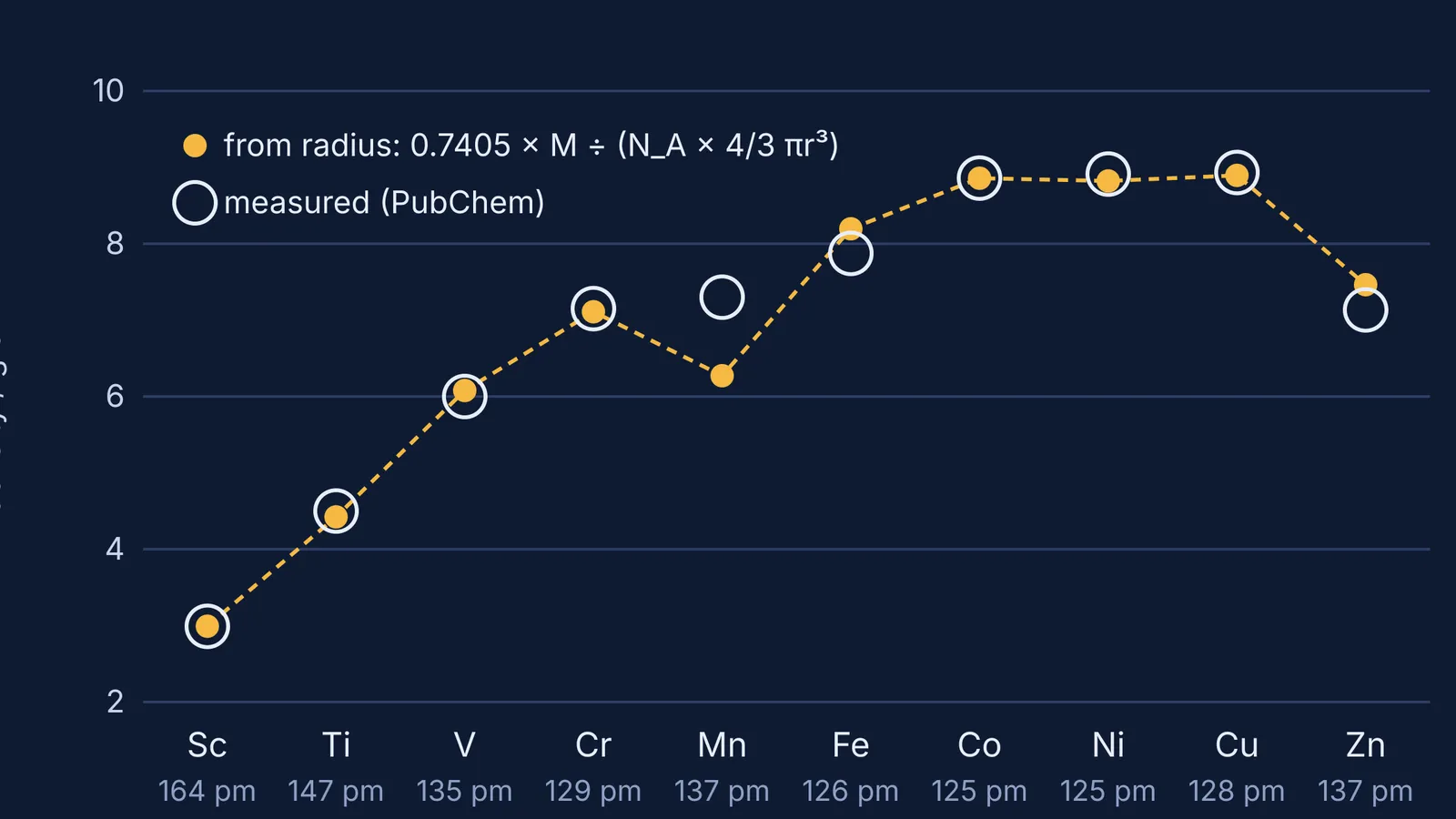
Here is the same calculation for all ten metals, with Table 4.2's printed density and PubChem's measured density beside it (all in g cm⁻³):
Sc (164 pm): from radius 2.99; Table 4.2 3.43; measured 2.99
Ti (147 pm): from radius 4.42; Table 4.2 4.1; measured 4.5
V (135 pm): from radius 6.08; Table 4.2 6.07; measured 6.0
Cr (129 pm): from radius 7.11; Table 4.2 7.19; measured 7.15
Mn (137 pm): from radius 6.27; Table 4.2 7.21; measured 7.3
Fe (126 pm): from radius 8.19; Table 4.2 7.8; measured 7.874
Co (125 pm): from radius 8.86; Table 4.2 8.7; measured 8.86
Ni (125 pm): from radius 8.82; Table 4.2 8.9; measured 8.912
Cu (128 pm): from radius 8.89; Table 4.2 8.9; measured 8.933
Zn (137 pm): from radius 7.46; Table 4.2 7.1; measured 7.134
Three things stand out.
Nine of the ten metals land within about 5% of the measured density. Good for a hard-ball model.
Manganese misses by 14%. Ordinary α-manganese has a complicated cubic cell of 58 atoms that are not all the same size, so it is not a simple close-packed metal. That is a limit of the method, not of the data.
Iron and zinc come out about 4 to 5% high. Iron is bcc, and zinc's hcp lattice is stretched along one axis, so neither is a perfect close packing of equal spheres. Expect a few per cent of error from this shortcut.
Density depends on the cube of the radius, so the check is sensitive. A radius that is 4% too small makes the calculated density about 13% too large. That is also why a density that disagrees with its radius by 10 to 15% is worth a second look.
Why does density rise from scandium to copper?
The formula says ρ is proportional to M/r³. From Sc to Cu, the molar mass rises from 44.96 to 63.55, a factor of 1.41. The metallic radius shrinks from 164 to 128 pm, so r³ falls by a factor of (164/128)³ = 2.10. Together they multiply the density by about 1.41 × 2.10 = 2.97, which takes scandium's 2.99 to copper's 8.9.
The radius shrinks because each added proton pulls on the outer electrons, and d electrons shield one another poorly. Zinc breaks the trend. With a full 3d¹⁰ set, its d electrons no longer help the metallic bonding, so its atoms sit further apart (137 pm) and its density falls to about 7.1 even though each atom is heavier. Our post on why transition metals have high melting points but zinc does not traces the same weak bonding in zinc's melting point.
If you want more practice turning radii, edge lengths and densities into one another, the Fermi Problem Library has worked problems with a step-by-step solver that explains the reasoning. For the packing ideas underneath, the Concept Library gives each concept its own lesson.
Quick checklist before you trust a density
Mass of one atom: M ÷ N_A, in grams.
Radius: the metallic radius, converted from pm to cm before cubing.
Packing: multiply the single-sphere density by 0.7405 for a close-packed metal.
Sense check: a 3d metal should come out between about 3 and 9 g cm⁻³.
If the answer and the table differ by more than 5 to 10%, check the structure (Mn) and recheck the numbers before you decide which is right.