

On this page
Urea, CO(NH₂)₂, is a neutral molecule. Dissolve it in water and the pH barely moves. Yet fields fed on urea for years drift towards acid, and on soils that are already acidic this can wreck a crop. In ICAR's long-term fertiliser experiments, the plot at Palampur (an acid soil) that got nitrogen alone gave 0 kg/ha of wheat, below the 400 kg/ha from the plot that got no fertiliser at all, according to a 2022 Indian Farming review by ICAR-Indian Institute of Soil Science scientists. The acid does not come from the bag. It comes from bacteria, and you can count it with a redox equation from Class 11.
Where does the acid come from if urea is neutral?
Urea goes through two changes in soil.
Hydrolysis. The enzyme urease breaks urea into ammonium. Written for an acidic soil solution: CO(NH₂)₂ + 2H⁺ + H₂O → 2NH₄⁺ + CO₂. This step uses up H⁺, so the soil right around a urea granule briefly becomes less acidic, not more.
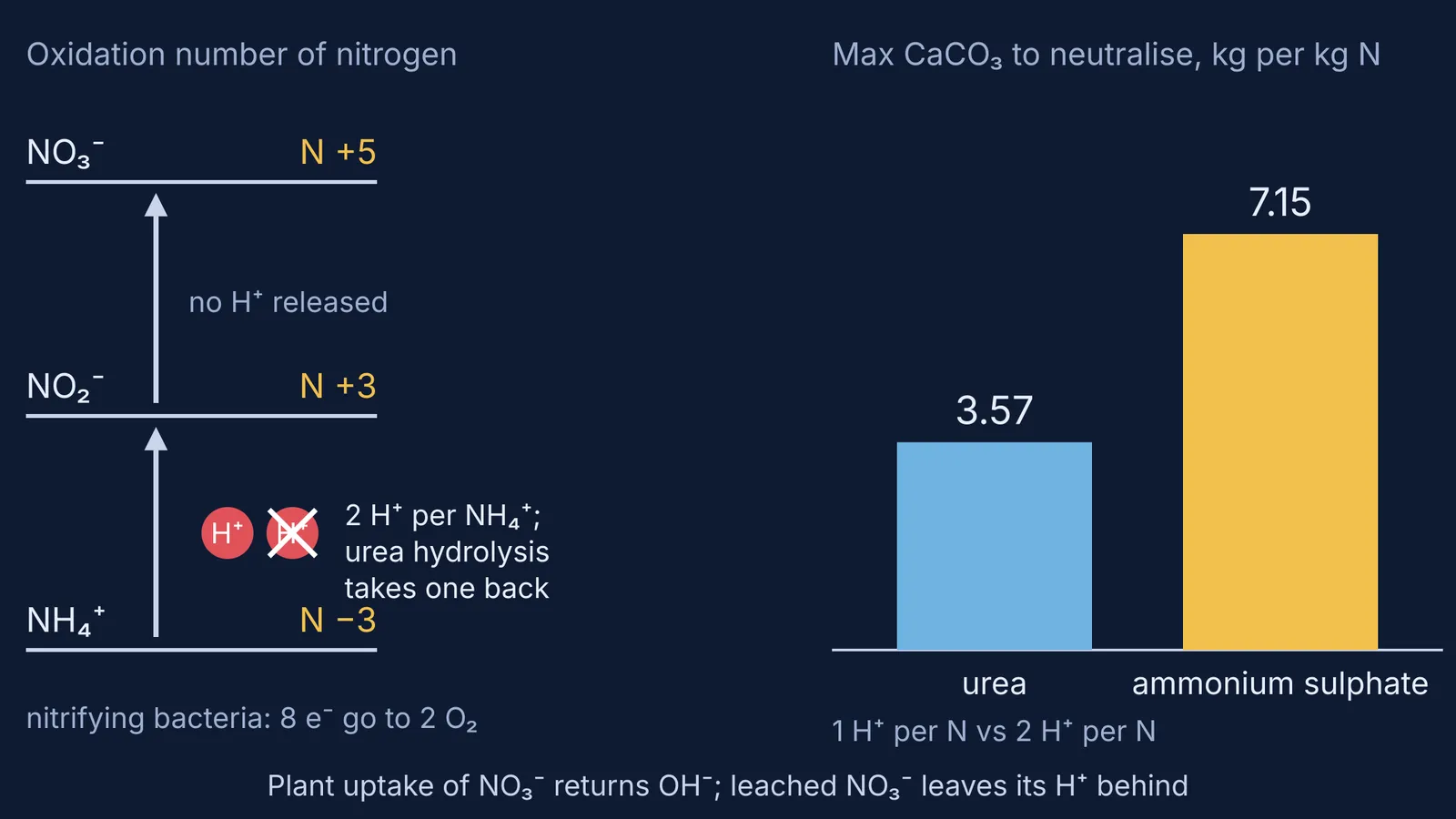
Nitrification. Bacteria then oxidise the ammonium to nitrate. The first step, by Nitrosomonas, is NH₄⁺ + 3/2 O₂ → NO₂⁻ + 2H⁺ + H₂O. The second, by Nitrobacter, is NO₂⁻ + 1/2 O₂ → NO₃⁻ and releases no H⁺.
So all the acid is made in the first nitrification step. If the order of the bacteria is hazy, the nitrogen cycle steps and the bacteria that run each one are set out there; here we only count protons.
How do you balance the nitrification equation?
Use the ion-electron method in acid medium. Nitrogen goes from −3 in NH₄⁺ to +5 in NO₃⁻, a change of 8.
Oxidation half. NH₄⁺ → NO₃⁻. Balance O with water: NH₄⁺ + 3H₂O → NO₃⁻. Balance H with H⁺: 4 + 6 = 10 H on the left, so add 10H⁺ on the right. Balance charge: left +1, right −1 + 10 = +9, so add 8e⁻ on the right. Result: NH₄⁺ + 3H₂O → NO₃⁻ + 10H⁺ + 8e⁻.
Reduction half. O₂ + 4H⁺ + 4e⁻ → 2H₂O. Multiply by 2 to take 8 electrons: 2O₂ + 8H⁺ + 8e⁻ → 4H₂O.
Add and cancel. Cancel 8e⁻, 8H⁺ and 3H₂O: NH₄⁺ + 2O₂ → NO₃⁻ + 2H⁺ + H₂O.
Check. N: 1 = 1. H: 4 = 2 + 2. O: 4 = 3 + 1. Charge: +1 = −1 + 2. Balanced.
Every ammonium ion that is nitrified releases two H⁺.
Why does ammonium sulphate acidify soil twice as much as urea?
Now add the hydrolysis step for urea. Two NH₄⁺ from one urea release 4H⁺ when nitrified, but hydrolysis already took 2H⁺ back. Adding the equations gives:
CO(NH₂)₂ + 4O₂ → 2NO₃⁻ + 2H⁺ + CO₂ + H₂O
Check: C 1 = 1; N 2 = 2; H 4 = 2 + 2; O 1 + 8 = 6 + 2 + 1; charge 0 = −2 + 2. That is one H⁺ per nitrogen.
Ammonium sulphate brings its nitrogen in as NH₄⁺ already, with nothing to take protons back:
(NH₄)₂SO₄ + 4O₂ → 2NO₃⁻ + SO₄²⁻ + 4H⁺ + 2H₂O
That is two H⁺ per nitrogen, so at full nitrification it can make twice the acid of urea for the same nitrogen. If you need the nitrogen percentages behind these two salts, see how to calculate nitrogen percentage in urea and ammonium sulphate.
How much lime would cancel that acid? A worked example
Limestone neutralises H⁺ just as it does in the everyday neutralisation examples: CaCO₃ + 2H⁺ → Ca²⁺ + CO₂ + H₂O. One mole of CaCO₃ (100.09 g) cancels two moles of H⁺.
These are stoichiometric maxima for a chemistry exercise, not field advice.
Part (a): maximum lime per kg of nitrogen.
Moles of N in 1 kg: 1000 / 14.007 = 71.39 mol.
Urea: 71.39 mol H⁺, so 35.70 mol CaCO₃ = 35.70 × 100.09 g = 3.57 kg CaCO₃ per kg N.
Ammonium sulphate: 142.8 mol H⁺, so 7.15 kg CaCO₃ per kg N.
Part (b): a field given 120 kg N per hectare as urea.
Urea is 28.014 / 60.056 = 46.6% N, so 120 / 0.4665 = 257 kg of urea.
Moles of N: 120,000 / 14.007 = 8,567 mol, which can release at most 8,567 mol H⁺.
CaCO₃ needed: 8,567 / 2 = 4,284 mol × 100.09 g = 429 kg per hectare per year, at most.
The same 120 kg N as ammonium sulphate (566 kg of the salt) could need up to 857 kg CaCO₃.
Part (c): why the real figure is smaller.
A plant that takes up a nitrate ion has to stay electrically neutral, so its roots release OH⁻ or HCO₃⁻ in exchange. That base cancels the H⁺ the nitrate came with. Only the nitrate that is not taken up and washes below the roots (leaches) leaves its H⁺ behind.
Suppose, purely for illustration, that 40% of the nitrate leaches.
Acid left: 0.40 × 8,567 = 3,427 mol H⁺.
CaCO₃: 3,427 / 2 = 1,713 mol × 100.09 g = about 172 kg per hectare.
As quicklime (CaO, 56.08 g/mol, also 2H⁺ per mole): 1,713 × 56.08 g = about 96 kg.
Extension tables give smaller, empirical figures. A University of Nebraska–Lincoln guide on reducing soil acidification lists about 1.8 kg CaCO₃ per kg N for urea and 5.4 for ammonium sulphate. Both sit between the plant-uptake and full-leaching limits you just worked out.
Does this mean urea ruins soil?
No. Nitrogen acidifies soil slowly, and the effect depends on how much nitrate is lost, the soil's buffering, and what else goes on with it. The same ICAR review reports that balanced NPK, and NPK with farmyard manure, kept or improved soil organic carbon, and that the authors reject the idea that chemical fertiliser itself destroys soil. At Palampur, NPK gave 1,904 kg/ha of wheat and NPK plus manure 2,879 kg/ha, compared with 0 for nitrogen alone. For more of those trial results, read what 180 years of organic and chemical fertiliser trials show.
Two more cautions. First, pH is a log scale, but soil acidity is mostly held on clay and organic matter, not dissolved in water, so you cannot work out a lime dose from the pH reading alone. Real lime requirement comes from a soil buffer test done by a soil-testing laboratory, not from fertiliser arithmetic. Second, the arithmetic here ignores ammonia lost to air, ammonium taken up directly by plants, and nitrogen lost by denitrification, each of which changes the balance.
If the half-equation method is where you lose marks, the Fermi Problem Library has a step-by-step solver that explains the reasoning at each stage of a redox balance.
Quick checklist
Urea hydrolysis uses 2H⁺ per urea; nitrification of each NH₄⁺ releases 2H⁺.
Net: urea 1 H⁺ per N, ammonium sulphate 2 H⁺ per N.
CaCO₃ + 2H⁺ → Ca²⁺ + CO₂ + H₂O, so 0.5 mol CaCO₃ per mol H⁺.
Maximum lime: 3.57 kg CaCO₃ per kg N for urea, 7.15 for ammonium sulphate.
Nitrate taken up by plants returns base; leached nitrate leaves its acid.
Field lime doses come from a soil test, not from this sum.


