On this page
An antacid tablet, a farmer spreading lime and a factory treating its wastewater all run the same reaction: an acid meets a base and the two cancel out. Learn the pattern and the chapter becomes four short examples with equations.
What is neutralisation in chemistry?
NCERT's Class 7 chapter Acids, Bases and Salts defines it in one line: the reaction between an acid and a base is called neutralisation, and salt and water are produced in this process with the evolution of heat.
The textbook example is Hydrochloric acid + Sodium hydroxide → Sodium chloride + Water, or HCl + NaOH → NaCl + H2O.
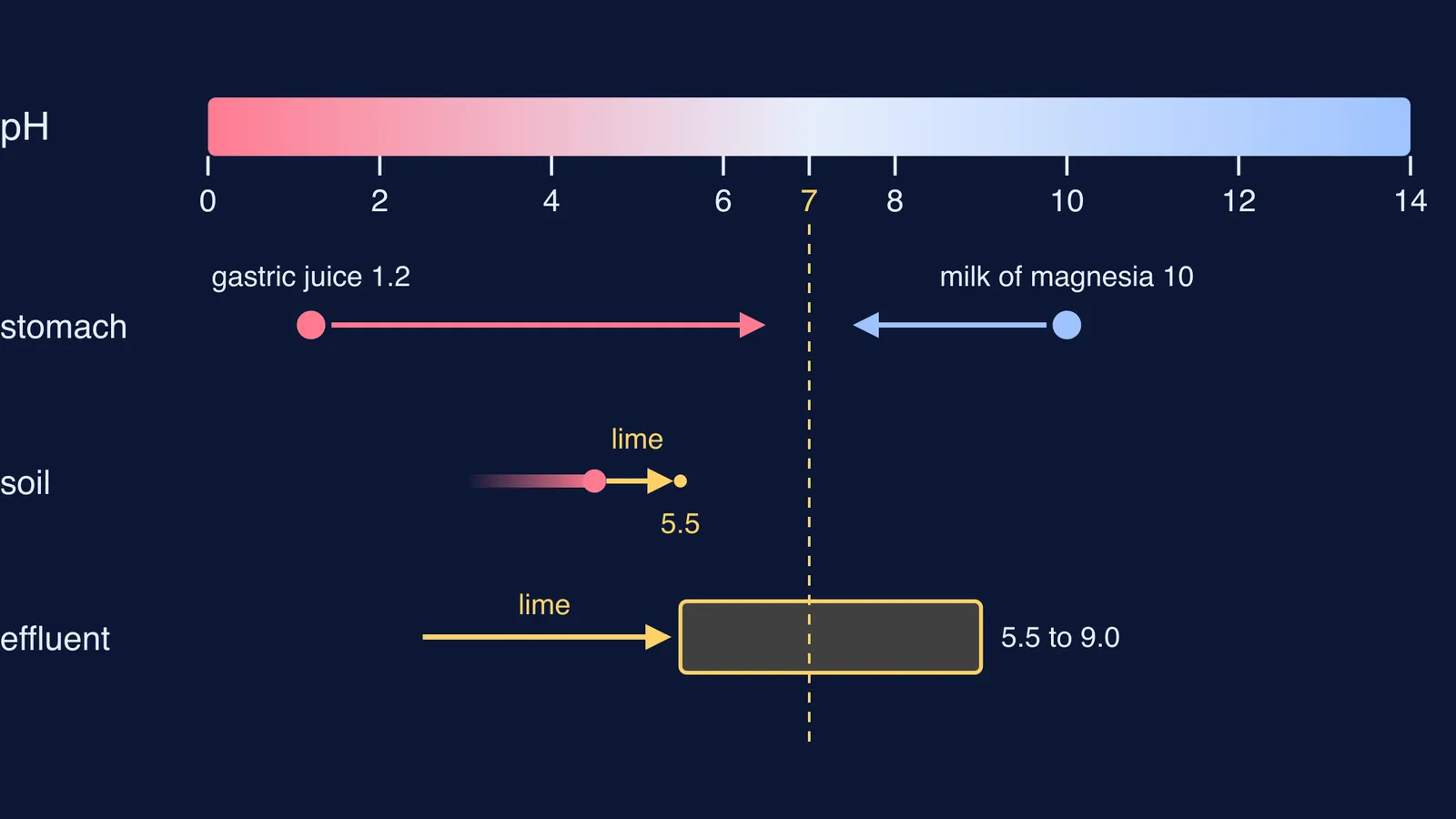
The Class 10 chapter Acids, Bases and Salts adds the pH scale: a neutral solution has pH 7, values below 7 are acidic and values above 7 are basic. Neutralisation moves a solution towards pH 7.
What are examples of neutralisation in daily life?
Antacids for acidity
Your stomach makes hydrochloric acid to help digest food. NCERT's Class 10 chapter puts gastric juice at about pH 1.2 and milk of magnesia at about pH 10, and explains that during indigestion the stomach makes too much acid, which causes pain and irritation (NCERT Class 10). Antacids are mild bases that neutralise the excess acid.
MedlinePlus, from the US National Library of Medicine, describes aluminium hydroxide and magnesium hydroxide antacids: they combine with stomach acid and neutralise it (MedlinePlus). The equation is Mg(OH)2 + 2HCl → MgCl2 + 2H2O.
Baking soda for ant bites
When an ant bites, it injects formic acid (methanoic acid, HCOOH) into the skin. NCERT's Class 7 text says the effect can be neutralised by rubbing moist baking soda (sodium hydrogencarbonate) or calamine solution, which contains zinc carbonate (NCERT Class 7). The reaction is NaHCO3 + HCOOH → HCOONa + H2O + CO2. Notice the extra product: hydrogencarbonates and carbonates release carbon dioxide as well as salt and water.
Lime for acidic soil
Plants do not grow well in soil that is too acidic or too basic. NCERT's Class 7 text says acidic soil is treated with bases such as quick lime (calcium oxide) or slaked lime (calcium hydroxide), while basic soil gets organic matter such as compost, which releases acids (NCERT Class 7).
An article by ICAR Research Complex for NEH Region scientists in Indian Farming (February 2021) states that India has 25 million hectares of problematic acid soils with pH below 5.5, and that the North Eastern Hill region holds 54% of that area. The same article calls liming the most desirable way to improve acidic soils with pH below 5.5.
Lime for factory waste
The wastes of many factories contain acids, and if they flow into water bodies, the acids kill fish and other organisms, so they are neutralised with basic substances first (NCERT Class 7). In India, the general standards in Schedule VI of the Environment (Protection) Rules, 1986, set a pH range of 5.5 to 9.0 for effluents discharged into inland surface water, public sewers, land for irrigation and marine coastal areas (CPCB general standards). Lime is widely used for this job, according to a National Lime Association bulletin. With sulphuric acid waste: Ca(OH)2 + H2SO4 → CaSO4 + 2H2O.
How do you write a neutralisation equation?
Four steps work for any example.
Name the acid and the base, with formulas.
Make the salt: take the metal (or ammonium) from the base and the part of the acid left once its hydrogen is removed, then use valencies to fix the formula.
Add water. If the base is a carbonate or hydrogencarbonate, add CO2 as well.
Balance the metal and the acid part first, then check hydrogen and oxygen.
Worked example: antacid in the stomach. The acid is HCl and the base is Mg(OH)2. The salt takes Mg from the base and Cl from the acid; magnesium has a valency of 2, so the salt is MgCl2. Two Cl atoms need 2HCl, and the two H from the acid join the two OH groups to give 2H2O. Final answer: Mg(OH)2 + 2HCl → MgCl2 + 2H2O.
If step 2 or step 4 is where you go wrong, the Fermi Problem Library has worked problems with a step-by-step solver that explains the reasoning rather than printing an answer.
Which neutralisation questions come up in school exams?
NCERT's exercises ask why an antacid is taken for acidity, why calamine is applied to an ant bite and why factory waste is neutralised (Class 7), and when a farmer would use quick lime, slaked lime or chalk (Class 10). Test yourself:
Antacid: acid HCl, base Mg(OH)2, salt MgCl2.
Ant bite: acid HCOOH, base NaHCO3, salt HCOONa, plus CO2.
Acidic soil: acid in the soil, base CaO or Ca(OH)2.
Factory waste: acid such as H2SO4, base Ca(OH)2, salt CaSO4, target pH 5.5 to 9.0.
Cover each line after the colon and say the acid, base and salt aloud. If pH, salts or valency still feel shaky, the Fermi Concept Library gives every concept in chemistry its own lesson, so you can fix the gap before the next test.